How to Choose an Online Casino: Games, Safety & User Experience
Learn how to evaluate an online casino through game selection, transparent rules, account security, payment information, mobile usability and customer support before using a platform.
In this article
- What Should You Look for in an Online Casino?
- Start With the Information, Not the Promotion
- Understanding Different Casino Game Categories
- Are More Games Always Better?
- How to Evaluate Game Rules and Payout Information
- Account Security and Privacy
- Recognising Suspicious Websites
- Payment Information and Withdrawal Conditions
- Questions Worth Checking
- Mobile Experience and Browser Compatibility
- Why Loading Speed Is Not Everything
- Why Customer Support Quality Matters
- Bonuses, VIP Programmes and Loyalty Rewards
- Responsible Gaming and Financial Risk
- Comparing Online Casinos Without Misleading Rankings
- Frequently Asked Questions
- How do I choose an online casino?
- Does a large game catalogue mean a platform is better?
- What does RTP mean in an online casino?
- Should I trust websites advertising guaranteed winnings?
- Why are bonus terms important?
- Are mobile casino applications always safe?
- What should I check before sharing personal information?
- Does this guide recommend a particular operator?
- Conclusion
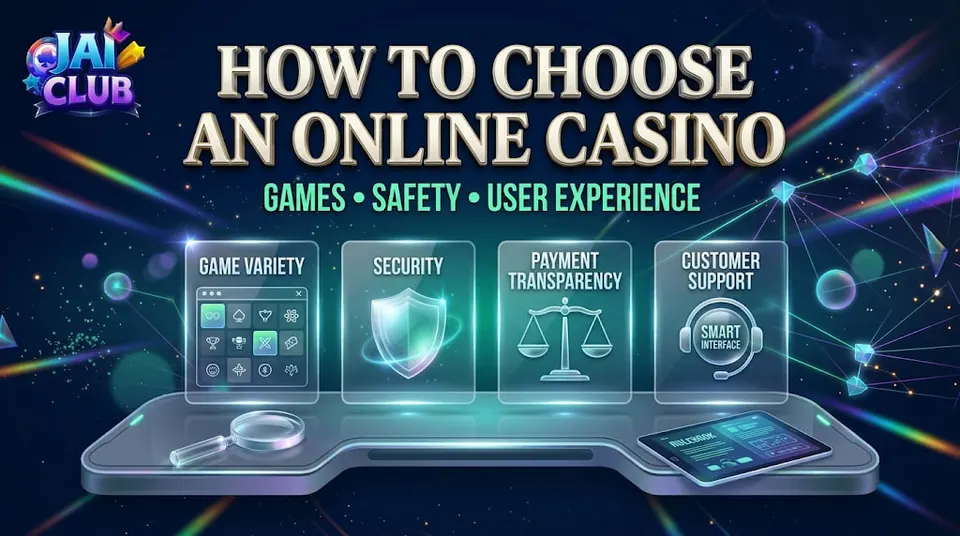
Choosing an online casino involves more than looking at colourful game thumbnails, welcome promotions or an attractive mobile interface. Different platforms can offer different game categories, account controls, payment conditions and customer support arrangements. A website may look professional while providing very little information about the rules that govern its games or the handling of user funds.
For readers in India researching online gaming platforms, understanding these differences is useful before creating an account or sharing personal information. A careful evaluation should focus on whether the service clearly explains how it operates, what risks are involved and how users can access reliable information when problems arise.
This guide explains how to assess online casino features, game information, mobile compatibility, security, payment transparency and support quality. It is an independent educational resource rather than a ranking of operators or a recommendation to gamble.
What Should You Look for in an Online Casino?
A useful starting point is transparency. An online gaming platform should make it reasonably easy to find its relevant terms, the identity of the operator, game rules and information about the handling of funds. If essential details are missing, contradictory or hidden behind promotional messages, it becomes difficult to evaluate the service properly.
The variety of games is another consideration, but a larger catalogue is not necessarily better. A platform offering hundreds of titles may still provide incomplete descriptions or confusing interfaces. A smaller catalogue with clearly documented rules can be easier to understand than an extensive collection of games whose payout systems are poorly explained.
Security, customer support and account controls deserve equal attention. A visually impressive homepage cannot compensate for weak account protection or the absence of a meaningful process for resolving disputes.
Start With the Information, Not the Promotion
Promotional banners tend to highlight large prizes, bonus amounts or limited-time offers. These claims can be eye-catching, but they rarely provide enough context to understand the conditions involved.
Before treating an offer as valuable, examine its eligibility restrictions, wagering requirements, expiry dates and withdrawal conditions. A bonus that appears generous may involve substantial restrictions that change how it can actually be used.
The same principle applies to advertised game payouts. A theoretical return percentage or maximum award does not guarantee a particular individual result.
Understanding Different Casino Game Categories
Online casinos may contain several categories of games, each with its own rules and presentation. Slots typically involve reel-based symbol combinations, while table games use formats based on cards, dice, wheels or other established game systems. Live dealer games introduce a streamed interface in which real-time activity is presented through video.
The important distinction is not simply how the games look, but how their results are evaluated. A traditional payline slot differs from a ways-to-win slot, just as a digital table game differs from a streamed live table. Game names alone do not establish payout conditions or the availability of particular features.
For example, modern slots may use scatter symbols, wilds, multipliers, respins and different forms of bonus rounds. These features can make the interface more complex without making the outcome predictable.
Readers interested in understanding these mechanics can explore the educational content under the Jai Club Slots section of JaiClubGame.com.
Are More Games Always Better?
Not necessarily. A large catalogue may provide more variety, but it does not demonstrate stronger security, fairer rules or better support. The relevant question is whether the games are clearly described and whether their conditions can be reviewed before any money-related activity.
Some providers display the name of the game developer, the relevant paytable and information about theoretical returns. Others may provide less detail. The absence of important information should be treated as a reason for caution rather than filled with assumptions.
A platform should also distinguish ordinary gaming features from promotions and account-level rewards. These are different systems with different rules.
How to Evaluate Game Rules and Payout Information
Game information should explain how qualifying outcomes are determined. In a slot game, this may include symbols, paylines, ways to win and bonus features. In a table game, the relevant information may include the rules of the game, settlement conditions and any house advantage.
Return to Player, commonly called RTP, is often mentioned in discussions of online slots. It describes a theoretical long-run ratio under a defined game configuration, not a guaranteed return for an individual session. A game displaying an RTP percentage does not promise that a person will receive that proportion of their wagers back.
Volatility is another concept that may be relevant. It concerns variation in payout outcomes rather than the average theoretical return. Two games with similar RTP figures can have very different patterns of small and large awards.
The most useful approach is to read the actual game rules rather than relying on screenshots of previous results or claims that a particular game is currently more likely to pay.
Account Security and Privacy
Account security is a fundamental part of evaluating any online service that handles personal information or money-related transactions. A gaming website may request contact details, identification information or other data depending on its services and applicable requirements.
Before providing information, review the privacy policy and check whether the website explains how data is collected, used, retained and protected. A privacy policy should be relevant to the actual service rather than an unrelated generic document.
Strong, unique passwords and appropriate authentication controls can reduce some account risks. Users should also be cautious of messages requesting one-time passwords, recovery codes or payment credentials outside a verified process.
Recognising Suspicious Websites
A suspicious site may imitate a known brand, use a slightly altered domain or display misleading contact information. The presence of familiar logos does not, by itself, prove that the website is authentic.
Check the address carefully and avoid assuming that a link shared through a messaging group is official. Fake customer support accounts may attempt to redirect users to unrelated pages or request confidential credentials.
If the operator's identity and contact channels cannot be established, the service should not be treated as verified merely because it appears in search results.
Payment Information and Withdrawal Conditions
Payment transparency matters because depositing funds and receiving withdrawals are different processes. A platform may describe one set of conditions for adding money and another for requesting a withdrawal.
Important information can include supported payment methods, minimum and maximum transaction amounts, processing stages, account verification requirements and any restrictions on the use of promotional balances.
A service may also have separate terms governing cancelled, delayed or disputed transactions. These conditions should be available before users rely on the platform.
Questions Worth Checking
| Area | Information to review |
|---|---|
| Deposits | Accepted methods, limits and charges |
| Withdrawals | Eligibility, processing rules and restrictions |
| Verification | Required documents and privacy handling |
| Bonuses | Whether promotional funds affect withdrawals |
| Disputes | How an incorrect transaction can be challenged |
| Account closure | How balances and personal data are handled |
A payment interface that accepts deposits quickly does not independently demonstrate that withdrawals will be processed correctly.
Mobile Experience and Browser Compatibility
For many readers in India, mobile usability is a practical consideration. A gaming interface may be accessed through Android, a mobile browser or a dedicated application, depending on what the service supports.
A mobile-friendly website should present readable controls, clear game rules and accessible transaction information on a smaller screen. Important account details should not be hidden behind confusing menus or displayed only on a desktop version.
Performance also depends on factors such as network stability, browser compatibility and device resources. Complex graphics and live video can place more demands on a mobile connection than a simple informational page.
If an application is offered, its authenticity and distribution source should be verified. Downloading APK files from unfamiliar websites can expose users to altered software or credential theft.
Why Loading Speed Is Not Everything
A fast-loading interface is convenient, but performance should not be the only basis for evaluation. A game that loads quickly while providing unclear transaction records or incomplete rules may still present significant problems.
A practical interface should make important information available without requiring users to rely on promotional screenshots or unofficial support channels.
Why Customer Support Quality Matters
Customer support becomes particularly important when a user encounters an interrupted game, a payment discrepancy or an account access problem. A legitimate support process should provide a clear way to report an issue and understand what information is required.
The presence of a chat button does not establish the quality or authority of the service behind it. Readers should consider whether the support channel is clearly connected to the operator and whether it explains how complaints or disputes are handled.
Where transaction records are involved, a round ID, reference number or timestamp may help identify the event. A support team should not require users to disclose passwords or one-time verification codes.
Claims such as “24/7 support” should be verified rather than assumed from a website's appearance.
Bonuses, VIP Programmes and Loyalty Rewards
Gaming platforms sometimes advertise welcome bonuses, loyalty points or VIP tiers. These features may offer promotional balances, points or other defined benefits, but their actual value depends on the terms attached.
For example, a bonus may have a wagering requirement, an expiry date or restrictions on eligible games. A VIP tier may depend on account activity and may not provide the same benefits to every user.
A larger advertised reward does not automatically mean a more favourable financial result. Requirements that encourage additional spending can create additional exposure to losses.
Readers should separate the promotional description from the contractual conditions and avoid treating loyalty status as proof that an operator is trustworthy.
Responsible Gaming and Financial Risk
Online casino games involving wagers can result in financial losses. A responsible approach begins with recognising that game outcomes are uncertain and that theoretical payout percentages do not guarantee individual returns.
Money needed for rent, food, education, debt payments or other essential obligations should not be exposed to gambling losses. A service offering spending limits, session controls or account restrictions may provide useful safeguards, although their availability and effectiveness must be verified.
It is also important to recognise that losing sequences do not create a debt owed by the game to the user. Trying to recover losses through additional wagers can increase financial harm.
If gaming is no longer manageable or is causing distress, stepping away and seeking independent support is more appropriate than relying on another promotional offer.
Comparing Online Casinos Without Misleading Rankings
A comparison should be based on verifiable information rather than a claim that one platform is automatically the best. Different readers may care about different aspects of a service, but certain fundamentals remain relevant across operators.
A useful comparison can include whether game rules are disclosed, whether payment restrictions are understandable, whether security and privacy information is accessible and whether complaints can be submitted through a verified channel.
It should also clearly distinguish facts from unverified marketing claims. A platform's own statement about having the highest payouts, the fastest withdrawals or the largest game catalogue is not independent evidence of those qualities.
For an informational website such as JaiClubGame.com, explaining these evaluation criteria is more useful than making unsupported rankings of operators.
Frequently Asked Questions
How do I choose an online casino?
Evaluate the operator's identity, game rules, payment terms, security information, customer support and relevant restrictions before considering the service.
Does a large game catalogue mean a platform is better?
No. The number of titles does not independently establish security, transparency or better payout conditions.
What does RTP mean in an online casino?
RTP is a theoretical long-run return measure under a defined game configuration. It does not guarantee an individual result.
Should I trust websites advertising guaranteed winnings?
No. Claims of guaranteed gambling outcomes should be treated with considerable caution.
Why are bonus terms important?
Bonus terms may include wagering requirements, expiry dates, eligible-game restrictions and withdrawal conditions that materially affect the offer.
Are mobile casino applications always safe?
No. Application authenticity, permissions and distribution source must be evaluated individually.
What should I check before sharing personal information?
Review the website's identity, privacy policy, security arrangements and the reason the information is requested.
Does this guide recommend a particular operator?
No. It provides independent educational criteria and does not rank or endorse individual casino operators.
Conclusion
Choosing an online casino requires careful attention to information that promotional banners often leave out. Game rules, payment conditions, account security, mobile usability and customer support are more meaningful evaluation criteria than impressive screenshots or large advertised bonuses.
A transparent platform should make its relevant terms accessible and give users a clear understanding of how the service operates. Even where information is available, gambling-related financial risks remain and no payout can be guaranteed.
Readers can explore the game guides on JaiClubGame.com for further explanations of slot mechanics and common online gaming terminology.
Editorial disclaimer: This article is intended for general information and does not recommend any gambling operator or guarantee the safety, availability or financial performance of a particular service.