
Understanding Slot Volatility: Why Some Games Pay Less Often
Learn what slot volatility means, how low, medium and high volatility differ, why payout frequency can vary, and why RTP does not predict individual results.
In this article
- What Is Slot Volatility?
- Why Volatility Matters
- Low Volatility Slots Explained
- Does Low Volatility Mean Low Risk?
- High Volatility Slots Explained
- Why Larger Awards May Be Less Frequent
- What Is Medium Slot Volatility?
- Comparing Volatility Categories
- Slot Volatility vs RTP: What's the Difference?
- Why a 96% RTP Is Not a Promise
- Hit Frequency vs Slot Volatility
- Why Frequent Wins Can Be Misleading
- How Bonus Features Influence Volatility
- Does a Higher Maximum Win Mean Higher Volatility?
- Why Two Slots With the Same RTP Can Feel Different
- Can Past Spins Reveal a Slot's Volatility?
- Why the Next Spin Is Not Due
- How to Interpret a Slot's Volatility Label
- Frequently Asked Questions
- What does slot volatility mean?
- What is the difference between high and low volatility?
- Is medium volatility a universal standard?
- Does low volatility guarantee frequent profit?
- Is RTP the same as volatility?
- Does a high-volatility slot always have a higher maximum win?
- Can I predict a bonus using volatility?
- Does hit frequency measure profitable spins?
- Can two slots with the same RTP have different volatility?
- Are Jai Club slot volatility levels verified in this guide?
- Conclusion
Two slot games can have similar themes, comparable reel layouts and even the same advertised Return to Player percentage, yet produce very different patterns of payouts. One game might show smaller awards relatively frequently, while another may go through long periods without substantial awards before producing a larger result. This difference is often discussed using the concept of slot volatility.
For readers exploring Jai Club slot-related games, understanding volatility is useful because it explains why payout frequency and payout size are separate characteristics. A game may display a high theoretical return while still producing highly variable results during a short session. Conversely, a game with more frequent small awards does not automatically offer a better long-run return.
This guide explains high, medium and low slot volatility, how the concept differs from RTP, what hit frequency means and why historical outcomes cannot reliably predict the next result. The examples are illustrative and do not establish the volatility level of any particular Jai Club slot.
What Is Slot Volatility?
Slot volatility describes the degree of variation in a game's payout outcomes. It is sometimes discussed using the term variance, although volatility labels used in gaming descriptions are not always based on identical public measurement standards.
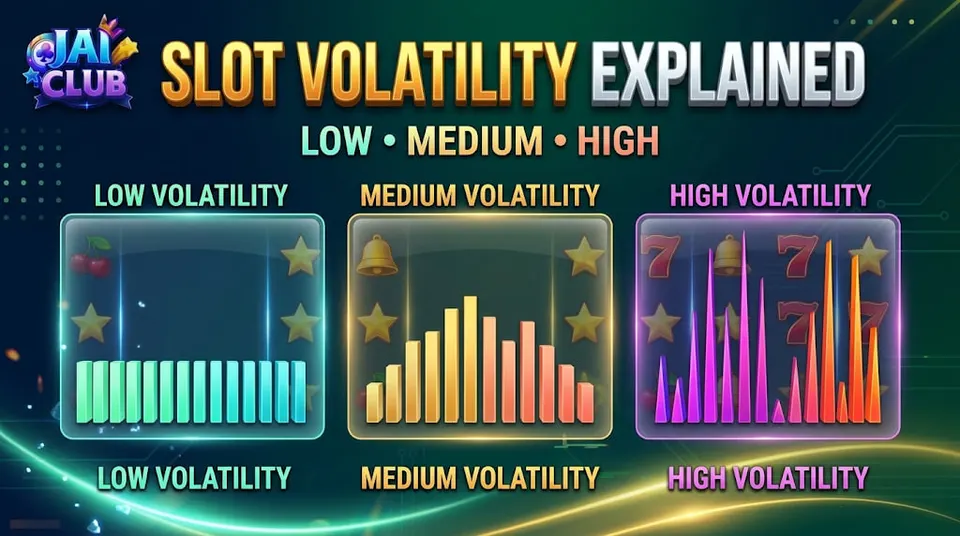
In general, a lower-volatility game is associated with less extreme fluctuations and may concentrate more of its return in smaller, more frequent awards. A higher-volatility game may distribute more of its theoretical return through less frequent, larger awards.
The precise mathematical behaviour depends on the game. A volatility label is a broad description rather than a guarantee about what will happen in any individual session.
Why Volatility Matters
Imagine two fictional slot games with the same theoretical RTP. Both might be designed to return the same proportion of total wagers over a very large amount of gameplay. However, that return could be distributed through very different combinations of award sizes and frequencies.
One game might generate many small awards, while another may generate fewer qualifying awards with a wider range of possible amounts. Their long-run average could be similar, but their short-run results could look completely different.
This is why a single RTP figure cannot fully describe a game's payout behaviour.
Low Volatility Slots Explained
Low-volatility slots are commonly described as games with relatively smaller fluctuations in their payout outcomes. They may award smaller amounts more frequently than certain higher-volatility games, but this is a general pattern rather than an absolute rule.
A fictional low-volatility game might generate numerous small qualifying combinations. Some awards may be smaller than the wager, while others may exceed it. The overall experience could involve relatively frequent displayed wins without guaranteeing that the account balance increases.
The distinction between a winning combination and a net gain is particularly important here. A game can produce frequent awards and still result in financial losses because each wager must be considered alongside the gross payout.
Our Slot Payout Calculation Guide explains that difference in detail.
Does Low Volatility Mean Low Risk?
Not in the ordinary financial sense. Lower payout variability does not remove the possibility of substantial losses, especially when repeated wagers accumulate over time.
A slot with smaller fluctuations can still have a theoretical house advantage and can still produce losing sessions. Volatility describes the distribution of outcomes; it does not make a money-related game safe or profitable.
High Volatility Slots Explained
High-volatility slots are commonly associated with greater variation in payout outcomes. Some implementations may have relatively infrequent large awards, longer sequences without meaningful payouts or bonus features that account for a substantial part of the game's theoretical return.
This can make individual results fluctuate considerably. A short session might contain few significant awards even when the game advertises a substantial maximum payout.
However, a high-volatility label does not tell readers exactly when a large award might occur. It also does not prove that every high-volatility slot has the same distribution or bonus structure.
Why Larger Awards May Be Less Frequent
In certain game designs, a larger proportion of theoretical return can be concentrated in outcomes that occur relatively rarely. This produces a different distribution from a game offering more frequent smaller payouts.
The relationship depends on the game's mathematical configuration, including symbol probabilities, bonus mechanics and payout values.
A screenshot showing a large result does not reveal how likely that result was or how many unsuccessful outcomes occurred beforehand. This is one reason that promotional examples should not be used as substitutes for documented mathematical information.
What Is Medium Slot Volatility?
Medium volatility is often used as a descriptive category between low and high volatility. It generally suggests a balance between payout frequency and award-size variation, but the exact meaning depends on how the developer defines the term.
There is no single universal public classification system that every slot publisher must use when applying labels such as low, medium or high. As a result, one developer's medium-volatility description may not be directly comparable with another's.
Readers should treat these labels as general guides and look for more specific documentation whenever available.
Comparing Volatility Categories
| Characteristic | Low volatility | Medium volatility | High volatility |
|---|---|---|---|
| General payout variation | Lower | Intermediate | Higher |
| Typical award pattern | Often smaller, more frequent | Mixed | May be less frequent, larger |
| Short-run fluctuations | Often less extreme | Variable | Can be substantial |
| Guaranteed positive result | No | No | No |
| Predicts the next outcome | No | No | No |
The categories are conceptual and do not represent verified measurements for any specific Jai Club game.
Slot Volatility vs RTP: What's the Difference?
RTP, or Return to Player, describes a theoretical long-run ratio between total awards and total wagers under a defined configuration. Volatility describes how results vary around that long-run pattern.
These are different statistical characteristics, and understanding both is important when interpreting a game's documented information.
Imagine two fictional games with a theoretical RTP of 96%. Over a sufficiently large number of plays under the intended mathematical assumptions, both could have a similar expected return ratio. Yet one might distribute awards through many small outcomes, while the other might concentrate more of its return in relatively rare large awards.
The RTP describes the average relationship, while volatility helps describe the variability of the underlying outcomes.
Why a 96% RTP Is Not a Promise
A theoretical RTP of 96% does not mean that a person wagering ₹100 will receive exactly ₹96 during a session. Individual results may be higher or lower, sometimes by a considerable amount.
RTP also does not specify when any particular award will appear. A game can produce long sequences of results that differ substantially from its theoretical average.
The mathematical expectation applies to the specified game model over extensive gameplay, not as a guaranteed result for each individual user.
Hit Frequency vs Slot Volatility
Hit frequency usually refers to how often a defined type of qualifying award occurs. Depending on the game's documentation, the definition may include all winning combinations or another specified category of results.
Hit frequency and volatility are related concepts, but they are not identical. A game could have relatively frequent small awards while still including rare large outcomes that contribute substantial variability to the payout distribution.
Likewise, a game with a lower hit frequency does not automatically have a precisely defined volatility level. The sizes and probabilities of the available awards also matter.
Why Frequent Wins Can Be Misleading
Imagine a fictional game in which a ₹20 wager produces a ₹5 award. The game may recognise that result as a win because a qualifying symbol combination appeared. However, the net result of that spin is a loss of ₹15.
If outcomes like these occur frequently, the interface may display many winning animations without producing a positive overall result.
Therefore, hit frequency should not be confused with the frequency of profitable spins.
How Bonus Features Influence Volatility
Bonus rounds can play an important role in how a slot's payout distribution is structured. Some titles allocate a meaningful portion of their theoretical return to free spins, respins, multiplier combinations or other special features.
When relatively large awards depend on rare feature events, the resulting distribution may become more variable. However, the precise relationship depends on the mathematical model and cannot be established from the presence of a bonus feature alone.
For instance, two games might both include free spins. One may use modest fixed awards during the bonus, while another might offer a much wider range of possible results. The shared feature name does not imply identical volatility.
Our Slot Bonus Features Guide explains the individual mechanics that can appear in these designs.
Does a Higher Maximum Win Mean Higher Volatility?
A high maximum possible payout can be associated with a game offering rare large awards, but the maximum amount alone is not enough to classify volatility.
The mathematical distribution also depends on the probabilities and values of other possible outcomes. Two games could advertise the same maximum multiplier while having different payout patterns.
A maximum award is simply the upper limit established by the relevant rules under the specified conditions. It does not reveal the probability of achieving that amount.
Readers should be particularly careful with promotional screenshots showing exceptionally large results. Such examples may demonstrate a possible outcome without indicating how representative or likely it is.
Why Two Slots With the Same RTP Can Feel Different
A game may seem to produce frequent activity because its reels regularly display qualifying combinations, while another might contain long sequences with little visible reward. These differences can influence how the experience feels, even when the mathematical expectations are similar.
Visual presentation can amplify the distinction. A small award accompanied by a lengthy animation may attract more attention than the actual net result warrants. Similarly, a game that builds anticipation around rare bonus features may feel unpredictable because those features contribute heavily to the presentation.
The correct interpretation requires separating the visual experience from the financial and statistical information. Animations cannot establish RTP, volatility or the probability of future outcomes.
Can Past Spins Reveal a Slot's Volatility?
A limited set of observed results is generally not enough to determine a game's underlying payout distribution reliably. Small samples can be affected by random variation, and unusual sequences may appear more meaningful than they really are.
For example, observing a series of spins without a large award does not prove that a game is high volatility. A game described as low volatility can still produce losing sequences, while a higher-volatility game can occasionally produce several smaller awards.
Reliable statistical analysis requires appropriate definitions, sufficient data and an understanding of the game configuration. Even then, historical observations do not identify the next outcome.
Why the Next Spin Is Not Due
A common misconception is that after many unsuccessful outcomes, a particular award must appear soon. This reasoning is often associated with the gambler's fallacy.
In games where relevant outcomes are independent, previous results do not make a specific future outcome due. Other mechanisms require their own mathematical analysis, but a visible losing sequence is not enough to demonstrate a predictable next result.
Volatility describes variability, not a countdown to a bonus.
How to Interpret a Slot's Volatility Label
If a game provides volatility information, first establish whether the label comes from the developer or another trustworthy source. Then consider what the description actually explains.
A simple low, medium or high label may be useful as introductory terminology, but it should not be treated as precise numerical evidence unless a definition or measurement is supplied.
If additional information about RTP, payout distribution or feature probabilities is available, it can provide further context. However, no combination of these figures guarantees a favourable outcome for an individual session.
When documentation is incomplete, it is better to acknowledge the uncertainty than assign a volatility category based on a handful of screenshots or results.
Frequently Asked Questions
What does slot volatility mean?
Slot volatility describes the variation in payout outcomes under a game's mathematical design.
What is the difference between high and low volatility?
Low volatility generally refers to less extreme payout variation, while high volatility refers to greater variation and may involve less frequent large awards.
Is medium volatility a universal standard?
No. The exact meaning of medium-volatility labels can vary between developers and sources.
Does low volatility guarantee frequent profit?
No. Frequent small awards can still be lower than the wager, and losses remain possible.
Is RTP the same as volatility?
No. RTP describes a theoretical long-run return ratio, while volatility describes variation in the outcome distribution.
Does a high-volatility slot always have a higher maximum win?
Not necessarily. Maximum payout and volatility are different characteristics.
Can I predict a bonus using volatility?
No. Volatility does not reveal when a particular future outcome will occur.
Does hit frequency measure profitable spins?
Not necessarily. Hit frequency may count qualifying awards that are smaller than the wager.
Can two slots with the same RTP have different volatility?
Yes. Games with similar expected returns can distribute their awards differently.
Are Jai Club slot volatility levels verified in this guide?
No. This article explains general slot mathematics and does not assign confirmed volatility levels to particular Jai Club games.
Conclusion
Slot volatility helps explain why games with similar appearances or theoretical returns can produce different patterns of payouts. Lower-volatility games generally involve less extreme variation, while higher-volatility games may concentrate more of their theoretical return in less frequent, larger results.
These categories do not guarantee outcomes, remove financial risk or predict when a bonus might occur. They are descriptions of statistical behaviour rather than tools for forecasting individual spins.
The most useful interpretation combines volatility with an understanding of RTP, hit frequency, paytable rules and the difference between gross awards and net results.
For related educational guides, explore the Jai Club Slots category.
Editorial note: This article provides general statistical education about slot games. It does not verify specific Jai Club game configurations, recommend betting strategies or guarantee financial outcomes.