How Live Dealer Casino Games Work: Features & Limitations
Explore how live dealer casino games operate through real-time video streaming, interactive tables and digital interfaces, including their benefits, technical requirements and limitations.
In this article
- What Are Live Dealer Casino Games?
- How Live Dealer Systems Work
- The Main Components
- The Real-Time Viewing Experience
- Live Dealer Games vs Digital Table Games
- Main Differences
- What Are the Benefits of Live Dealer Casino Games?
- More Familiar Table Presentation
- Interactive Interface Features
- Why Internet Speed and Stability Matter
- Understanding Latency in Live Games
- Mobile Live Dealer Games
- Are Live Dealer Games More Transparent?
- Payout Rules and House Edge
- Common Limitations of Live Dealer Games
- Live Dealer Games and Customer Support
- Live Dealer Games and Financial Risk
- Frequently Asked Questions
- What is a live dealer casino game?
- How do live dealer games differ from digital casino games?
- What games are commonly offered in live dealer formats?
- Do live dealer games need a stable internet connection?
- What is latency in live dealer games?
- Are live dealer games guaranteed to be fair?
- Can live dealer games work on Android?
- Are live dealer games safer financially than digital games?
- Are live dealer games currently available on Jai Club?
- Conclusion
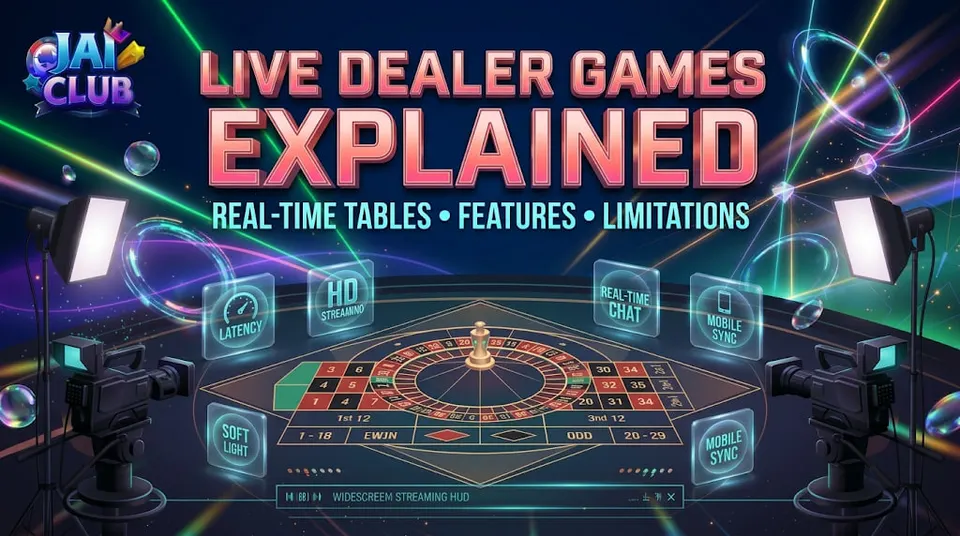
Online casino games are available in several formats, ranging from computer-generated slot reels to digital table games and streamed gaming sessions. Live dealer casino games are a distinct format because they use real-time video to present activity taking place at a physical or studio-based table.
Unlike a conventional digital game that displays animated cards or a simulated wheel, a live dealer interface typically combines a video stream with digital controls. The screen may show a presenter or dealer, the gaming table, the current round information and an area for user interaction. This combination creates a different experience from ordinary browser-based casino graphics.
For readers researching the benefits of live dealer games at online casinos, it is useful to examine both the features and their limitations. Real-time presentation, streamed tables and interactive controls may make the format distinctive, but they also introduce technical requirements and do not remove the financial risks of wagering.
This article explains how live dealer systems generally work, how they differ from digital table games, what affects their performance and why advertised features should be interpreted carefully. It does not verify the availability of any particular live dealer title on Jai Club.
What Are Live Dealer Casino Games?
Live dealer casino games use a real-time video feed to present a gaming event taking place at a physical table or in a purpose-built studio. The interface allows a remote user to view the activity through a browser or compatible application.
Common examples in the wider online casino industry include streamed versions of roulette, blackjack and baccarat. Different providers may also offer other game formats or studio-based variations.
Although the video is an important part of the presentation, the interface typically contains additional digital components. These may include round timers, game information, eligible controls, recorded results and account-related messages.
The result is a combination of physical presentation and digital communication rather than a purely animated game environment.
How Live Dealer Systems Work
A live dealer system usually begins with a studio or gaming table equipped with cameras, appropriate lighting and equipment for presenting the game. The video feed is transmitted to remote users through a streaming system, while the game interface displays relevant information and controls.
Depending on the specific game, the system may use technology to record or communicate the outcome. Physical cards, wheels or other equipment can be incorporated into a digital record through various mechanisms.
The user's interface then presents the relevant round information. This may include the current phase of the game, a countdown, an outcome display or other messages defined by the provider.
The Main Components
| Component | General purpose |
|---|---|
| Studio or physical table | Location where the live activity takes place |
| Cameras | Capture the game presentation |
| Video streaming | Delivers live footage to users |
| Digital interface | Displays game information and controls |
| Round information system | Communicates timing and recorded results |
| Support and records | Helps address technical or transaction questions |
The technical architecture varies between providers. This table describes a general model rather than the infrastructure of a particular casino service.
The Real-Time Viewing Experience
One of the principal features of live dealer games is the ability to watch a gaming event unfold through video. This differs from a conventional digital table game in which the environment and equipment are represented mainly through graphics.
A streamed presentation may allow viewers to observe a physical table, see the progress of the round and follow the result through the camera feed. This can make certain aspects of the game easier to recognise for people already familiar with its traditional format.
However, video presentation does not by itself establish the integrity of the underlying operation. The authenticity of the provider, the rules governing the game and the accuracy of recorded outcomes must still be assessed separately.
A high-quality stream is an interface feature, not proof that every associated service or transaction is reliable.
Live Dealer Games vs Digital Table Games
Digital table games and live dealer games can be based on similar familiar game formats while using different presentation and outcome systems.
A digital version may use a graphical table with animated cards or a computer-generated wheel. The visual sequence is produced through software, and the relevant rules describe how the game determines and displays outcomes.
A live dealer version presents a streamed event involving physical equipment or a studio-based gaming system. The digital interface remains important, but the visible game activity is captured through video rather than represented entirely through animation.
Main Differences
| Feature | Digital table game | Live dealer game |
|---|---|---|
| Presentation | Computer-generated graphics | Real-time video |
| Table environment | Digital simulation | Physical or studio-based |
| Interaction | Software controls | Software controls with live presentation |
| Internet demand | Varies by game | Often greater due to video |
| Timing | Software-defined sequence | May depend on live round timing |
| Availability | Depends on provider | Depends on provider |
Neither format automatically offers better mathematical returns. Game rules and payout conditions must be evaluated individually.
What Are the Benefits of Live Dealer Casino Games?
The distinguishing advantages of the format are mainly related to presentation and interaction. Users may be able to follow a physical table through a real-time feed rather than relying on a fully animated representation.
Some services provide multiple camera angles or allow the viewer to switch between views. Others may display additional information about the round or offer communication features alongside the video.
These elements can make the interface more informative or visually engaging, but their availability varies considerably. A feature advertised by one provider should not automatically be assumed to exist in another live dealer product.
More Familiar Table Presentation
For readers accustomed to physical card tables or roulette wheels, a streamed presentation may be easier to recognise than an abstract digital layout. The video can provide context about the sequence of actions taking place during a round.
However, familiarity should not be confused with financial safety. A visually recognisable format can still involve uncertainty, a house advantage or the possibility of losing the wagered amount.
Interactive Interface Features
Some live dealer systems include message panels or other interaction tools. These may be used to display game information or support communication features within the experience.
The extent of interaction depends on the provider, and a chat feature does not necessarily mean that the dealer can respond to every user or resolve account issues.
It is important to distinguish entertainment-oriented interaction from official customer support.
Why Internet Speed and Stability Matter
Live video requires a reliable connection, especially when the stream must remain synchronised with game information. If connectivity becomes unstable, the video may buffer, lose quality or fall behind the actual event.
A device may continue displaying an earlier video frame while the remote service has already progressed to the next stage. This is why a delayed stream should not be used alone to infer whether an action was processed.
Some services adjust video quality automatically according to network conditions. Lower-quality video may remain usable on a weaker connection, but important game information should still be readable.
If an interface becomes unresponsive during a money-related session, the correct response is to check the authorised round and transaction records rather than assume that the visible delay cancelled the event.
Understanding Latency in Live Games
Latency refers to the delay between an event occurring and information about that event reaching the viewer. In a live dealer system, latency can affect video, interactive controls and the timing of displayed messages.
For example, the studio may complete an action before every remote viewer sees it on screen. Streaming systems attempt to manage these delays, but their performance can vary according to network conditions and technical design.
A well-designed interface should communicate relevant timing rules clearly. Users should not assume that the video feed and all account updates are perfectly simultaneous.
Latency is a technical characteristic, not evidence that an outcome can be predicted or influenced.
Mobile Live Dealer Games
Many online services offer mobile interfaces, although compatibility and available features depend on the provider. On Android devices, a live dealer presentation may need to fit a video feed, game information and interactive controls into a relatively small display.
This can create design challenges. Text may be difficult to read, buttons may compete for screen space and switching between information panels can interrupt the viewing experience.
The performance of a mobile session may also depend on browser compatibility, available device resources and network stability. Video-intensive formats can consume more mobile data than simple text-based interfaces.
Before using any application, its authenticity and source should be verified. An unofficial APK is not made trustworthy simply because it claims to provide access to live casino games.
Are Live Dealer Games More Transparent?
A live video feed can make aspects of the game presentation visible, but transparency requires more than video. The operator should still provide accessible rules, clear payout information and appropriate procedures for checking recorded outcomes.
A streamed table may allow viewers to observe physical equipment, yet the complete system also includes software, settlement processes and account records that may not be visible in the footage.
Therefore, the presence of a live dealer should not automatically be interpreted as proof of fairness or reliability.
Meaningful transparency depends on trustworthy information about how the service operates and how disputes can be investigated.
Payout Rules and House Edge
Live dealer games may use rules similar to their physical table counterparts, but the exact configuration and payout conditions should be checked for each title. Small rule differences can materially affect the mathematical characteristics of a game.
For example, two games using a familiar table format may define different eligible actions or settlement rules. Their expected returns can therefore differ, even when their video presentations appear similar.
A theoretical house edge describes an expected mathematical advantage under specified rules. It does not guarantee an individual outcome or determine what will happen during one session.
Live video does not remove that mathematical structure. It changes how the game is presented, not the basic uncertainty involved in the result.
Common Limitations of Live Dealer Games
Live dealer formats introduce several practical limitations that are less prominent in simpler digital games. They may require stable video streaming, may operate according to defined round timing and may offer fewer opportunities to control presentation speed.
A user with a slow or unstable connection may experience buffering or delayed controls. A small mobile screen may also make the interface less convenient than a desktop layout.
Availability can be another limitation. A particular title, table or feature may not be offered on every platform or in every location. Restrictions may also apply to account eligibility or supported devices.
These limitations mean that an attractive studio presentation does not automatically create a better overall experience for every user.
Live Dealer Games and Customer Support
Technical problems can be more complicated when real-time video, game controls and transaction records are involved. A delayed interface may create uncertainty about whether an action was accepted or how a round was settled.
A verified support process should provide a way to report such issues. Where available, round identifiers, timestamps and non-sensitive error information can help identify the relevant event.
Users should avoid sharing passwords, one-time verification codes or full financial credentials with unknown messaging contacts offering to repair live game sessions.
The authenticity of the support channel is more important than how quickly an unfamiliar contact promises to solve the problem.
Live Dealer Games and Financial Risk
Live dealer casino games involving wagers can result in financial losses, just like other money-related gaming formats. The presence of a real-time host or physical equipment does not eliminate uncertainty or guarantee favourable outcomes.
A streamed interface can create a sense of immediacy, especially when rounds follow one another closely. It is important to remain aware of the financial effect of repeated wagers rather than focusing only on the presentation.
Theoretical returns and advertised prizes should not be treated as promises. If gambling activity is causing financial strain or distress, stepping away and seeking independent help is preferable to attempting to recover losses through further play.
Understanding the format should support informed interpretation, not encourage assumptions about guaranteed results.
Frequently Asked Questions
What is a live dealer casino game?
It is an online casino game presented through real-time video of a physical or studio-based gaming event, combined with digital interface controls.
How do live dealer games differ from digital casino games?
Live dealer games use streamed video, while conventional digital games typically rely primarily on computer-generated presentation.
What games are commonly offered in live dealer formats?
The wider industry includes streamed versions of roulette, blackjack and baccarat, although availability varies by provider.
Do live dealer games need a stable internet connection?
A reliable connection is important because the experience depends on receiving video and game information.
What is latency in live dealer games?
Latency is the delay between an event occurring and the viewer receiving the relevant video or information.
Are live dealer games guaranteed to be fair?
No. The presence of live video alone does not establish the integrity of the complete system. The provider's rules, controls and relevant records still matter.
Can live dealer games work on Android?
Some providers support mobile browsers or applications, but compatibility and features must be checked individually.
Are live dealer games safer financially than digital games?
No such general conclusion follows from the presentation format. Financial risk depends on the game rules, wagers and outcomes.
Are live dealer games currently available on Jai Club?
This article does not independently verify which live dealer titles, if any, are currently offered through Jai Club.
Conclusion
Live dealer casino games combine real-time video with digital game interfaces, creating a format that differs from conventional computer-generated table games. Their main distinguishing features involve the streamed presentation, familiar physical equipment and possible interactive elements.
However, the format also introduces technical requirements, including connection stability, latency management and mobile interface limitations. A live video feed does not independently establish a trustworthy operator or a more favourable financial result.
Understanding both the benefits and limitations helps readers interpret live dealer technology without relying on promotional claims. For more general gaming explanations and educational guides, visit JaiClubGame.com.
Editorial disclaimer: This article is for educational purposes and does not endorse a live casino operator, verify specific Jai Club game availability or guarantee financial outcomes.