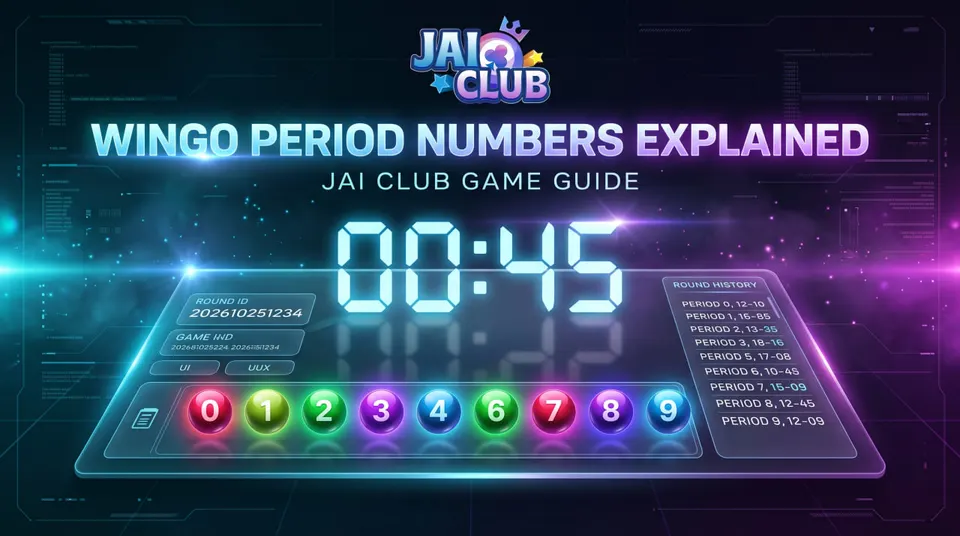
What Do Wingo Period Numbers Mean? Understanding Jai Club Game Rounds
Learn what Wingo period numbers mean, how game rounds and countdown timers work, how to read previous results, and why round IDs cannot predict future outcomes.
In this article
- What Do Wingo Period Numbers Mean? Understanding Jai Club Game Rounds
- What Is a Wingo Period Number?
- Why Are Period Numbers Important?
- Is a Period Number the Same as a Result?
- How Wingo Game Rounds Work
- Stage 1: A New Round Appears
- Stage 2: The Countdown Runs
- Stage 3: The Round Closes
- Stage 4: The Result Appears
- Stage 5: The Result Enters History
- Understanding Wingo Period Number Formats
- Example of Sequential Period Numbers
- Why Numbers May Increase Sequentially
- Wingo 30 Seconds vs 1 Minute: Understanding Timers
- 30-Second Round Format
- One-Minute Round Format
- Comparing Round Durations
- Does a Shorter Round Mean Better Results?
- How to Read Wingo Result History
- Period Column
- Number Column
- Big and Small Column
- Colour Column
- Does the Wingo Period Number Predict the Next Result?
- Why Sequential IDs Are Not Predictive
- What About Wingo Prediction Bots?
- Why Wingo Results Sometimes Appear Late
- The Timer Reaches Zero but Nothing Happens
- A Previous Result Is Still Visible
- History and Main Screen Look Different
- Can Wingo Period History Reveal Patterns?
- The Problem With Small Samples
- Understanding the Gambler's Fallacy
- History Is Useful for Records, Not Guarantees
- Common Mistakes When Reading Wingo Periods
- Wingo Period Numbers and Colour Trading
- Frequently Asked Questions
- What is a Jai Club Wingo period number?
- Does every Wingo game use the same period format?
- How do I identify the current Wingo period?
- What happens after a Wingo period ends?
- Can a Wingo period number predict the next colour?
- What is a Wingo 1-minute period?
- Why does Wingo history show multiple period numbers?
- Why is the current Wingo result not visible?
- Are Wingo period prediction bots accurate?
- Are period numbers the same as winning numbers?
- Final Thoughts
What Do Wingo Period Numbers Mean? Understanding Jai Club Game Rounds
If you have ever looked at a Jai Club Wingo game screen, you may have noticed a long number appearing next to the countdown timer. That number is often called a Wingo period number, round ID, or game period.
For beginners, the format can be confusing. Why does the number change? What happens when the countdown reaches zero? And does a period number contain useful information about the next result?
Understanding these details makes Wingo-style game interfaces easier to read.
In this guide, we explain period numbers, countdown timers, round history, number results, and the differences between various Wingo formats.
Quick answer: A Wingo period number generally identifies a particular game round. It helps distinguish one round from another and may be used to match a displayed result with its corresponding entry in the game's history. A period number does not, by itself, reveal the next winning number or colour.
What Is a Wingo Period Number?
A Wingo period number is an identifier associated with a particular round of a Wingo-style game.
Many short-round number games use identifiers to distinguish current and previous results.
The identifier may contain a combination of digits representing a sequence, date, or other information determined by the platform.
However, there is no universal rule requiring every Wingo service to use the same period-number format.
For this reason, the structure of an identifier should be interpreted according to the actual game interface.
Why Are Period Numbers Important?
Period numbers provide a way to distinguish one completed round from another.
Imagine a game interface displaying ten previous results.
Without identifiers, it might be difficult to determine which outcome belongs to which round.
A period number helps keep those records organised.
It may also be useful when comparing a result displayed on the main game screen with its entry in the history table.
Is a Period Number the Same as a Result?
No.
The period number identifies the round.
The result describes the outcome associated with that round.
For example, a history table might contain a period identifier, a number result, a colour label, and a Big or Small category.
These fields describe different pieces of information.
To understand the wider game interface, read our Jai Club Wingo Guide.
How Wingo Game Rounds Work
A Wingo-style game usually divides activity into individual rounds.
A round may have a defined opening time, countdown period, closing point, and result display.
The precise sequence depends on the version of the game.
Stage 1: A New Round Appears
The interface displays information for the current round.
This may include a period identifier and countdown timer.
The identifier allows the displayed information to be associated with the correct round.
Stage 2: The Countdown Runs
A visible timer may indicate how much time remains in the current phase.
Different game formats may use different countdown lengths.
The timer should be interpreted according to the instructions provided by that version.
Stage 3: The Round Closes
When the countdown reaches its closing point, the current phase ends.
The interface may temporarily display a processing state before the outcome appears.
A temporary delay does not necessarily mean that the next round has already completed.
Stage 4: The Result Appears
Once processed, a result may become visible on the screen.
Some versions display a number, colour, or additional category.
Stage 5: The Result Enters History
The completed round may then appear in a history section.
This lets readers distinguish the previous result from the current round.
Understanding Wingo Period Number Formats
One of the most common questions is whether the digits inside a period number have a special meaning.
A period identifier may look like a long sequence of numbers.
Some game interfaces use identifiers that appear to combine dates and sequential values.
Others may simply use a running counter.
Without documented rules from the operator, it is not possible to reliably decode every identifier.
Example of Sequential Period Numbers
Consider this fictional example:
| Period ID | Example result | Status |
|---|---|---|
| ROUND-2041 | 3 | Completed |
| ROUND-2042 | 8 | Completed |
| ROUND-2043 | 1 | Completed |
| ROUND-2044 | — | Current |
These are illustrative identifiers and results, not actual Jai Club records.
The table demonstrates that each period can have a separate identity and status.
Notice that the current period does not yet have a completed result.
Why Numbers May Increase Sequentially
A running counter is one possible way to organise rounds.
If a game uses sequential identifiers, later periods may have higher numbers.
However, not every system uses a simple counter.
Some may reset identifiers according to a defined schedule.
Others may combine a date reference with a sequence number.
Do not assume how a real period ID is constructed without evidence.
Wingo 30 Seconds vs 1 Minute: Understanding Timers
Searches such as "Wingo 30 seconds period" and "Wingo 1 minute period" usually refer to the time intervals associated with a game format.
A shorter interval means a round cycle may complete more frequently.
But a shorter timer does not reveal anything about whether the next colour or number will be predictable.
30-Second Round Format
In a hypothetical 30-second format, a complete cycle would take 30 seconds if the platform followed that timing exactly.
This could mean up to two completed rounds per minute without gaps.
The actual interface may include additional phases or delays.
One-Minute Round Format
A one-minute format would nominally use a 60-second cycle.
Again, the actual experience depends on the operator's rules and timing.
Comparing Round Durations
| Format | Nominal duration | Important consideration |
|---|---|---|
| 30 seconds | Half a minute | Shorter interval |
| 1 minute | One minute | Longer than 30 seconds |
| 3 minutes | Three minutes | Fewer nominal cycles |
| 5 minutes | Five minutes | Longer interval |
These durations are general examples of timer-based formats and are not verified specifications for a particular Jai Club operator.
Does a Shorter Round Mean Better Results?
No such conclusion follows from round duration.
A shorter timer changes how frequently rounds may occur.
It does not, on its own, establish different outcome probabilities, better returns, or a reliable prediction method.
How to Read Wingo Result History
A Wingo result history typically displays information about completed rounds.
The layout may contain several columns.
Common labels include period, number, Big/Small, and colour.
Period Column
The period column identifies the round associated with each row.
This is useful when comparing multiple entries.
Number Column
The number column shows the outcome recorded for that round.
In some Wingo-style formats, results are represented using digits from 0 to 9.
The exact range should be confirmed from the game being discussed.
Big and Small Column
Some versions classify number outcomes into two categories.
A commonly discussed ten-number format places 0–4 in Small and 5–9 in Big.
However, this convention should not be assumed to apply to every operator.
For additional context, read our Jai Club Wingo Big vs Small Guide.
Colour Column
Some versions use red, green, or violet labels.
The mapping between numbers and colours depends on the platform's rules.
Do not infer a universal colour mapping merely from screenshots on third-party websites.
Does the Wingo Period Number Predict the Next Result?
This is an important distinction.
A period number usually serves as a reference for a round.
A sequence of identifiers alone does not provide a reliable basis for forecasting outcomes.
For example, knowing that one round follows another does not establish which number will appear next.
Why Sequential IDs Are Not Predictive
Suppose an identifier increases from 2041 to 2042.
That change tells us which round comes next in the example.
It does not tell us the next game's outcome.
A round identifier and a result-generation process serve different functions.
What About Wingo Prediction Bots?
Some websites or messaging groups claim that period numbers contain hidden patterns.
They may advertise prediction bots, colour calculators, or guaranteed outcome signals.
These claims require independent evidence.
A demonstration involving a few successful guesses is not enough to prove that a tool can reliably predict future results.
Avoid treating promotional accuracy claims as established facts.
Why Wingo Results Sometimes Appear Late
Users may occasionally see a countdown reach zero before the result is displayed.
There are several possible explanations.
A service might be processing the completed round.
A network delay could prevent the updated screen from loading immediately.
A browser may also continue displaying older information until it refreshes.
These are general possibilities, not verified diagnoses of a particular Jai Club service.
The Timer Reaches Zero but Nothing Happens
If the interface becomes unresponsive, check whether the internet connection is stable.
Avoid repeatedly refreshing if the service explicitly warns that doing so can interrupt an active session.
A Previous Result Is Still Visible
Some interfaces display the most recently completed result separately from the current period.
Check the labels before assuming that the displayed number belongs to the newest round.
History and Main Screen Look Different
If two parts of an interface show apparently inconsistent information, examine their round identifiers.
They may be displaying data from different periods.
If the inconsistency persists, rely on the verified operator's documented results and support channels.
Can Wingo Period History Reveal Patterns?
A series of previous outcomes can be arranged into a table or chart.
This can make historical information easier to understand.
However, seeing a visual pattern does not demonstrate that future outcomes can be predicted.
The Problem With Small Samples
A short sequence can appear meaningful even when it does not support a reliable conclusion.
For example, repeated colours may attract attention because people naturally look for patterns.
Without evidence about the actual result-generation process, those observations cannot establish a predictive advantage.
Understanding the Gambler's Fallacy
The gambler's fallacy is the mistaken belief that a previous sequence makes a particular future outcome due to occur.
Imagine seeing several consecutive results in the same colour.
It might feel as though another colour must appear next.
That expectation is not justified merely by the previous sequence.
Whether outcomes are independent, dependent, random, or determined by another mechanism must be established from the real system.
History Is Useful for Records, Not Guarantees
Round history can help verify which result was displayed for a particular identifier.
That is different from predicting the next outcome.
The distinction is especially important when a game involves financial risk.
Common Mistakes When Reading Wingo Periods
Several misunderstandings can make game interfaces harder to interpret.
Confusing the period ID with the outcome: A round identifier does not normally represent the winning number.
Reading the previous period as the current period: Always check the interface labels and status.
Assuming all Wingo platforms use the same format: Different services may use different identifiers and timing conventions.
Treating repeated colours as guaranteed predictions: Historical sequences alone cannot establish future outcomes.
Trusting third-party prediction screenshots: Screenshots may omit unsuccessful predictions or important context.
Assuming the countdown controls the result: A visible timer describes a time interval, not necessarily the mechanism used to generate an outcome.
Wingo Period Numbers and Colour Trading
The term colour trading is often associated with number-and-colour gaming interfaces.
Despite its name, colour trading should not automatically be confused with financial asset trading.
In a colour prediction game, the outcome categories are established by the game's rules.
A period number may help identify which round produced a particular number or colour.
But it does not independently explain the game's probability distribution or payout conditions.
Those details require separate documentation.
Frequently Asked Questions
What is a Jai Club Wingo period number?
A period number is generally an identifier assigned to a specific game round. It helps distinguish current and historical results.
Does every Wingo game use the same period format?
No. Identifiers can vary between platforms and game versions.
How do I identify the current Wingo period?
Look for the current round label and associated countdown timer on the relevant game interface.
What happens after a Wingo period ends?
The interface may close the current phase, process the outcome, and display the result. Exact behaviour depends on the operator.
Can a Wingo period number predict the next colour?
There is no reliable basis for predicting an outcome from the period identifier alone.
What is a Wingo 1-minute period?
It describes a format associated with a nominal one-minute round interval. Verify the actual timing in the relevant game rules.
Why does Wingo history show multiple period numbers?
Different identifiers help organise records for separate rounds.
Why is the current Wingo result not visible?
Possible reasons include an incomplete round, delayed processing, network latency, or an outdated interface display.
Are Wingo period prediction bots accurate?
Accuracy claims should not be accepted without independent, reproducible evidence.
Are period numbers the same as winning numbers?
No. Period numbers identify rounds, while winning numbers are recorded outcomes.
Final Thoughts
Understanding Jai Club Wingo period numbers is mainly about learning how a game interface organises rounds and results.
The period identifier tells you which round is being displayed. A countdown indicates the relevant time interval, and result history records outcomes from completed rounds.
These features are useful for reading and comparing information.
They should not, however, be mistaken for guaranteed prediction tools.
For more background, explore our Jai Club Wingo Overview and Wingo Big vs Small Guide.
Editorial note: This article is an independent explanation of commonly used Wingo-style game terminology. Examples are illustrative and do not represent verified live game records or a prediction system.