How Cluster Pays Work in Slots Without Traditional Paylines
Learn how Cluster Pays slot games evaluate connected matching symbols, why adjacent positions matter, how clusters differ from paylines, and how cascading features affect results.

In this article
- What Is a Cluster Pays Slot?
- How Connected Symbols Form a Cluster
- Do Diagonal Symbols Count?
- Understanding Minimum Cluster Sizes
- Fictional Cluster Paytable
- Cluster Pays vs Traditional Paylines
- Main Differences
- How Cluster Payouts Are Calculated
- What Happens When Two Clusters Appear Together?
- Cascading Symbols in Cluster Pays Games
- Example of a Cascading Cluster
- Do Cascades Always Increase Multipliers?
- Wild Symbols in Cluster Pays Slots
- Cluster Pays vs Megaways
- Why Cluster Pays Games Can Look More Complicated
- Does a Larger Grid Mean More Winning Chances?
- Can Cluster Patterns Predict Future Results?
- How to Read a Cluster Pays Paytable
- Frequently Asked Questions
- What is a Cluster Pays slot?
- How many symbols are needed to form a cluster?
- Do diagonal symbols count as connected?
- Is Cluster Pays the same as ways to win?
- Can Cluster Pays games include cascades?
- Do wild symbols help form clusters?
- Does a bigger cluster always pay more?
- Is Cluster Pays the same as Megaways?
- Can Cluster Pays history predict the next result?
- Are Cluster Pays games confirmed on Jai Club?
- Conclusion
Most people recognise traditional slot machines by their spinning reels and matching symbols. A classic slot may evaluate winning combinations along fixed horizontal or diagonal paylines, but modern video slots have introduced several other ways to calculate results. One of these methods is known as Cluster Pays, where the game evaluates groups of connected matching symbols instead of relying exclusively on traditional paylines.
This difference changes how the game screen is interpreted. A group of matching symbols can form an irregular shape rather than a straight line, and the size of that group may influence the payout assigned by the paytable. Some cluster-based games also include cascading reels, multipliers or special wild symbols that modify how the visible grid changes.
For readers exploring slot game mechanics through JaiClubGame.com, understanding Cluster Pays is useful when comparing modern slot systems. This guide explains how connected-symbol groups are formed, why the minimum cluster size matters and how Cluster Pays differs from paylines, ways-to-win systems and Megaways-style reels.
All numerical examples and symbol grids are illustrative, not verified results from any particular Jai Club slot.
What Is a Cluster Pays Slot?
A Cluster Pays slot is a game that evaluates qualifying groups of connected matching symbols. Instead of requiring symbols to appear along one predefined line, the game examines whether enough eligible symbols form a connected group under its rules.
The exact definition of a connection varies. Some games consider symbols connected when they occupy horizontally or vertically adjacent positions. Others may use additional or different rules. The number of symbols needed to qualify also depends on the particular title.
For example, a fictional cluster-based slot might require at least five matching symbols to touch one another through horizontal or vertical connections. A connected group of five could qualify for an award, while four matching symbols might be insufficient.
This is the central idea behind Cluster Pays: the arrangement and connection of symbols matter, not simply how many identical symbols appear anywhere on the screen.
How Connected Symbols Form a Cluster
Imagine a slot grid containing diamonds, stars, crowns and other symbols. Several diamonds may appear in different positions across the screen. Whether those diamonds form a qualifying cluster depends on the game's connection rules.
A diamond immediately above another diamond may form a vertical connection. Two diamonds occupying neighbouring columns on the same row may form a horizontal connection. If these connections link several symbols into one group, the game may recognise them as a cluster.
However, matching symbols separated by other symbols or empty positions may not belong to the same group. A screenshot showing six diamonds scattered across the grid does not prove that a six-symbol cluster exists.
Do Diagonal Symbols Count?
Diagonal connections are not universally recognised. Many cluster-based designs use horizontal and vertical adjacency, although specific games may define their connections differently.
For example, a fictional paytable might state that diagonal positions do not count. Two matching symbols touching only at their corners would therefore not form a qualifying connection.
The proper interpretation requires the game's documented adjacency rule rather than relying on visual closeness alone.
Understanding Minimum Cluster Sizes
A Cluster Pays game usually establishes a minimum number of connected symbols needed for a qualifying combination. This minimum can vary between titles, and the same game may assign different payout values to groups of different sizes.
Imagine a fictional game requiring at least five matching symbols for an award. A connected group of four would not qualify under that rule, while five or more could produce a payout if the remaining conditions were satisfied.
As the connected group grows, the paytable may assign different values. Some games use several size ranges, such as five to six symbols, seven to eight symbols or nine or more.
Fictional Cluster Paytable
| Connected symbols | Example multiplier |
|---|---|
| 5–6 | 1x |
| 7–8 | 2x |
| 9–10 | 5x |
| 11 or more | 10x |
These values are fictional. The example illustrates how cluster size may relate to payout tiers, not how any specific Jai Club game calculates awards.
A real calculation would also require knowing the symbol type, the betting unit and any applicable modifiers.
Cluster Pays vs Traditional Paylines
Traditional paylines use predefined paths across reel positions. A game may display horizontal, diagonal or zigzag lines, and matching symbols generally need to follow the relevant rules along an active path.
Cluster Pays does not necessarily require a fixed path. Instead, the game evaluates connected groups that may form irregular shapes on the grid.
For example, a qualifying cluster might include two matching symbols on the first row, two immediately below them and another attached on the third row. Such a shape would not resemble a conventional straight payline, yet it could qualify under suitable cluster rules.
Main Differences
| Feature | Traditional paylines | Cluster Pays |
|---|---|---|
| Winning structure | Defined paths | Connected groups |
| Symbol arrangement | Specific line positions | Adjacent positions |
| Minimum requirement | Payline combination rules | Cluster size and connection rules |
| Typical shape | Straight or patterned lines | May be irregular |
| Cascades | Optional | Common in many designs |
Neither evaluation method automatically offers a higher RTP, better payout frequency or more favourable financial outcome.
How Cluster Payouts Are Calculated
The award for a qualifying cluster depends on the game's paytable. The calculation may consider the symbol type, the number of connected positions and the selected betting unit.
Consider a fictional game where a group of eight matching diamonds qualifies for a 2x award based on the total wager. If the wager is ₹10, the gross award would be ₹20 under those invented rules.
However, another cluster-based game might calculate payouts in credits, use different multiplier bases or impose additional conditions. A payout example from one game should therefore not be applied to another.
It is also important to distinguish gross payout from net result. A qualifying award may be smaller than the wager, and a visually highlighted cluster does not guarantee a profitable spin.
Our Slot Payout Calculation Guide explains this difference in more detail.
What Happens When Two Clusters Appear Together?
A cluster-based slot may display more than one qualifying group during the same evaluation. The game must then determine how those groups are recognised and whether their awards are calculated separately.
For example, a fictional grid could contain one eligible group of stars and another eligible group of diamonds. If both satisfy their respective rules, the game may calculate awards for each before combining the amounts.
However, the treatment of overlapping groups, wild substitutions and special symbols depends on the particular system. The presence of several visible clusters does not establish how their payouts interact.
A complete paytable should explain the game's evaluation and aggregation rules.
Cascading Symbols in Cluster Pays Games
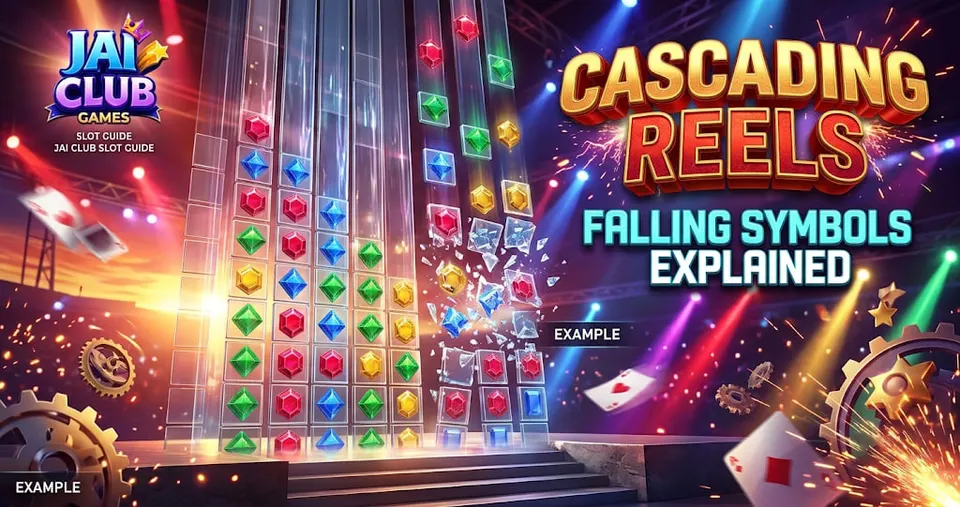
Cascading features are common in many cluster-based games. After a qualifying group is evaluated, certain symbols may disappear and new symbols may enter the available positions.
The changed grid can then be evaluated again. If another qualifying cluster appears, the game may calculate a further award and repeat the process.
This produces a sequence of changing symbol arrangements during one overall spin event. The visual effect can be quite different from ordinary fixed-payline games, where a completed spin commonly transitions directly to the next independent spin.
Example of a Cascading Cluster
Imagine a fictional grid where six stars form an eligible group. The game calculates the award and removes those six symbols, leaving empty spaces.
New symbols then fill the spaces. If five connected diamonds appear under the game's rules, another cluster award might be calculated.
The process may continue until no further qualifying groups remain or another programmed condition ends the sequence.
Each cascade is governed by the actual game's rules, and there is no guarantee that a new cluster will appear after the previous one is removed.
Do Cascades Always Increase Multipliers?
Some games use increasing multipliers during cascading sequences, but this is not universal. A slot might apply a multiplier to each additional qualifying cascade, while another could evaluate all clusters using ordinary payout rules.
Where multipliers are present, the relevant amount being multiplied also matters. A modifier might apply to one cluster award, an entire cascade or another defined total.
Two visually similar cascade features can therefore produce very different payout calculations.
The correct interpretation comes from the game's documented rules rather than assumptions based on the animation.
Wild Symbols in Cluster Pays Slots
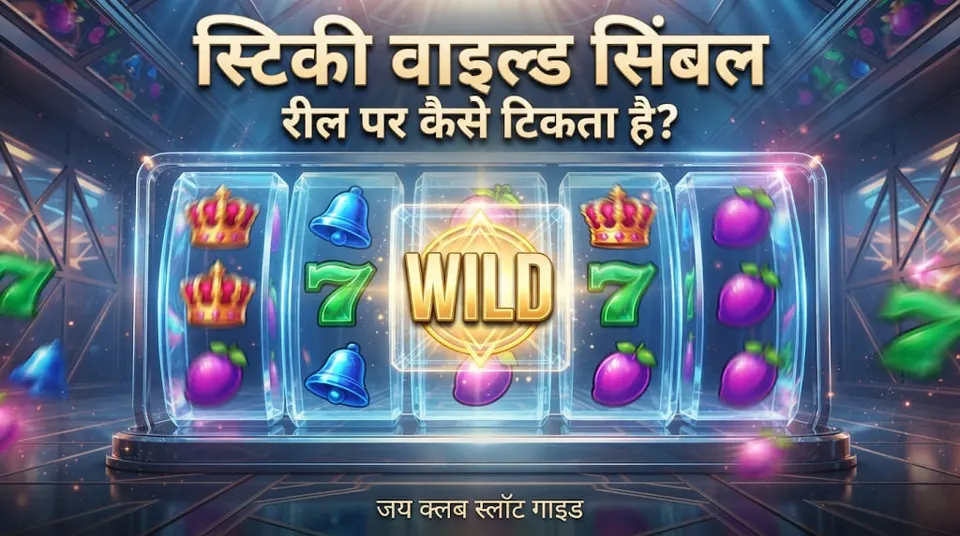
Wild symbols can affect cluster formation by substituting for certain regular symbols, subject to the particular game's rules. A wild positioned between matching symbols might help connect an otherwise incomplete group if the game permits that substitution.
However, wild behaviour is not identical across all cluster-based games. Some wilds may substitute for most regular symbols, while others have restrictions or additional effects.
A special wild could also expand or remain in place during a feature, changing how subsequent grids are evaluated. These modifications should be interpreted separately from the basic adjacency requirements.
A wild symbol's appearance does not guarantee that a particular cluster will qualify or that the resulting payout will exceed the wager.
Cluster Pays vs Megaways
Cluster Pays and Megaways can both create unusual-looking winning patterns, but they use different underlying structures.
Megaways-style games generally involve variable-height reels and ways-to-win evaluation across eligible reels. Cluster Pays focuses on the formation of connected matching symbol groups on a grid.
In a Megaways-style game, the number of possible ways may change because the number of visible positions on each reel changes. In a Cluster Pays game, the relevant question is usually whether enough matching symbols form a connected group under the paytable.
These are separate mechanics, even when both include cascading features or special wild symbols.
For a detailed explanation, read our Megaways Slots Guide.
Why Cluster Pays Games Can Look More Complicated
Cluster-based slots often display large grids containing many symbols. A single evaluation may include several matching groups, only some of which qualify for awards.
Cascades can further change the layout, with symbols disappearing and new ones entering the grid. Special effects may highlight connections, display multipliers or animate the removal of qualifying clusters.
This visual complexity can make the final payout difficult to interpret without examining the rules. A large number of matching symbols on the screen does not necessarily mean that a large award has been generated.
The proper calculation depends on the connected group sizes, symbol values, betting units and relevant feature conditions.
Does a Larger Grid Mean More Winning Chances?
A larger grid contains more symbol positions, but this does not automatically mean that the game has a higher RTP or a more favourable expected result.
The complete mathematical design must consider symbol distributions, minimum cluster sizes, payout tiers and any modifiers. A game with a large grid might require relatively large connected groups to produce an award, while another game with fewer positions could use different conditions.
Comparing grids solely by their dimensions is therefore incomplete.
The number of visible positions describes the interface structure, not the full probability distribution.
Can Cluster Patterns Predict Future Results?
Previous cluster arrangements do not establish what symbols will appear during the next spin. The fact that several large groups formed earlier does not mean that another large group is due or that the next result must be smaller.
People may notice apparent patterns when looking at screenshots or recorded histories, but visual repetition alone is not sufficient evidence of a predictive rule.
Understanding cluster connections is useful for explaining completed outcomes. It should not be mistaken for a method of forecasting future results or avoiding losses.
How to Read a Cluster Pays Paytable
The most useful first step is to identify the minimum cluster size. Next, determine what qualifies as a connection and whether different symbol types use different rules.
The paytable should also explain how awards change with cluster size and how wild symbols affect group formation. Where cascades or multipliers exist, their conditions should be read separately.
Some games may provide information about maximum payouts or special feature limits. These figures should not be confused with the likelihood of receiving a particular outcome.
For general background, our Slot Paytable Guide explains how payout rules are commonly presented.
Frequently Asked Questions
What is a Cluster Pays slot?
A Cluster Pays slot evaluates qualifying groups of connected matching symbols instead of relying solely on traditional paylines.
How many symbols are needed to form a cluster?
The minimum number depends on the game. Different titles may require different cluster sizes.
Do diagonal symbols count as connected?
Not necessarily. Connection rules vary and must be checked in the paytable.
Is Cluster Pays the same as ways to win?
No. Cluster Pays evaluates connected groups, while ways-based systems generally evaluate combinations across qualifying reels.
Can Cluster Pays games include cascades?
Yes. Cascading mechanics are common in many implementations, although specific rules vary.
Do wild symbols help form clusters?
They may, depending on the game's substitution and adjacency rules.
Does a bigger cluster always pay more?
Not universally. The result depends on the game's paytable and symbol values.
Is Cluster Pays the same as Megaways?
No. Megaways focuses on variable reel heights and ways-based evaluation, while Cluster Pays uses connected-symbol groups.
Can Cluster Pays history predict the next result?
No reliable prediction follows from past symbol arrangements alone.
Are Cluster Pays games confirmed on Jai Club?
This guide does not independently verify the availability of particular Cluster Pays titles on Jai Club.
Conclusion
Cluster Pays games evaluate matching symbols according to connection rules rather than conventional fixed paylines. Their mechanics may involve minimum group sizes, different payout tiers and cascading features that repeatedly change the grid.
Understanding those rules can make it easier to interpret completed results and compare cluster-based games with traditional paylines or Megaways-style systems.
However, connected symbols and visual patterns do not provide guaranteed predictions or eliminate the possibility of financial losses.
Explore the Jai Club Slots category for further educational explanations of slot mechanics.
Editorial note: All examples are fictional. This article explains general Cluster Pays mechanics and does not verify a specific Jai Club game configuration or guarantee financial outcomes.