Jai Club Slot Paytable: Symbols & Payouts Explained
Learn how a slot paytable works, how symbol combinations and payouts are displayed, what wilds and scatters mean, and why every slot game has its own rules.
In this article
- What Is a Slot Paytable? Understanding Symbols, Payouts and Game Rules
- What Is a Slot Paytable?
- Why Paytables Matter
- Is Every Slot Paytable the Same?
- Where Can You Find a Slot Paytable?
- Common Paytable Menu Labels
- What Information Should You Expect?
- Understanding Regular Slot Symbols
- High-Value and Low-Value Symbols
- Example of a Fictional Slot Paytable
- Why More Matching Symbols May Pay More
- What Are Paylines in Slot Games?
- Straight Paylines
- Diagonal Paylines
- Zigzag Paylines
- Why Payline Direction Matters
- Paylines vs Ways to Win: What's the Difference?
- Traditional Payline Example
- Ways-to-Win Example
- Does More Ways Mean Better Odds?
- How Slot Payout Multipliers Work
- Example Using a Total Bet
- Why the Bet Unit Matters
- Gross Payout vs Net Result
- What Is a Wild Symbol?
- Wild Substitution
- Can Wild Symbols Replace Everything?
- Expanding and Sticky Wilds
- What Is a Scatter Symbol?
- Scatter Symbols vs Regular Symbols
- Do Three Scatters Always Trigger Free Spins?
- Understanding Bonus Symbols and Special Features
- Free Spins
- Respins
- Multipliers During Bonuses
- Why Two Similar Slot Games Can Have Different Payouts
- Theme Is Not a Payout System
- Game Versions Can Also Differ
- Slot Paytable vs RTP: Understanding the Difference
- Why the Paytable Does Not Reveal Every Probability
- Can a Paytable Predict the Next Spin?
- Common Mistakes When Reading Slot Paytables
- How to Compare Two Slot Paytables
- How to Read a Slot Paytable on Mobile
- Check the Current Game Version
- Be Careful With Screenshots
- Frequently Asked Questions
- What is a slot paytable?
- How do I read slot symbol values?
- Do three matching symbols always win?
- What does 5x mean in a slot paytable?
- Are wild and scatter symbols the same?
- Does every slot game have paylines?
- What is the difference between a paytable and RTP?
- Can a paytable show which symbol will appear next?
- Are higher-value symbols more likely to appear?
- Why does a slot show a win smaller than the bet?
- Are all Jai Club slot paytables identical?
- Where can I learn about other Jai Club game formats?
- Final Thoughts
What Is a Slot Paytable? Understanding Symbols, Payouts and Game Rules
Ever opened a slot game and wondered why three matching symbols sometimes produce a payout while another combination does not? The answer is usually found in the game's paytable.
A slot paytable is more than a list of pictures and numbers. It explains how winning combinations are recognised, what different symbols represent, and how payouts are determined under the game's rules.
For readers exploring Jai Club slot-related games, understanding a paytable is a useful starting point. Different slot titles can look similar while using completely different payout systems, reel layouts, and bonus mechanics.
This guide explains how to read a slot paytable, understand symbol values, recognise different winning patterns, and interpret payout calculations.
All numerical examples are fictional and intended for education. They are not verified payout information from a particular Jai Club slot.
What Is a Slot Paytable?
A slot paytable is the section of a game that explains its payout rules.
It commonly lists the symbols appearing on the reels, the number of matching symbols required for a payout, and the amount or multiplier associated with each qualifying combination.
Modern slot paytables can also describe special features, bonus rounds, wild symbols, scatter symbols, and other game-specific mechanics.
In simple terms, the paytable helps answer three questions.
What counts as a winning combination?
How is that combination evaluated?
What payout does the game assign to it?
These questions matter because a winning combination is determined by the game's rules, not simply by whether several matching pictures appear somewhere on the screen.
Why Paytables Matter
Consider two fictional slot games using identical-looking diamond symbols.
In the first game, three diamonds along an active payline might qualify for a payout.
In the second, the game might require diamonds to appear on adjacent reels under a ways-to-win system.
The symbols look similar, but the rules are different.
A paytable provides the information needed to understand those differences.
Is Every Slot Paytable the Same?
No.
Game developers can use different symbol values, reel structures, special features, and payout arrangements.
Even two slots featuring the same theme or visual style may have completely different mathematical designs.
This is why an explanation of one game's paytable should not automatically be applied to another game.
For a broader overview of other gaming formats discussed on this website, see the Jai Club Games Guide.
Where Can You Find a Slot Paytable?
In many modern slot games, the paytable is available through an information, help, or settings menu.
Depending on the design, you might see a small information symbol, a question mark, or a button labelled Paytable or Game Rules.
On mobile devices, some games place this information inside an expandable menu.
Common Paytable Menu Labels
A game may use one or more of the following labels.
- Paytable
- Game Info
- Rules
- Help
- Symbol Values
- Winning Combinations
- Bonus Information
The layout can vary between titles.
If the relevant rules cannot be located, avoid assuming that a different game's instructions apply.
What Information Should You Expect?
A reasonably detailed paytable may explain the regular symbols, payout conditions, special symbols, and applicable winning patterns.
It may also contain information about the game's betting units, return-to-player figure, or maximum payout.
Not every game provides all these details on one screen.
Some divide them across several information panels.
Understanding Regular Slot Symbols
Regular symbols are the standard pictures displayed on slot reels.
Common themes include playing card letters, fruit, gemstones, animals, objects, and fictional characters.
Their appearance is mostly a design choice.
A visually impressive symbol is not automatically more valuable than a simple one.
Its value depends on the paytable.
High-Value and Low-Value Symbols
Many slot games divide symbols into different payout groups.
High-value symbols may award larger amounts for qualifying combinations.
Lower-value symbols may award smaller amounts.
However, their relative values must be checked in the actual game information.
Example of a Fictional Slot Paytable
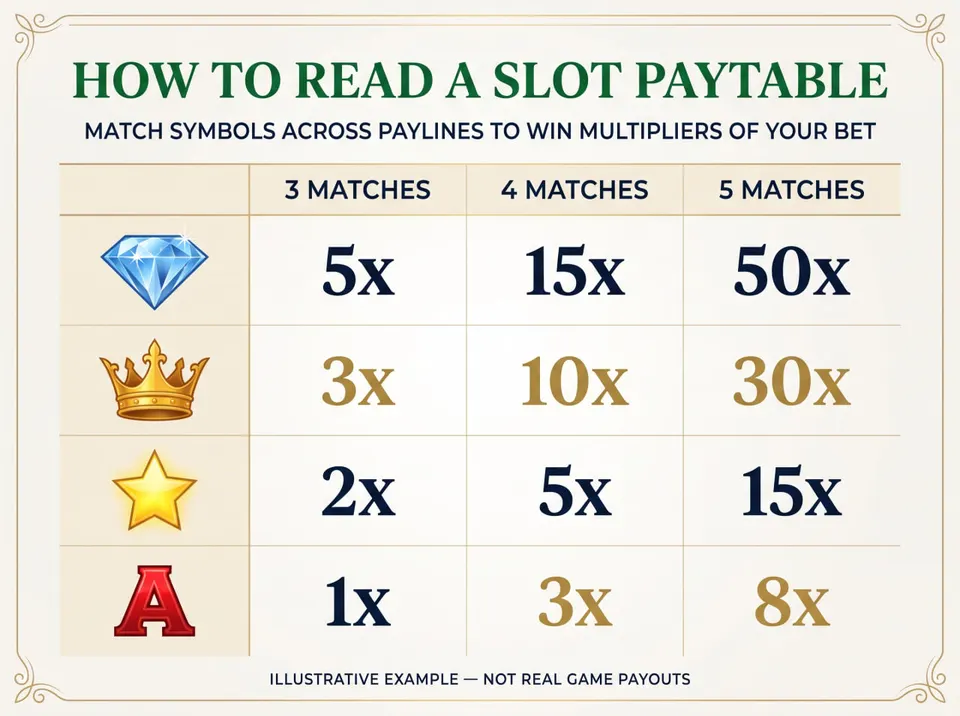
The following table is an invented example.
| Symbol | 3 matches | 4 matches | 5 matches |
|---|---|---|---|
| Diamond | 5x | 15x | 50x |
| Crown | 3x | 10x | 30x |
| Star | 2x | 5x | 15x |
| Letter A | 1x | 3x | 8x |
For this example, assume the values are multipliers of a defined wager amount and the combinations satisfy the game's rules.
Three diamonds would correspond to a 5x award.
Five diamonds would correspond to a 50x award.
These are hypothetical figures, not Jai Club payout rates.
Why More Matching Symbols May Pay More
Many slots assign higher values to longer qualifying combinations.
However, the number of matching symbols is only one part of the calculation.
Those symbols may also need to appear on specific reels, active paylines, or valid positions.
Five identical symbols scattered randomly across the screen do not necessarily create a winning combination.
What Are Paylines in Slot Games?
A payline is a defined pattern of reel positions used to evaluate a winning combination.
Traditional slots may use a small number of straight lines.
Modern video slots can have horizontal, diagonal, zigzag, or other predefined patterns.
The exact patterns are shown in the game's rules.
Straight Paylines
Imagine a three-row slot with five reels.
A horizontal payline might run across the middle row.
Matching symbols may need to appear across consecutive reels on that row to qualify.
Diagonal Paylines
A diagonal payline moves across different vertical positions.
The symbols must occupy the positions specified by the line.
Merely displaying identical symbols on the reels is not enough.
Zigzag Paylines
A zigzag line may travel from the top row to the middle row and then to the bottom row.
The payline diagram determines which positions count.
Why Payline Direction Matters
Some slot games evaluate combinations from left to right.
Others may support different directions or use alternative systems entirely.
Do not assume that every game pays for matching symbols appearing anywhere on the screen.
Always check the specific payline requirements.
Paylines vs Ways to Win: What's the Difference?
Paylines and ways-to-win systems are two different methods of evaluating symbol combinations.
Traditional paylines rely on defined paths.
Ways-to-win systems typically evaluate qualifying symbols across adjacent reels without requiring them to occupy one fixed line.
This can create very different-looking winning patterns.
Traditional Payline Example
Suppose three matching stars appear on reels one, two, and three.
If they follow an active payline and meet the game's minimum match requirement, they may qualify.
If the same stars land outside the required positions, they might not qualify.
Ways-to-Win Example
In a ways-based game, matching stars might count when they appear on consecutive reels, regardless of which row each star occupies.
The precise rule depends on the game.
Some modern slots also use cluster-based or other methods that are different from both traditional paylines and ways-to-win.
Does More Ways Mean Better Odds?
A larger advertised number of ways does not, by itself, establish better odds or a higher expected return.
The actual probability structure depends on the complete mathematical design.
Two games with different reel arrangements can have different payout distributions even when their promotional descriptions sound similar.
How Slot Payout Multipliers Work
A payout multiplier describes how a particular winning combination's award relates to a specified amount.
For example, an award labelled 5x generally means five times the amount defined by the relevant game rules.
The important detail is identifying what amount is being multiplied.
It might be the total wager, a line bet, a coin value, or a different defined unit.
Example Using a Total Bet
Imagine a fictional slot game where the paytable clearly states that symbol awards are based on the total wager.
Suppose the total wager is ₹10.
A qualifying combination has a payout of 5x.
The resulting gross payout would be ₹50.
If that were the only award for the spin, the gross payout would be five times the wager, but the net change after accounting for the ₹10 wager would be ₹40.
Why the Bet Unit Matters
Not every slot uses total-bet multipliers.
Some display values in credits.
Others calculate awards using a line-specific stake.
Applying the wrong unit can produce an incorrect estimate.
Check the payout definition before making calculations.
Gross Payout vs Net Result
A displayed win is not necessarily the same as a net profit.
For example, if a spin costs ₹20 and awards ₹10, the game may display a ₹10 win while the overall result of that spin is a ₹10 loss.
Understanding this distinction prevents a common misunderstanding of slot payout screens.
What Is a Wild Symbol?
A wild is a special symbol that may substitute for certain regular symbols.
Its purpose is generally to help complete combinations that would otherwise require matching regular symbols.
However, substitution rules vary.
Wild Substitution
In a fictional game, imagine a winning line that requires three crowns.
The game might allow a wild symbol to substitute for one crown.
That could create a qualifying combination.
But this is only valid if the paytable explicitly allows that substitution.
Can Wild Symbols Replace Everything?
Not necessarily.
Some games exclude scatters, bonus symbols, or other special symbols from wild substitution.
Some wilds may also have their own payout values.
The only reliable approach is to read the rules for the specific game.
Expanding and Sticky Wilds
Certain slots include additional wild mechanics.
An expanding wild may cover more positions, while a sticky wild may remain on the reels for a defined number of spins or during a particular feature.
These are game-specific behaviours rather than universal rules.
What Is a Scatter Symbol?
A scatter is another common special symbol.
Depending on the game, scatters may award a prize, activate a bonus feature, or unlock free spins.
Some games count scatter symbols anywhere on the visible reels.
Others apply additional placement conditions.
Scatter Symbols vs Regular Symbols
Regular symbols commonly depend on line or ways-based matching rules.
Scatters may use a separate evaluation method.
This is why a scatter can sometimes trigger a feature without following a conventional payline.
Do Three Scatters Always Trigger Free Spins?
No.
The required number, positions, and conditions depend on the game.
Some titles use three scatters, while others use different requirements or special bonus symbols.
Do not assume the rule based on another slot's design.
Understanding Bonus Symbols and Special Features
Modern slot games often include additional mechanics beyond regular symbol matching.
These may include free spins, respins, multipliers, expanding symbols, or special bonus rounds.
A paytable should explain the conditions relevant to the particular feature.
Free Spins
A free-spin feature provides a defined number of spins under the game's bonus rules.
These spins may have different symbol behaviour or payout conditions from the regular game.
The term does not necessarily mean the feature is free of all financial risk, particularly if it was triggered through paid gameplay.
Respins
A respin feature allows one or more reels or positions to be evaluated again under specific rules.
Some features hold certain symbols in place while other positions change.
The precise behaviour depends on the game.
Multipliers During Bonuses
Some slot features apply multipliers to qualifying awards.
For example, a fictional feature might multiply a winning combination by three.
But the multiplier may apply only to a specific feature, symbol, or award component.
Check the paytable rather than assuming every win is multiplied.
Why Two Similar Slot Games Can Have Different Payouts
Imagine two slot games using five reels, gemstone symbols, and a similar purple background.
Both display diamonds, crowns, stars, and playing card letters.
Despite the similarities, one game might use twenty fixed paylines while the other uses a ways-to-win system.
Their symbol values may differ.
Their minimum combination requirements may also differ.
One might offer wild substitutions during its main game, while another reserves special symbols for a bonus round.
The visual design cannot explain these differences.
Only the actual rules and paytable can.
Theme Is Not a Payout System
A game's theme describes its artwork and presentation.
Its payout system describes how outcomes are evaluated and paid.
These two elements should not be confused.
A slot featuring expensive-looking gemstones does not necessarily offer higher returns than a slot featuring ordinary fruit symbols.
Game Versions Can Also Differ
Different releases in the same series may introduce new features or alternative payout arrangements.
An updated title does not automatically preserve every rule from the original.
Each version should be examined separately.
Slot Paytable vs RTP: Understanding the Difference
A paytable and RTP describe different information.
The paytable explains payouts for particular qualifying combinations.
RTP, or return to player, is a statistical measure of the proportion of wagered money expected to be returned over a very large number of plays under a defined game configuration.
A displayed RTP figure is not a guarantee for an individual session.
Why the Paytable Does Not Reveal Every Probability
A paytable may tell you that five diamonds pay 50x.
That information does not necessarily tell you how often five diamonds can occur.
The probability depends on the game's underlying mathematical design.
Two games can display similar payouts but have different frequencies of winning outcomes.
Can a Paytable Predict the Next Spin?
No.
A paytable is an explanation of result evaluation, not a forecasting system.
It does not tell you which symbols will appear next.
Repeated losses, near misses, or a long period without a bonus do not prove that a particular outcome is about to occur.
Common Mistakes When Reading Slot Paytables
Many misunderstandings come from overlooking small details.
Confusing credits with currency: A value displayed as credits may not equal the same amount in rupees.
Ignoring qualifying positions: Matching symbols may need to appear on particular reels or lines.
Assuming every wild substitutes for scatters: Some symbols are explicitly excluded.
Misreading multipliers: A multiplier may apply to a line stake, total wager, or feature-specific amount.
Treating bonus animations as payout evidence: Visual effects do not replace the stated payout rules.
Comparing games only by theme: Similar artwork does not establish identical game mechanics.
Assuming large advertised prizes are frequent: A maximum possible award says little about how likely it is to occur.
How to Compare Two Slot Paytables
A simple comparison begins with the rules rather than promotional artwork.
Consider these fictional games.
| Feature | Game A | Game B |
|---|---|---|
| Reel layout | 5 × 3 | 5 × 4 |
| Win evaluation | Fixed paylines | Ways to win |
| Regular symbols | 8 | 9 |
| Wild | Standard substitution | Feature-specific |
| Scatter | Bonus trigger | Separate scatter rule |
| Special feature | Free spins | Respins |
These fictional differences demonstrate why it is important to evaluate each title independently.
Neither example can be declared better simply from the table.
The relevant payout probabilities and game configuration would also be needed.
How to Read a Slot Paytable on Mobile
Mobile interfaces have less screen space, so game information may be divided across multiple panels.
Look for an information or rules section if the game provides one.
Read each page carefully.
If payout figures are difficult to see, avoid assuming that a small symbol or number has the same meaning as in another game.
Check the Current Game Version
Rules may differ across versions.
If you are reading an article or watching a tutorial, check whether the example matches the exact version being discussed.
Be Careful With Screenshots
Screenshots can explain an interface, but they can also become outdated.
A screenshot without its game name, version, and full rules may not provide enough context to verify a payout claim.
For broader game terminology, return to the Jai Club Games Guide.
Frequently Asked Questions
What is a slot paytable?
A slot paytable explains how qualifying symbol combinations and special features are evaluated and paid.
How do I read slot symbol values?
Find the symbol in the paytable, check the required number of matches, identify the qualifying positions, and confirm the payout unit.
Do three matching symbols always win?
No. The symbols must satisfy the specific game's rules, including any relevant payline, reel, or position requirements.
What does 5x mean in a slot paytable?
It generally means five times a defined amount. The amount being multiplied depends on the game's payout rules.
Are wild and scatter symbols the same?
No. Wilds commonly substitute for regular symbols, while scatters may follow separate payout or bonus-trigger conditions.
Does every slot game have paylines?
Not necessarily. Some games use ways-to-win, cluster-based, or other evaluation methods.
What is the difference between a paytable and RTP?
A paytable describes individual payout conditions. RTP is a long-run statistical measure under a specified game configuration.
Can a paytable show which symbol will appear next?
No. It describes what qualifying results pay, not what the next result will be.
Are higher-value symbols more likely to appear?
Their payout value alone does not establish their probability. That depends on the game's mathematics.
Why does a slot show a win smaller than the bet?
A qualifying combination can award an amount smaller than the wager used for the spin. A positive displayed award does not necessarily mean a net gain.
Are all Jai Club slot paytables identical?
No universal paytable has been established for all Jai Club-associated slot titles. Each specific game should be evaluated using its own documented rules.
Where can I learn about other Jai Club game formats?
Visit our Jai Club Games Guide for information about the site's other game categories.
Final Thoughts
A slot paytable is one of the most useful parts of a game's information screen.
It explains which symbols have defined values, how winning combinations are recognised, what special features do, and how payouts are calculated.
The key lesson is that visual similarity does not mean identical game rules.
Two slots can display similar symbols while using completely different paylines, ways-to-win systems, and bonus mechanics.
Understanding the paytable helps readers interpret a game's stated rules more accurately. It does not make outcomes predictable or eliminate the possibility of financial losses.
Explore our Jai Club Games Guide for more explanations of game formats and terminology.
Editorial note: This article is an independent educational explanation of slot mechanics. All example payouts, multipliers, symbols, and comparison tables are fictional. No specific live Jai Club slot configuration has been independently verified.