Jai Club Wingo Entry Records: Reading Stakes, Deductions & Account History
Learn how Wingo entry records may show stake amounts, transaction deductions, settlement status and account history, and why result history is not the same as a complete financial record.
In this article
- What Is a Wingo Entry Record?
- Entry History vs Result History
- Understanding Stake Amount
- What Does Deduction Mean?
- Stake vs Gross Return vs Net Result
- Example Wingo Entry Record
- Why Round IDs Matter in Account History
- Attempted Entry vs Accepted Entry
- Pending Entries and Completed Records
- Why the Result Number Is Not Enough
- Understanding Balance Before and After an Entry
- Why Account Balance Alone Can Mislead
- Gross Payout Screenshots vs Financial Evidence
- Deductions, Fees and Adjustments
- Why Currency Symbols Matter
- Entry History and Internet Interruptions
- Why Duplicate-Looking Entries Need Careful Reading
- Wingo Entry History and Prediction Claims
- Privacy and Account Security
- Frequently Asked Questions
- What is a Wingo entry record?
- Is entry history the same as result history?
- What does stake mean?
- Is gross return the same as net profit?
- Why might an entry show pending?
- Does a button tap prove an entry was accepted?
- Can two entries have the same stake amount?
- Does a result screenshot prove a financial payout?
- Can entry history predict future Wingo outcomes?
- Are the amounts in this article actual Jai Club rates?
- Conclusion
Wingo-style games commonly display completed results through round numbers, numerical outcomes and colour classifications. Some related account interfaces may also provide entry records showing a user's submitted selections and associated financial activity.
These two types of information are easy to confuse.
A result history describes what the game recorded for completed periods. An entry or transaction history, where available, may describe what an account submitted, what amount was deducted and how a transaction was settled.
Quick answer: Wingo entry records and result history serve different purposes. A result record identifies the outcome of a round, while an entry record may identify an account action and its financial status. The exact fields and settlement rules depend on the operator's system.
This guide explains common accounting terms, including stake, deduction, gross return and net change. All numerical examples are fictional, and this article does not claim access to actual Jai Club account records.
What Is a Wingo Entry Record?
An entry record is information associated with a user's participation in a particular game period.
A service may record the submitted selection, entry amount, period identifier and later settlement status.
This type of record can help distinguish an attempted action from a completed transaction.
However, the fields available in a particular game are not universal.
A record may contain only basic information, while another system may provide more detailed transaction fields.
The correct interpretation depends on what the operator actually displays and how it defines those terms.
Entry History vs Result History
Result history and entry history should not be treated as identical.
A completed result belongs to a game period and may be visible to multiple users.
An account entry belongs to a particular account action.
For example, one completed round could have a result of 7 in a fictional Wingo-style game.
That does not mean every person participating in the round made the same selection or submitted the same amount.
The result is one part of the event. Individual entries are separate records.
For basic game terminology, see the Jai Club Wingo Guide.
Understanding Stake Amount
A stake is the amount committed to a particular entry under the applicable rules.
For example, a fictional record might show a stake of ₹100.
That amount identifies the value associated with the entry, but it does not automatically tell the reader the final financial outcome.
A stake is not the same as a gross return, net profit or account balance.
The service may use additional terminology for fees or deductions.
These terms should be understood according to the actual transaction records rather than assumptions about a typical game.
What Does Deduction Mean?
A deduction is an amount subtracted from an account or transaction.
In some systems, a deduction may represent the cost of an accepted entry.
Other services may display separate fields for fees or adjustments.
A reader should not assume that every deduction means the same thing.
For example, a ₹100 debit might represent a submitted stake, while another debit could have a different purpose.
The transaction description, reference and status help determine its meaning.
Without those fields, a change in balance should not be assigned to a specific Wingo round merely by looking at the amount.
Stake vs Gross Return vs Net Result
These financial terms describe different values.
Stake: The amount committed to the entry.
Gross return: The total payment associated with the result, if any, before subtracting the entry's cost for a net calculation.
Net result: The difference between the gross return and the total relevant cost, assuming no other fees or adjustments.
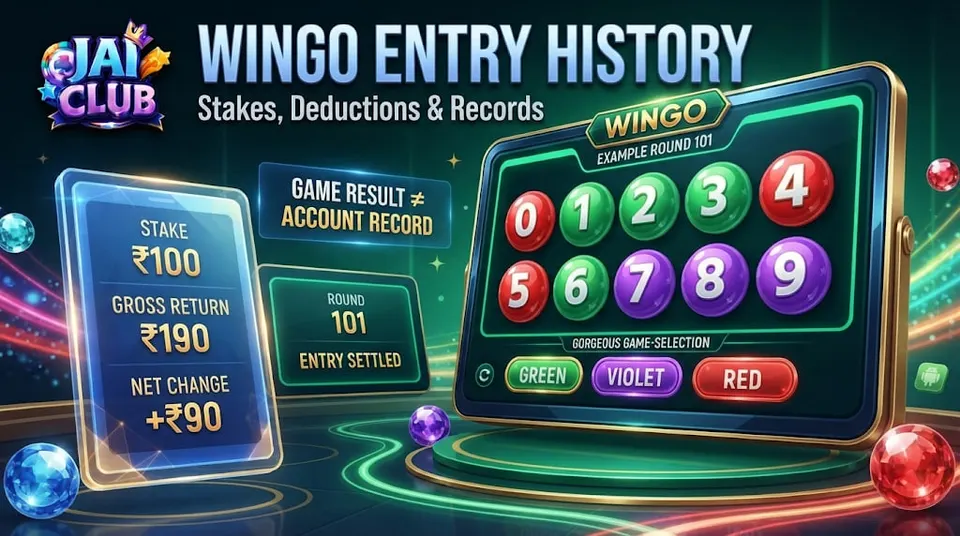
For example, imagine a fictional entry with a cost of ₹100 and a gross return of ₹190.
The net change attributable to that entry would be:
₹190 − ₹100 = ₹90
The ₹190 is not the same as ₹190 in net profit.
The example assumes that no separate fee or adjustment applies.
Example Wingo Entry Record
Consider the following fictional entries.
| Period | Stake | Gross return | Net change | Example status |
|---|---|---|---|---|
| EXAMPLE-101 | ₹100 | ₹190 | +₹90 | Settled |
| EXAMPLE-102 | ₹100 | ₹0 | −₹100 | Settled |
| EXAMPLE-103 | ₹50 | Not established | Not established | Pending |
These figures illustrate how information might be organised.
They are not real Jai Club transaction values or payout rates.
The pending example deliberately avoids assigning a result before settlement information is available.
This distinction matters because a pending entry cannot always be evaluated in the same way as a completed entry.
Why Round IDs Matter in Account History
A round ID connects a game event with a specific period.
An account record may also have its own transaction or entry identifier.
Those identifiers can be different.
If a person sees a deduction and wants to understand which round it belongs to, the correct record reference is important.
Two entries with the same stake amount may belong to different periods.
A screenshot showing only the amount does not establish the associated round.
The most reliable comparison uses the relevant account record and the corresponding completed period.
Attempted Entry vs Accepted Entry
A user may tap a selection button while the interface is loading.
That tap is an attempted action.
The remote system may need to accept and record the request before it becomes a valid entry.
If the network connection fails during submission, the user might not know whether the request was received.
The visible button press is not automatically proof of acceptance.
An accepted entry should be distinguished from an unconfirmed attempt using whatever acknowledgement and history fields the actual service provides.
This article does not invent Jai Club's acceptance or rejection policy.
Pending Entries and Completed Records
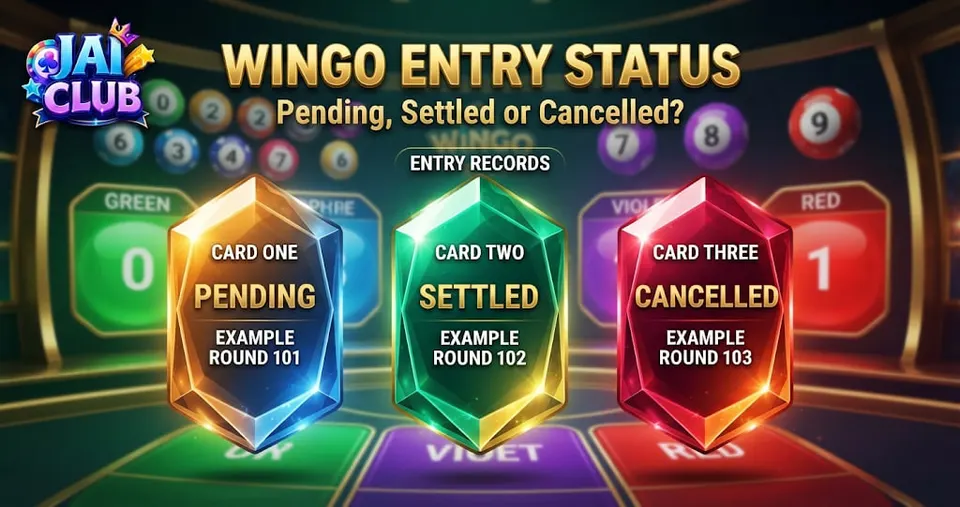
A pending entry is one whose final status has not yet been established in the displayed record.
It may be waiting for processing or settlement, depending on the service.
A completed game round does not necessarily mean every individual account transaction has already been displayed as settled.
The interface could update different information at different times.
However, a delayed status should not automatically be blamed on a particular technical cause.
The correct interpretation requires the service's relevant record and rules.
A pending label alone does not establish a successful or unsuccessful financial outcome.
Why the Result Number Is Not Enough
Suppose a completed round displays the number 4.
That tells readers something about the recorded outcome.
It does not identify the account's selection, stake, accepted entry status or actual settlement.
A user cannot determine their own financial change from the result number alone.
The relevant account action and settlement conditions are also required.
This is why result-history screenshots should not be treated as substitutes for transaction records.
A result is one part of the information, not a complete financial statement.
Understanding Balance Before and After an Entry
A balance comparison can help illustrate how transactions change an account.
For example, imagine a fictional opening balance of ₹1,000.
A ₹100 entry is accepted and debited, reducing the balance to ₹900.
A later gross return of ₹190 is credited, bringing the balance to ₹1,090.
The overall increase relative to the opening balance is ₹90.
However, this calculation is accurate only if no other transactions or adjustments occurred during the same interval.
If the account also received a deposit, withdrawal or separate debit, the simple comparison would no longer isolate the game entry.
Why Account Balance Alone Can Mislead
An account balance represents a total at a particular point in time.
It may reflect more than one transaction.
For example, a user could submit several entries in different rounds, receive a separate credit or make a withdrawal.
The final balance would combine the effects of those events.
A screenshot showing an increased balance does not independently prove which game result caused the change.
Likewise, a decrease does not establish that one particular round was responsible.
Detailed records are more useful than isolated balance screenshots.
Gross Payout Screenshots vs Financial Evidence
Promotional images sometimes show a large winning amount without describing the original stake.
This can make the result look more profitable than it actually was.
For example, a gross return of ₹2,000 and a cost of ₹1,800 would produce a net difference of ₹200, assuming no other fees.
The gross return alone does not reveal that calculation.
A screenshot may also omit losses from earlier entries.
Therefore, selected payout images cannot establish complete account profitability or reliable prediction performance.
Deductions, Fees and Adjustments
Some financial systems distinguish a submitted stake from other deductions.
Possible categories include transaction adjustments, fees or reversals.
However, no specific Jai Club fee schedule is being asserted here.
If an interface displays a deduction whose purpose is unclear, the correct explanation should come from the actual transaction description and applicable terms.
Readers should not invent a fee percentage simply by comparing two displayed amounts.
Differences may have more than one explanation.
Why Currency Symbols Matter
Indian users may encounter values displayed in rupees, but an interface's exact accounting currency should still be identified.
A number such as 100 is ambiguous without a relevant unit.
A game record might also use points, tokens or another representation under its rules.
Therefore, an account entry should not automatically be interpreted as ₹100 unless the currency or unit is actually established.
All rupee values in this guide are fictional calculation examples.
They do not certify the denomination used by any particular Wingo service.
Entry History and Internet Interruptions
Network interruptions can create uncertainty when a user submits an action.
The screen may freeze before an acknowledgement appears.
After reconnection, an account might show a new transaction, or the attempt may remain unconfirmed.
The actual status depends on whether the remote service received and accepted the action.
Repeated tapping can make the situation harder to interpret.
The user should distinguish a visible tap from an accepted transaction and rely on the authenticated history rather than guess.
Why Duplicate-Looking Entries Need Careful Reading
Two entries may have the same amount and similar timestamps.
That does not automatically mean the account was charged twice for one action.
They may be separate accepted requests, or the interface may display information in a confusing way.
A meaningful comparison uses transaction identifiers, periods and status information.
If the relevant records genuinely conflict, the issue requires investigation.
A cropped screenshot without the identifiers may not provide enough context for a confident conclusion.
Wingo Entry History and Prediction Claims
An entry history describes past account actions.
It does not automatically provide a method for forecasting future Wingo results.
Some people may analyse past entries and outcomes to identify patterns.
However, success in a selected group of previous rounds does not establish that the same strategy will work later.
Financial performance also depends on the complete set of accepted entries and their costs.
An analysis that includes only successful examples is incomplete.
Privacy and Account Security
Transaction histories can contain sensitive account details.
Readers should avoid publishing complete personal identifiers, private references or authentication information.
OTP codes, passwords and recovery credentials should never appear in public screenshots.
A person offering to explain a transaction does not need unrestricted access to the account.
Only independently verified support channels should receive information necessary to investigate a legitimate issue.
The privacy of account records matters as much as their mathematical interpretation.
Frequently Asked Questions
What is a Wingo entry record?
It is information associated with an account's participation in a particular game period, where such records are provided.
Is entry history the same as result history?
No. Entry history concerns account actions, while result history concerns completed game outcomes.
What does stake mean?
It is the amount committed to an entry under the applicable rules.
Is gross return the same as net profit?
No. Relevant costs must be subtracted to calculate the net change.
Why might an entry show pending?
The transaction or settlement may not yet have a completed displayed status.
Does a button tap prove an entry was accepted?
No. An appropriate acknowledgement or recorded status is needed.
Can two entries have the same stake amount?
Yes. Matching amounts do not necessarily indicate duplicate transactions.
Does a result screenshot prove a financial payout?
No. It does not establish the account's complete transaction history.
Can entry history predict future Wingo outcomes?
No reliable prediction follows from records alone.
Are the amounts in this article actual Jai Club rates?
No. All calculations are fictional examples.
Conclusion
Wingo entry records, game results and account balances describe different parts of an online game system.
The result identifies what happened in a period. The entry record may describe a submitted account action. The financial history can show deductions, credits and settlement status.
Understanding these distinctions helps prevent confusion about stakes, gross returns and net account changes.
Readers should examine complete authenticated records rather than relying on selected screenshots or incomplete calculations.
For general Wingo terminology, visit the Jai Club Wingo Guide.
Editorial note: All transactions, rupee amounts, round identifiers and settlement examples in this guide are fictional. No actual Jai Club account records or payout rates are verified here.