Wingo Result History Gaps: Missing Periods vs Delayed Updates
Understand why a Wingo result-history table may appear to skip a period, how delayed updates differ from missing results, and why a partial screen cannot prove that a round was removed.
In this article
- What Is a Wingo Result-History Gap?
- Period Numbers Are Identifiers
- EXAMPLE: A History Table With a Gap
- Delayed Updates vs Missing Records
- How Network Interruptions Affect History
- Pagination Can Hide Earlier Periods
- Filters and Game Modes
- Current Round vs Completed Round
- Why Screenshots Can Mislead
- EXAMPLE: Two Screenshots From the Same Phone
- History Gaps and Colour Results
- Can a Missing Period Be Reconstructed?
- When a Gap Becomes a Genuine Concern
- How to Organise Historical Records
- Result Gaps Are Not Prediction Signals
- Frequently Asked Questions
- Why is a Wingo period missing from history?
- Does a missing row prove that the result was deleted?
- Can a period appear after refreshing?
- Do all Wingo period numbers increase by one?
- Can an incomplete screenshot prove a missing round?
- Can the missing result be inferred from neighbouring colours?
- Is a current round supposed to appear in completed history?
- What should be preserved when documenting a gap?
- A Gap Should Remain a Gap Until the Record Is Found
A Wingo result-history table is useful because it allows readers to connect completed number results with their corresponding game periods. When every row appears in the expected order, the records are relatively easy to follow.
Confusion begins when a period seems to be missing.
A history screen might show one round, skip the next visible identifier and continue with a later round. In another situation, the missing period may appear after the page refreshes.
These two situations do not necessarily mean the same thing.
Quick answer: An apparent gap in Wingo result history may result from delayed loading, pagination, filtering, an incomplete screenshot or a genuine inconsistency in the displayed records. A missing row on one screen does not by itself prove that a completed game round was deleted.
This guide explains how to interpret missing-period claims carefully and why the complete period identifier matters more than the visual spacing between rows.
What Is a Wingo Result-History Gap?
A result-history gap is an apparent absence of one or more expected entries in a sequence of recorded rounds.
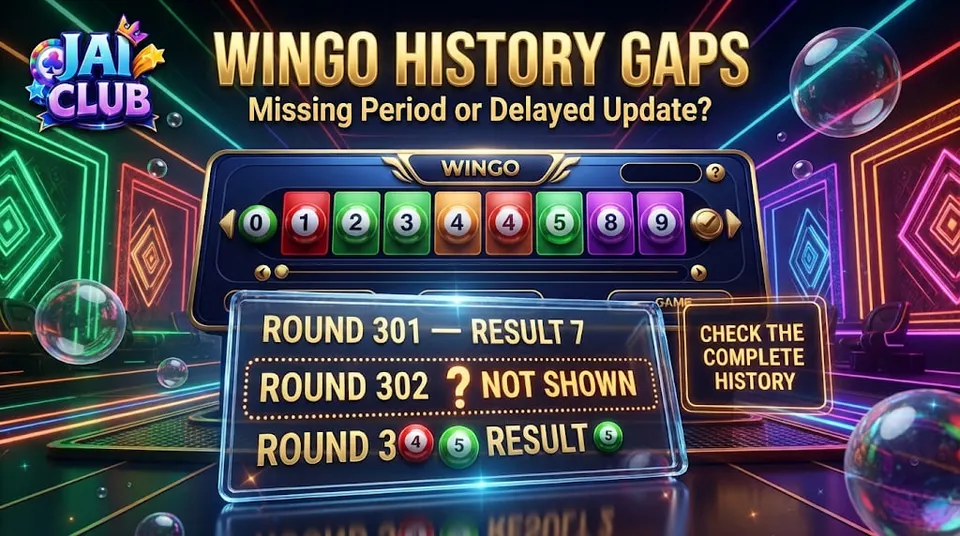
Suppose a fictional history displays EXAMPLE-301 and EXAMPLE-303 but does not display EXAMPLE-302.
A reader may call this a missing period.
However, the displayed numbers alone do not establish the cause.
The table might be incomplete. A loading request may have failed, or the interface might be showing a filtered subset of records.
The service may also use period identifiers whose numbering rules are not obvious from the interface.
Before declaring a missing round, readers need to understand the period format and the scope of the displayed history.
Period Numbers Are Identifiers
A period number is primarily an identifier associated with a game event.
It is not necessarily a simple counter that increases by exactly one under every circumstance.
Some systems may use identifiers incorporating dates, game modes or other fields.
Therefore, a large numerical difference between two identifiers does not automatically imply that every intermediate integer represents a missing round.
The actual period-numbering convention matters.
For example, an identifier might contain a date component that changes between sessions.
Without knowing its structure, subtracting two period numbers may produce a misleading count.
EXAMPLE: A History Table With a Gap
Consider this fictional result-history extract.
| Displayed period | Result | Visible status |
|---|---|---|
| EXAMPLE-301 | 7 | Completed |
| EXAMPLE-303 | 2 | Completed |
| EXAMPLE-304 | 9 | Completed |
EXAMPLE-302 does not appear in the visible table.
That observation establishes only that its entry is not shown in this extract.
It does not establish whether the period existed, whether the result was recorded elsewhere or whether the interface failed to display it.
A careful explanation should begin with the limited evidence rather than immediately assign a cause.
Delayed Updates vs Missing Records
A delayed update occurs when information reaches or appears on a device later than expected.
A missing record describes an entry that cannot be found within the relevant record set.
The difference is important.
Suppose EXAMPLE-302 appears after a page refresh.
The original gap may have been caused by incomplete loading or a delayed interface update.
If it remains absent across relevant complete records, there may be a different issue to examine.
However, the absence must be established in the proper record set, not merely a small screenshot.
How Network Interruptions Affect History
An online game interface may request completed results from a remote service.
If the network connection becomes unstable, the device may receive incomplete or outdated information.
A history table could temporarily display earlier data while waiting for a newer response.
Different interface sections may also update at different times.
For example, the current period label might change before the history table refreshes.
This creates the appearance of inconsistent timing.
Such behaviour is technically possible, although it does not confirm the implementation of any particular Jai Club Wingo version.
Pagination Can Hide Earlier Periods
Many websites and applications divide long histories into pages or smaller result batches.
The first screen may show only the latest entries.
Older periods might require another page or a separate history view.
A cropped screenshot cannot establish whether additional records are available outside the visible area.
Pagination should therefore be considered before deciding that a round has disappeared.
The same applies to interfaces that load more entries as the user scrolls.
A limited view is not equivalent to the complete historical dataset.
Filters and Game Modes
A history panel may display entries for a particular game mode or selected time range.
If the selected filter changes, the visible periods may also change.
For example, a fictional interface could show a shorter history for one game duration than another.
The resulting lists should not be combined without checking their labels.
Two similar-looking games may use separate period sequences.
Readers should therefore confirm that they are examining the same game mode and relevant result-history scope.
A difference between filtered tables does not automatically indicate a missing outcome.
Current Round vs Completed Round
A current round and a completed round are different stages.
The current period may be visible in a countdown panel before its result becomes available.
A completed-history table may show only the periods that have reached the relevant final state.
Therefore, a period visible at the top of the game interface might not yet appear in completed history.
This can create the impression that the result is missing.
The correct comparison depends on whether the period has actually been recorded as completed.
A countdown reaching zero is not necessarily proof that every screen has finished updating.
Why Screenshots Can Mislead
A screenshot captures the visible state of a page at one moment.
It may omit the top of the table, its selected mode or the pagination controls.
The image could also be taken during an interface transition.
If the relevant identifiers are cropped out, a reader may compare results belonging to different rounds.
A screenshot is useful for documenting what was displayed, but it is not necessarily a complete record.
More context is required before drawing conclusions about missing or changed results.
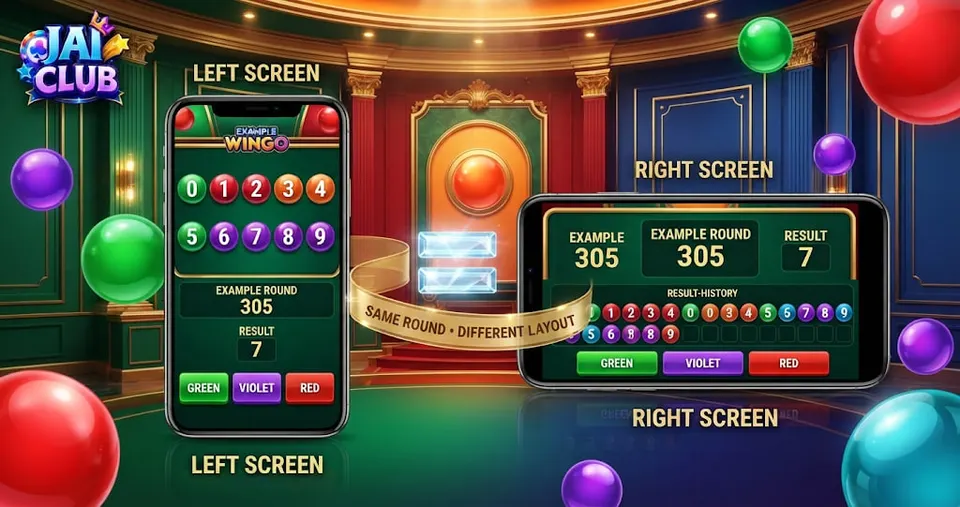
EXAMPLE: Two Screenshots From the Same Phone
Imagine one fictional screenshot taken at 15:00 showing EXAMPLE-401 as the latest completed period.
A second screenshot taken later shows EXAMPLE-403 at the top.
If EXAMPLE-402 is not visible, several explanations remain possible.
The screen might show only selected rows. A previous refresh could have failed, or the interface might have omitted an entry.
The images alone cannot establish the cause.
A better comparison would examine the relevant full history with consistent period identifiers.
The example illustrates why screenshots should be treated as observations rather than complete technical evidence.
History Gaps and Colour Results
A result-history entry may contain more than a period ID.
Some Wingo-style interfaces also show a digit and colour classification.
If a row is missing, readers may attempt to infer its result from the neighbouring colours.
That would be unreliable.
For example, a Green result followed by a Red result does not reveal the missing period's numerical outcome.
The colours of neighbouring records are not a substitute for authenticated data.
A missing result should remain unknown until appropriate evidence establishes it.
Can a Missing Period Be Reconstructed?
A period identifier might be inferred under a known sequential numbering system.
However, inferring an identifier is not the same as reconstructing its result.
A reader cannot calculate an unknown completed digit merely from neighbouring period numbers.
Likewise, a past colour pattern does not establish the missing outcome.
If a source record is genuinely unavailable, the appropriate response is to identify the gap and describe the uncertainty.
Inventing a result would make the historical dataset less reliable.
When a Gap Becomes a Genuine Concern
A display gap deserves closer investigation when the same completed period remains absent from the relevant authenticated history.
The concern becomes stronger if independent records for the same event are inconsistent.
However, identifying the cause may require technical information unavailable to the public.
A reader should distinguish a documented inconsistency from an allegation about why it occurred.
A missing row does not automatically prove manipulation.
Equally, a persistent conflict should not be dismissed without evidence.
How to Organise Historical Records
A useful historical table contains the game mode, period identifier, recorded result and any relevant timestamp.
The period should be stored accurately, without changing its format.
If the record is incomplete, the missing field can be marked as unknown rather than filled with a guess.
This prevents accidental fabrication of outcomes during data cleaning.
A spreadsheet can also include a separate note indicating where the result was observed.
Good recordkeeping matters more than producing an apparently perfect uninterrupted sequence.
Result Gaps Are Not Prediction Signals
Some online discussions interpret missing history periods as clues to future Wingo numbers.
However, the absence of a record on a screen does not establish any relationship with the next result.
A missing row could reflect a presentation issue.
Even a genuine historical data gap would not automatically create a predictive advantage.
Reliable prediction claims require evidence about the actual outcome-generation process.
A history anomaly alone does not provide that evidence.
Frequently Asked Questions
Why is a Wingo period missing from history?
Possible explanations include delayed updates, pagination, filters, an incomplete display or a genuine record discrepancy.
Does a missing row prove that the result was deleted?
No. A single incomplete history view cannot establish that.
Can a period appear after refreshing?
That is technically possible when the initial view was outdated or incomplete.
Do all Wingo period numbers increase by one?
Not necessarily. The identifier format must be understood before interpreting numerical gaps.
Can an incomplete screenshot prove a missing round?
No. It may omit records or context outside the captured area.
Can the missing result be inferred from neighbouring colours?
No reliable result follows from neighbouring colour patterns alone.
Is a current round supposed to appear in completed history?
That depends on whether it has reached the required completed state.
What should be preserved when documenting a gap?
The game mode, exact period identifier, visible record and relevant context.
A Gap Should Remain a Gap Until the Record Is Found
The most damaging mistake in historical analysis is filling missing information with an assumed result.
A reliable Wingo history can contain an explicitly marked unknown entry. That is preferable to a visually complete table containing fabricated data.
If a period appears to be missing, the immediate goal should be to establish whether the issue concerns the interface, history scope or underlying record.
For related timing behaviour, read Wingo Internet Disconnect.
Editorial note: All period numbers and results in this article are fictional. No actual Jai Club Wingo history gap or record deletion has been independently confirmed.