Moto Racing Fairness Claims: Recorded Outcomes vs Visual Race Effects
Learn why realistic motorcycle racing animations do not independently establish fair outcome generation, and how final rankings, event records and technical evidence should be interpreted.
In this article
- What Does Fairness Mean in a Digital Racing Game?
- Animation vs Result Generation
- Why Realistic Motorcycles Do Not Prove Fairness
- EXAMPLE: Two Different Game Designs
- What Does a Completed Ranking Prove?
- EXAMPLE: Visual Race vs Completed Result
- Why Result Timing Matters
- Can a Motorcycle Overtake After the Result Is Determined?
- What Does Randomness Mean?
- Does Randomness Guarantee Every Bike Has Equal Odds?
- What Is a Uniform Ranking Model?
- Individual First-Place Probability
- Can Race History Verify Fairness?
- Why Screenshot Comparisons Can Be Misleading
- What Would Stronger Fairness Evidence Include?
- Fairness vs Financial Outcome
- Can Animation Patterns Predict the Winner?
- What to Check When Records Disagree
- Frequently Asked Questions
- Does realistic racing animation prove that Moto Racing is fair?
- Can a result be determined before the animation finishes?
- Does a completed result panel prove fairness?
- Can a race look random without using a verified random process?
- Does every bike have a 10% chance of finishing first?
- Can historical results prove manipulation?
- Can a fair game still produce financial losses?
- Can an animation pattern guarantee the next winner?
- Does this article certify Jai Club Moto Racing fairness?
- Evaluate the Result System, Not the Racing Drama
A racing animation can make a digital game feel like an actual competition. Motorcycles overtake one another, the camera follows the leaders and participants cross the finish line in a dramatic sequence.
These details make the experience engaging.
However, realistic movement does not establish how the final result was generated.
A visual race and the underlying outcome-generation system are different technical components, even when they appear closely connected on the screen.
Quick answer: Moto Racing fairness cannot be verified from animations alone. A final ranking records the outcome reported by the service, while visual race effects show how that outcome is presented. Strong fairness claims require trustworthy information about how results are generated and whether the implemented rules are followed consistently.
This guide explains the difference between visual realism, random outcomes, recorded rankings and independent verification.
It does not claim that a particular Jai Club Moto Racing operator is fair or unfair.
What Does Fairness Mean in a Digital Racing Game?
Fairness can have several meanings depending on the game's rules and technical design.
For a digital game, a fairness claim may concern whether outcomes follow a declared mathematical process.
It may also concern whether the same published conditions are applied consistently to participants.
These questions are different from whether the animation looks realistic.
A visually impressive game can still have undocumented internal mechanics.
Similarly, a simple-looking interface could use a carefully specified mathematical model.
Visual quality is not a reliable measure of outcome fairness.
Animation vs Result Generation
An animation is the graphical presentation of events.
Result generation is the technical process that determines the outcome.
A game can be designed so that the software calculates an outcome and then presents an animation illustrating it.
Another design might use a simulation with its own rules and state.
Without implementation details, a viewer cannot determine which approach a specific operator uses.
Therefore, it would be inaccurate to assume that every visible motorcycle movement directly determines the final ranking.
The connection between graphics and outcomes must be established from the actual game design.
Why Realistic Motorcycles Do Not Prove Fairness
A motorcycle can lean naturally into a corner.
Its wheels can rotate, its suspension can respond and its speed can appear realistic.
These effects concern graphical rendering and animation quality.
They do not independently establish whether the final ranking was randomly generated, predetermined or calculated through another method.
The same visual scene could theoretically be produced by different underlying systems.
A game's fairness therefore cannot be inferred from realistic physics alone.
Technical evidence is required.
EXAMPLE: Two Different Game Designs
Consider two fictional racing games.
Game A selects a finishing order using a separate outcome-generation process and then plays an animation corresponding to that order.
Game B uses a simulation that calculates the participants' movements according to defined parameters and determines the ranking from the simulation.
Both could display similar motorcycle graphics.
However, their result-generation mechanisms are different.
A screenshot would not necessarily reveal which design was used.
This example demonstrates why visual similarity cannot establish equivalent fairness characteristics.
What Does a Completed Ranking Prove?
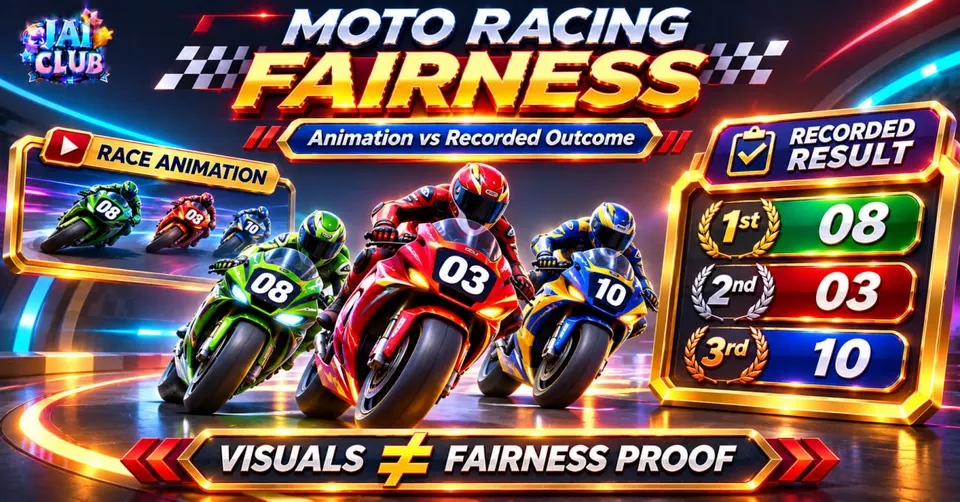
A completed ranking shows what the relevant service reports as the final order of participants.
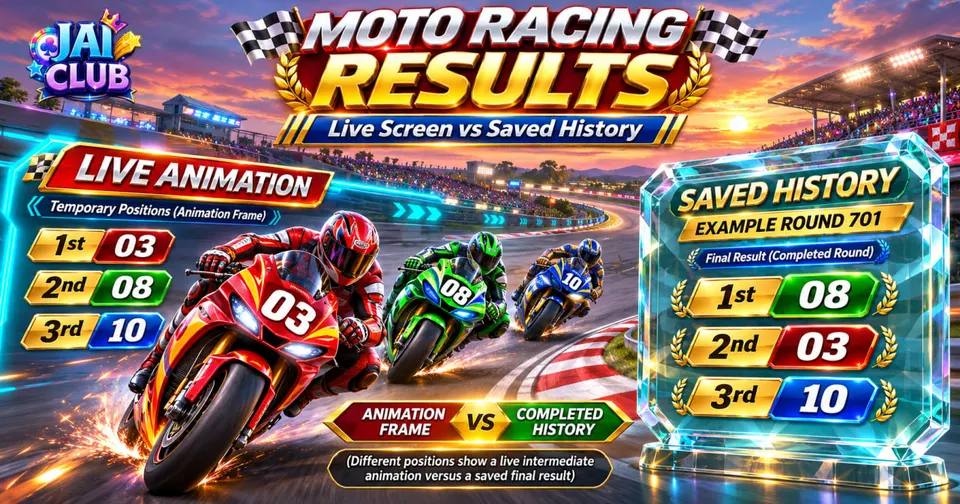
For example, a fictional result could display:
First: Bike 08
Second: Bike 03
Third: Bike 10
The record identifies the reported finishing positions.
However, it does not automatically reveal the mathematical or software process that generated them.
A result table is useful for reading the outcome, but it is not a complete audit.
EXAMPLE: Visual Race vs Completed Result
| Display | What it can show | What it does not prove |
|---|---|---|
| Mid-race animation | Temporary visual positions | Final ranking |
| Finish-line animation | Visual presentation of completion | Internal generation method |
| Result panel | Reported completed ranking | Independent fairness |
| History table | Earlier published outcomes | Future prediction accuracy |
| Technical documentation | Described system rules | That all live code follows them |
The last distinction is especially important.
Documentation can explain intended behaviour, but verifying implementation may require additional evidence.
Why Result Timing Matters
The apparent order of events can influence how a viewer interprets the race.
For example, a game might display an animation after the relevant outcome has already been determined.
In another system, the calculation may occur at a different stage.
Without technical documentation, a screenshot of the countdown or finishing animation cannot establish when the result was generated.
A viewer should therefore avoid assigning a precise outcome-generation time based only on the display.
The event timing and architecture require separate verification.
Can a Motorcycle Overtake After the Result Is Determined?
In some possible software designs, yes.
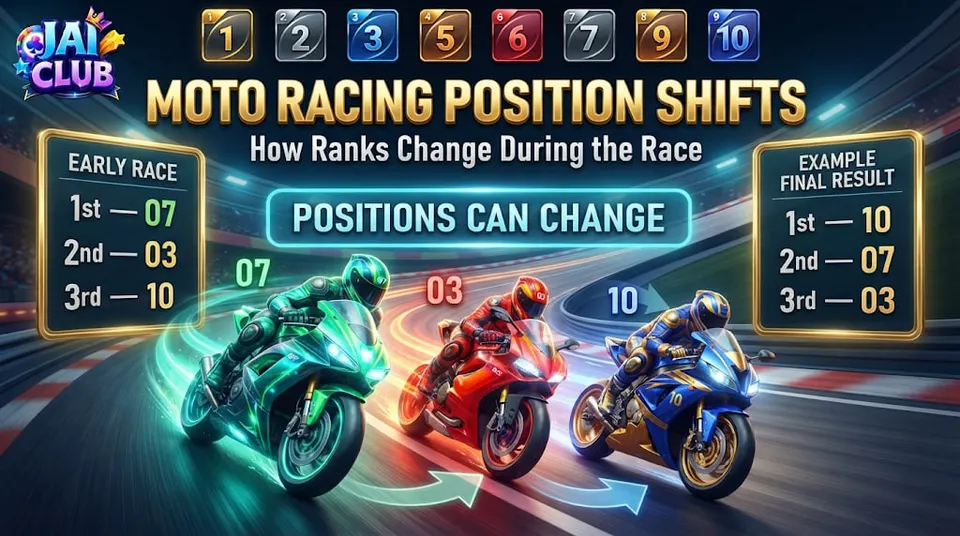
If the result is calculated before the animation, the animation can still show changing positions as part of its presentation.
However, this is an architectural possibility, not a verified Jai Club implementation.
The important point is that animated overtaking does not necessarily imply that the result is being recalculated with every frame.
An animation can create suspense independently of its underlying result logic.
The final outcome should be understood through the relevant game rules and records.
What Does Randomness Mean?
Randomness concerns uncertainty in the outcome-generation process.
A game may use a random number generator or another defined mechanism.
However, the presence of unpredictable-looking movements does not establish mathematical randomness.
A scripted animation can look unpredictable to a viewer.
Conversely, a random result can be displayed through a fixed visual sequence.
Therefore, appearance and randomness should not be treated as equivalent.
A meaningful claim requires information about the underlying model.
Does Randomness Guarantee Every Bike Has Equal Odds?
No universal conclusion can be made without knowing the game's rules.
A game could theoretically use a uniform model in which all permitted finishing orders are equally likely.
Another design might use a different distribution.
The name Moto Racing does not establish which model is used.
Even if every participant has an equal chance of a particular finishing position, proving that claim would require appropriate evidence.
A viewer cannot calculate the exact probabilities from the motorcycle graphics alone.
What Is a Uniform Ranking Model?
A useful mathematical illustration is a uniform random permutation of ten distinct participants.
Under that hypothetical model, every complete finishing order has the same probability.
There are:
10! = 3,628,800
possible complete rankings.
The probability of one particular full order is:
1/3,628,800.
However, this is only a mathematical example.
It does not establish that any particular Moto Racing game uses a uniform permutation of ten participants.
The actual outcome model may differ.
Individual First-Place Probability
Under the same hypothetical uniform ranking model, each of the ten participants would have a 1/10 probability of finishing first.
That equals 10%.
However, this figure depends entirely on the assumption that all participants are treated symmetrically.
A different mathematical model could produce different probabilities.
Therefore, the 10% figure should never be presented as the verified first-place probability of a specific Jai Club Moto Racing implementation.
It describes only the fictional uniform model.
Can Race History Verify Fairness?
A historical table can show completed outcomes.
It may help identify observed frequencies or visible inconsistencies.
However, a limited result sample cannot independently establish the complete mathematical model.
For example, one motorcycle appearing first more often in a short sample does not automatically prove bias.
Random samples naturally vary.
At the same time, persistent discrepancies may justify closer investigation.
The strength of the conclusion depends on the data quality, sample size and assumptions.
Why Screenshot Comparisons Can Be Misleading
A screenshot captures one moment.
A mid-race screenshot may show a temporary ranking.
A later screenshot may display the completed result.
Comparing them as though they were two final outcomes creates confusion.
Similarly, screenshots from different periods should not be treated as contradictory records.
The complete period identifier and interface stage are essential.
For a broader explanation of these distinctions, see: https://jaiclubgame.com/jai-club-moto-racing-result-rankings
What Would Stronger Fairness Evidence Include?
A meaningful fairness assessment would identify the actual game version and published result rules.
It would also examine the result-generation mechanism, relevant probability distribution and implementation controls.
Independent testing may provide additional confidence when the scope and authenticity of the assessment can be established.
However, a copied certification logo is not sufficient evidence.
The testing organisation, report and relevant version would need verification.
This guide does not invent or imply that a particular Moto Racing service has passed such testing.
Fairness vs Financial Outcome
A fair game does not automatically produce favourable financial results for participants.
Fairness concerns whether the game follows its defined rules.
Financial outcomes depend on the game's probability distribution, payment terms and costs.
A game could follow its published mathematical model while still having an expected financial disadvantage for participants.
Therefore, fairness and profitability should not be treated as the same concept.
A large displayed prize or exciting finish-line effect is not evidence of a positive expected return.
Can Animation Patterns Predict the Winner?
An animation may contain repeated visual sequences.
A viewer could notice that certain motorcycles seem to lead or overtake at particular moments.
However, those observations do not establish a reliable forecasting method.
The predictive value depends on how the animation relates to the underlying outcome-generation system.
Without that information, treating visual motion as a guaranteed result signal is unsupported.
A historical animation pattern should not be confused with a proven method for predicting future rankings.
What to Check When Records Disagree
A genuine discrepancy should be associated with the same completed period.
Readers should first confirm the round identifier and game mode.
Next, they should distinguish a live animation frame from the final reported ranking.
If authenticated completed records for the same period genuinely conflict, the issue deserves investigation.
However, the existence of a discrepancy does not automatically establish deliberate manipulation.
A technical explanation requires the appropriate evidence.
Frequently Asked Questions
Does realistic racing animation prove that Moto Racing is fair?
No. Visual realism does not independently verify result generation.
Can a result be determined before the animation finishes?
That is technically possible in some game designs, but a particular implementation requires verification.
Does a completed result panel prove fairness?
No. It reports an outcome but does not certify the process that generated it.
Can a race look random without using a verified random process?
Yes. Visual unpredictability and mathematical randomness are different concepts.
Does every bike have a 10% chance of finishing first?
Only under a hypothetical uniform model with ten symmetrical participants.
Can historical results prove manipulation?
Not by themselves. A valid assessment requires reliable data and appropriate statistical analysis.
Can a fair game still produce financial losses?
Yes. Fairness and financial profitability are separate issues.
Can an animation pattern guarantee the next winner?
No verified guarantee follows from visual patterns alone.
Does this article certify Jai Club Moto Racing fairness?
No. It explains the evidence needed to evaluate such claims.
Evaluate the Result System, Not the Racing Drama
A dramatic overtake, realistic finish-line animation or convincing ranking panel can make a digital race enjoyable to watch.
None of these elements independently establishes how the outcome was produced.
A meaningful fairness claim must be supported by reliable rules, an identifiable game version and evidence about the implemented result-generation process.
The visual race and the recorded result should be understood as related but distinct parts of the experience.
Editorial note: All rankings and probability examples are hypothetical. This article makes no unsupported allegation or certification about a specific Jai Club Moto Racing operator.