Moto Racing Position Shifts: Reading Rank Changes During a Race
Learn how position changes appear during Moto Racing animations, why a bike can move from first to third visually and how intermediate rankings differ from the completed race result.
In this article
- What Is a Position Shift in Moto Racing?
- Participant Number vs Position
- EXAMPLE: One Bike Changes Position
- Sample Position-Shift Timeline
- Why Overtaking Animations Can Be Misread
- Why the Leader Can Change Several Times
- Live Ranking vs Final Ranking
- Round IDs Prevent Comparison Errors
- Can a Bike Move From First to Last?
- The Importance of the Finish Line
- Can Different Devices Show Different Rank Changes?
- Missing Animation Frames
- Position Shifts and Result History
- Does a Position Shift Prove the Race Is Random?
- Can Live Position Changes Predict the Winner?
- How to Analyse a Position-Shift Screenshot
- When a Visual Mismatch Matters
- Frequently Asked Questions
- What is a Moto Racing position shift?
- Can a bike appear first and finish third?
- Does the participant number change during overtaking?
- Is a live ranking the same as the final result?
- Can two phones show different animation timing?
- Does frequent overtaking prove randomness?
- Can an animation frame predict the winner?
- Why is the round ID important?
- Is the result-history panel more useful than a paused animation?
- Are these verified Jai Club Moto Racing animation rules?
- The Last Position That Matters
Moto Racing-style games use moving motorcycles to present a competition between numbered participants.
During an animation, one bike may appear ahead of the others. A few moments later, another may take the lead.
The visible positions can change several times before the race ends.
These changes are easy to notice, but they should not automatically be interpreted as changes to an already finalised game result.
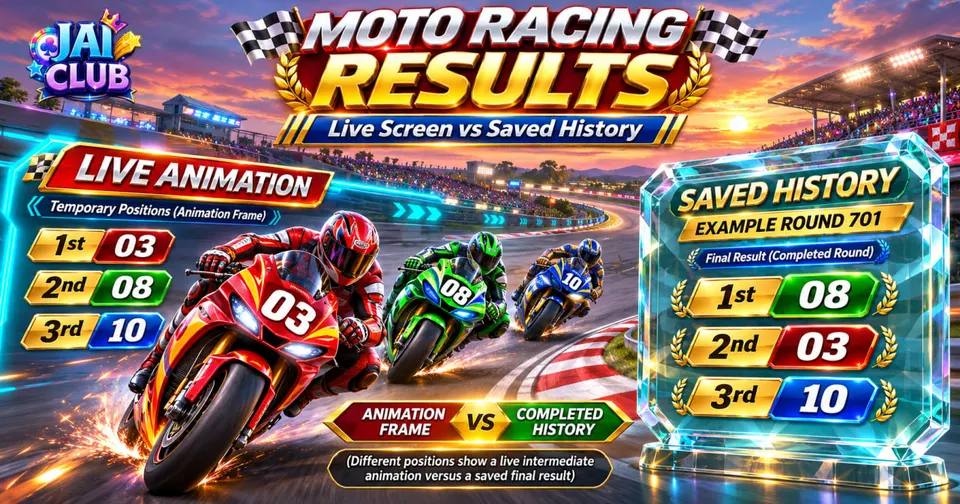
Quick answer: A position shift describes a change in the visible order of participants during a race animation. The final ranking is the recorded order associated with the completed round. Intermediate positions and final results are different kinds of information.
This guide explains overtaking visuals, participant numbers, ranking changes and why an animation frame is not enough to establish a completed result.
What Is a Position Shift in Moto Racing?
A position shift occurs when the displayed rank of a participant changes during the visual race.
For example, Bike 04 might appear first during one part of the animation and third later.
Another motorcycle may appear to overtake it.
This creates a change in the visible ranking.
However, a position shift during the animation is not necessarily a change to the game's authoritative outcome.
Depending on the software, the final result may already be determined or may be produced through another process.
The internal method cannot be identified from the animation alone.
Participant Number vs Position
A participant number identifies a motorcycle.
A position describes where that participant appears in the ranking.
For example, Bike 10 could be shown in first position.
If it later appears in fourth, its participant number remains 10.
The position has changed, but the participant identity has not.
This distinction is fundamental to reading any ranking-based race interface.
Confusing participant numbers with rank labels can make a result appear inconsistent even when the displayed information is logically correct.
EXAMPLE: One Bike Changes Position
Imagine a fictional racing animation with ten motorcycles.
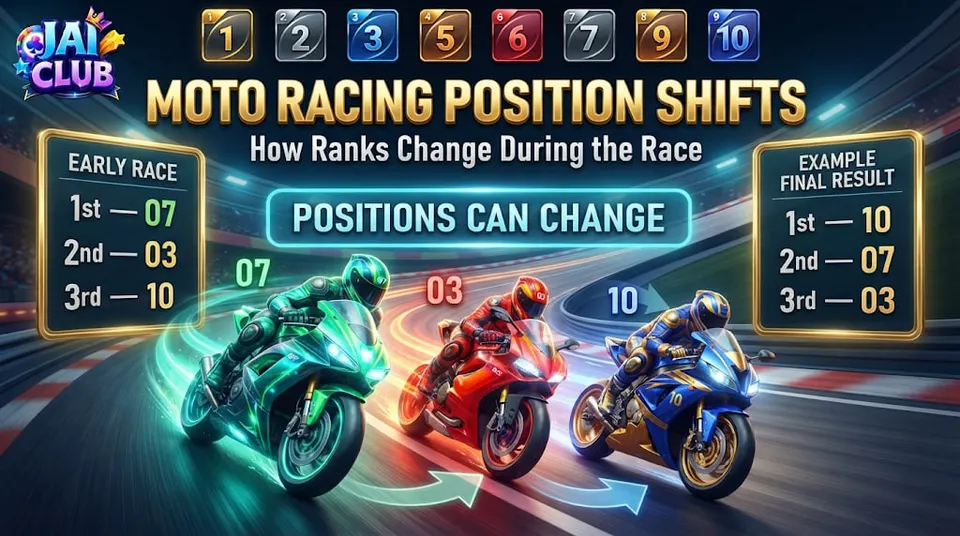
At the beginning of the visual sequence, Bike 07 appears first.
A few seconds later, Bike 03 overtakes it.
Near the end of the animation, Bike 10 moves ahead.
The positions have changed during the race.
However, the completed result has not yet been identified by the intermediate frames.
Only the final record establishes the reported finishing order for the relevant period.
The example is illustrative, not a verified description of Jai Club's internal racing engine.
Sample Position-Shift Timeline
| Animation stage | Visible 1st | Visible 2nd | Visible 3rd |
|---|---|---|---|
| Early stage | Bike 07 | Bike 03 | Bike 10 |
| Middle stage | Bike 03 | Bike 10 | Bike 07 |
| Late stage | Bike 10 | Bike 03 | Bike 07 |
| Completed record | Bike 10 | Bike 07 | Bike 03 |
All rows are fictional.
The table demonstrates how a sequence of intermediate rankings can differ from a completed result.
It does not establish that the game generates the result through physical race simulation.
The displayed motion and the authoritative result may be separate processes.
Why Overtaking Animations Can Be Misread
An overtaking animation may show motorcycles close together.
Camera perspective, motion blur and track curvature can make their exact order difficult to judge.
A small mobile screen may exaggerate this problem.
Two bikes that appear level might occupy slightly different positions within the animation.
A screenshot captured at that moment can be ambiguous.
This is why an intermediate frame should not be used as proof that a particular motorcycle finished first.
The completed ranking provides a separate record of the reported outcome.
Why the Leader Can Change Several Times
A racing animation is designed to show movement.
Changing positions creates a sense of competition and progression.
However, the number of visible overtakes does not necessarily reveal the probability of the final result.
A dramatic comeback animation may be part of the presentation rather than evidence of a particular underlying calculation.
Without technical documentation, readers should not assume that every movement corresponds to a real-time random event.
A game can present an animated sequence independently of its result-generation logic.
The exact architecture is implementation-specific.
Live Ranking vs Final Ranking
A live ranking describes the visible order at an intermediate stage.
A final ranking describes the completed outcome.
The live ranking can change while the animation continues.
The completed ranking should correspond to the relevant finished period.
For example, a live display showing Bike 04 first does not guarantee that Bike 04 will appear first in the final record.
The animation stage must be identified before interpreting the information.
An intermediate leaderboard should not be confused with historical result data.
Round IDs Prevent Comparison Errors
Each race should be associated with an identifiable period or round.
A screenshot from one period cannot be compared directly with the result of a different period.
For example, EXAMPLE-601 and EXAMPLE-602 may show similar motorcycles and layouts but completely different rankings.
If the round identifiers are hidden, a viewer might mistakenly assume the images belong to the same event.
The exact period is therefore essential when evaluating apparent rank changes.
The number of participants alone does not identify the round.
Can a Bike Move From First to Last?
A racing animation could depict substantial position changes.
However, the actual range of movements depends on the game's visual design.
Some animations may show many overtakes.
Others may be simplified.
A particular participant moving from first to last in one visual sequence does not establish a special game rule or financial condition.
The meaning of any ranking-related selection depends on the actual game's documented terms.
A dramatic change in the animation should not be treated as a guaranteed payout signal.
The Importance of the Finish Line
A finish-line animation can create the impression that the result is obvious from the visible order.
However, graphics can be difficult to interpret when motorcycles cross close together.
The final ranking may be displayed in a separate result panel.
That panel is more directly connected to the service's reported completed outcome.
Nevertheless, a final result panel is not an independent fairness audit.
It establishes what the service reported, not necessarily how the result was generated.
For a deeper comparison, read Moto Racing Animation vs Final Result.
Can Different Devices Show Different Rank Changes?
Two phones may render the same animation differently because of performance, frame rate or connection conditions.
One device might skip frames.
Another could show smoother motion.
This may influence how a viewer perceives overtaking events.
However, it does not automatically mean the final ranking differs.
A reliable comparison should use the same period and completed result record.
Differences in animation timing should be distinguished from differences in recorded outcomes.
Missing Animation Frames
A temporary connection problem may interrupt the display of racing frames.
The screen could freeze and resume later in a different-looking position.
A user might believe that several motorcycles suddenly changed rank without explanation.
In reality, the device may simply have missed part of the visual sequence.
This is one possible technical explanation, not a confirmed cause in any specific case.
For related display problems, see Moto Racing Countdown Freeze.
Position Shifts and Result History
A result history typically records completed rankings rather than every intermediate animation frame.
This means that a historical row may show the final first-, second- and third-place participants without describing who led during the animation.
The absence of intermediate positions from a history table does not necessarily mean the animation never displayed those changes.
The two views contain different kinds of information.
A complete event video and a completed history record may therefore serve different purposes.
For related recordkeeping, see Moto Racing Round History.
Does a Position Shift Prove the Race Is Random?
No.
An animation that shows frequent overtaking can appear unpredictable.
However, visual unpredictability is not the same as mathematically verified randomness.
A scripted animation could also contain position changes.
Conversely, a result-generation system could produce random outcomes while displaying them through a predetermined visual sequence.
The animation alone cannot distinguish those technical possibilities.
Claims about fairness or randomness require evidence about the actual implementation.
Can Live Position Changes Predict the Winner?
An intermediate rank does not automatically reveal the final outcome.
For example, Bike 07 appearing first halfway through an animation does not prove it will finish first.
Likewise, a bike temporarily appearing last does not establish that it cannot move ahead.
The appropriate interpretation depends on the game's actual mechanics.
If the displayed animation is simply presenting a result generated elsewhere, treating intermediate movement as a prediction method may be especially misleading.
No guaranteed forecasting claim follows from visible rank shifts alone.
How to Analyse a Position-Shift Screenshot
A screenshot can document what the interface displayed at a particular moment.
To interpret it, readers need to know the round identifier and animation stage.
They should also identify whether the displayed numbers refer to participant identities or ranking positions.
If the image claims to show a final result, it should be compared with the corresponding completed record.
A single screenshot may not reveal the full sequence of movement.
It also cannot independently establish whether the animation was genuine or edited.
When a Visual Mismatch Matters
A visible discrepancy becomes more meaningful when it involves the completed result for the same authenticated period.
For example, if two reliable completed records disagree about first place, the issue is more specific than one motorcycle appearing ahead in an intermediate animation.
Such a conflict requires investigation.
However, it should not immediately be described as deliberate manipulation without evidence.
The correct process is to identify what the records actually show and which aspects remain uncertain.
A careful comparison is more informative than an accusation based on a single frame.
Frequently Asked Questions
What is a Moto Racing position shift?
It is a change in the displayed ranking of a participant during the race animation.
Can a bike appear first and finish third?
Yes. Intermediate visual positions can differ from the final ranking.
Does the participant number change during overtaking?
No. The participant's identifier remains separate from its changing position.
Is a live ranking the same as the final result?
No. A live ranking describes an intermediate state.
Can two phones show different animation timing?
Yes. Rendering and network differences can affect visual presentation.
Does frequent overtaking prove randomness?
No. Animation behaviour does not independently establish the outcome-generation method.
Can an animation frame predict the winner?
No reliable guarantee follows from a single intermediate frame.
Why is the round ID important?
It identifies which event the animation and final ranking belong to.
Is the result-history panel more useful than a paused animation?
For interpreting the service's reported completed ranking, generally yes.
Are these verified Jai Club Moto Racing animation rules?
No. The examples explain general racing-interface concepts.
The Last Position That Matters
A racing animation may show several dramatic changes before the end.
Those movements can make the visual sequence engaging, but they do not necessarily reveal how the game generated its outcome.
When evaluating a completed round, the relevant facts are the correct period, participant numbers and final recorded ranking.
The most useful habit is to separate what the animation appeared to show from what the completed record actually reports.
Editorial note: All participant numbers, stages and rankings are fictional. This article does not claim that the actual Jai Club Moto Racing result system has been independently analysed.