
Slot Reel Strips vs Visible Symbols: Why the Screen Cannot Reveal Every Probability
Understand the difference between a slot's visible reel window and its underlying symbol arrangement or virtual reel mapping, including why screenshots cannot establish exact symbol probabilities.
In this article
- What Is a Slot Reel?
- What Is a Reel Strip?
- EXAMPLE: A Fictional Reel Strip
- Why the Visible Window Is Incomplete
- Physical Reels vs Virtual Reels
- What Is a Virtual Reel Stop?
- EXAMPLE: Equal-Looking Symbols With Unequal Weights
- A Visible Symbol Count Is Not a Probability Table
- Why Reel Order Matters
- Reel Strips and Paylines
- Why Ways-to-Win Games Can Be Different
- What About Megaways-Style Reel Heights?
- Reel Strips vs Random Number Generators
- Does the Animation Determine the Result?
- Why a Near Miss Is Not Proof of Probability
- Can Reel Strips Change During Bonus Features?
- Reel Strips and RTP
- Why Similar Slots Can Have Different Mathematics
- Can Historical Screenshots Reveal the Reel Strip?
- Why Symbol Size Does Not Indicate Probability
- Common Reel-Probability Mistakes
- Frequently Asked Questions
- What is a slot reel strip?
- Is the visible reel window the full reel strip?
- What is a virtual reel stop?
- Can symbols have different appearance probabilities?
- Does counting visible symbols reveal exact probabilities?
- Do all digital slots use fixed reel strips?
- Is a spinning animation proof of physical-style reel mechanics?
- Does a near miss make the next win more likely?
- Can two identical-looking slots have different RTP values?
- Does this article reveal Jai Club's actual slot reel mappings?
- The Screen Shows the Result, Not the Entire Model
A modern slot game may display three, five or more vertical reels filled with colourful symbols.
The player sees only the symbols appearing inside the visible game window.
However, the visible window does not necessarily reveal every symbol position, virtual stop or mathematical rule used by the game.
This distinction matters when people attempt to calculate a slot's probabilities from screenshots.
Quick answer: A reel strip is an ordered arrangement of symbols or symbol positions used in certain slot designs. The visible reel window shows only part of that arrangement. Digital slots may also use virtual stops, symbol weighting or other mathematical systems. As a result, visible symbol counts alone cannot reliably establish the actual outcome probabilities.
This guide explains reel-strip concepts, visible symbols, virtual mappings and the limitations of screenshot-based analysis.
The examples describe possible slot architectures, not independently verified mechanics of a specific Jai Club slot.
What Is a Slot Reel?
A reel is a vertical or otherwise arranged display area containing game symbols.
Traditional slot machines used physical spinning reels.
Modern video slots commonly use digital graphics to display reel movement and outcomes.
The visible reel may show several symbol positions at once.
For example, a five-reel slot with three visible rows displays fifteen positions in its main game window.
However, these visible positions do not necessarily describe the entire mathematical structure of the game.
The screen is a presentation of the outcome, not a complete probability specification.
What Is a Reel Strip?
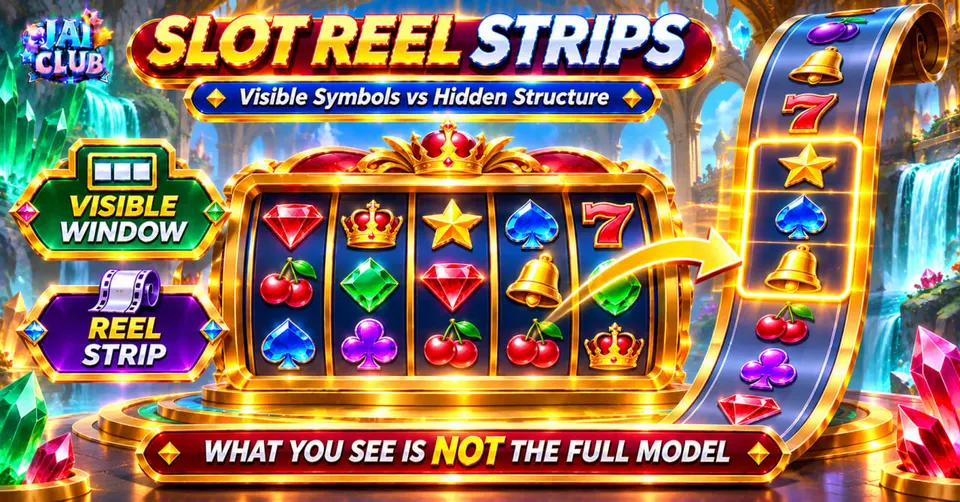
A reel strip is an ordered sequence of symbol positions associated with a reel in some slot designs.
Imagine a fictional reel strip containing twenty positions.
Each position contains a particular symbol, such as a gem, crown or star.
A reel stop determines which part of that strip appears in the visible window.
If the game shows three symbols at once, the displayed window may represent three adjacent positions from the underlying strip.
The full reel strip can be longer than the visible window.
However, not every modern slot uses a simple fixed physical-style strip.
EXAMPLE: A Fictional Reel Strip
Consider a simplified reel containing ten positions.
| Reel position | Symbol |
|---|---|
| 1 | Ruby |
| 2 | Emerald |
| 3 | Crown |
| 4 | Ruby |
| 5 | Sapphire |
| 6 | Emerald |
| 7 | Star |
| 8 | Ruby |
| 9 | Crown |
| 10 | Sapphire |
If the game displays three adjacent positions, a particular stop might show:
Ruby — Sapphire — Emerald.
Another stop could show:
Emerald — Star — Ruby.
The visible window changes according to the selected position.
This example assumes a circular reel strip with defined ordering.
It does not describe an actual Jai Club slot.
Why the Visible Window Is Incomplete
A screenshot might show three symbols on each reel.
However, it does not reveal every possible reel-strip position.
The hidden positions could contain different frequencies of symbols.
For example, the visible window might display one crown even if the underlying strip contains several crowns.
Alternatively, a crown could appear frequently in screenshots without being common across the complete mathematical model.
The visible result alone cannot establish the full arrangement.
A screenshot documents what appeared, not every possible stop.
Physical Reels vs Virtual Reels
A physical reel has a fixed arrangement of symbols around its circumference.
Traditional mechanical stops correspond to positions on that reel.
A digital game can represent reels through software.
Some games may simulate a physical-style arrangement.
Others may use virtual stops, weighted mappings or more complex methods for determining the final symbol display.
The exact architecture depends on the game.
Therefore, a digital spinning animation does not prove that the underlying system uses the same probabilities as a physical reel.
What Is a Virtual Reel Stop?
A virtual stop is a software-defined position or outcome state associated with a reel.
The game may use a random number generator to select a virtual stop.
A mapping can then determine which symbol arrangement is displayed.
In some designs, multiple virtual stops may correspond to the same visible symbol or position.
This can produce different probabilities from those suggested by counting artwork alone.
However, virtual mapping methods vary significantly.
A guide should not assume that every digital slot uses one specific virtual-reel arrangement.
EXAMPLE: Equal-Looking Symbols With Unequal Weights
Imagine a fictional virtual reel with 100 equally likely stop values.
Suppose the mapping assigns:
| Symbol | Virtual stop values |
|---|---|
| Ruby | 40 |
| Emerald | 30 |
| Sapphire | 20 |
| Crown | 10 |
| Total | 100 |
In this simplified model, Ruby corresponds to 40% of the virtual stops.
Crown corresponds to 10%.
However, the visible interface might show four beautifully designed symbol types without revealing those weights.
This demonstrates why the apparent visual importance of a symbol does not establish its probability.
The figures are hypothetical and not taken from any real game.
A Visible Symbol Count Is Not a Probability Table
A screenshot may contain many ruby symbols and only one crown.
This does not establish the probability of either symbol in future outcomes.
The screenshot represents a single displayed result.
Even many screenshots may not reveal the complete mapping, especially when outcomes are correlated or features operate under different rules.
The probability model may also depend on reel position, game state or other conditions.
Therefore, simply counting displayed icons is insufficient for a reliable mathematical conclusion.
Why Reel Order Matters
In a traditional strip-based model, the sequence of symbols affects which symbols can appear together in a multi-row window.
For example, a strip containing Ruby, Emerald and Crown consecutively can display those symbols together when the window covers the corresponding positions.
If the same symbols are arranged in a different order, the possible visible combinations change.
Therefore, knowing symbol frequency alone may not be enough.
The arrangement of symbols around the reel can also matter.
This is one reason why a true reel-strip analysis requires more information than a simple symbol inventory.
Reel Strips and Paylines
A payline is a defined path through visible positions used to evaluate matching symbols in some slots.
The payline does not necessarily describe the complete reel strip.
A five-reel slot may display several paylines across its visible window.
However, the probability of a particular combination depends on the underlying outcome distribution and relevant rules.
The visible path alone does not establish those probabilities.
A game can also use other evaluation systems, such as ways-to-win or cluster-based arrangements.
These should not be confused with a traditional payline model.
Why Ways-to-Win Games Can Be Different
Some slot games evaluate matching symbols across adjacent reels without relying on individually drawn paylines.
The number of visible symbol positions may affect how many matching routes are possible.
However, a larger ways count does not automatically imply higher RTP or a more favourable expected outcome.
The mathematical model still determines the actual probabilities and rewards.
A game may also change the number of visible reel positions during certain features.
Therefore, the meaning of the visible layout depends on the relevant game rules.
What About Megaways-Style Reel Heights?
Certain slot designs allow the number of visible positions on individual reels to vary.
When the reel heights change, the number of potential symbol routes may change as well.
However, the displayed ways count is not a direct measure of the probability of a winning result.
It describes possible ways to form combinations under the relevant evaluation system.
A larger number of routes does not establish that a particular round will be profitable.
The underlying symbol distribution and payout rules remain important.
This is another example of why screen layout cannot fully describe the mathematical model.
Reel Strips vs Random Number Generators
A random number generator produces values used by a game's outcome system.
The reel or symbol mapping determines how those values correspond to displayed results.
These are related but different components.
A random number generator may produce uniformly distributed values while the mapping creates non-uniform symbol probabilities.
Alternatively, a game may use a different structure.
Without technical documentation, the exact relationship cannot be inferred from an animation.
A spinning reel effect is not proof of any particular random-number-generation method.
Does the Animation Determine the Result?
In some digital slot implementations, the outcome may already be selected before the reel-stop animation finishes.
The moving symbols then present that result visually.
However, the precise timing and process are implementation-specific.
A viewer cannot determine the architecture simply by watching the reels spin.
Likewise, stopping an animation at a particular visual moment does not necessarily reveal an alternative outcome.
The visible movement should be distinguished from the game's actual result-generation process.
Why a Near Miss Is Not Proof of Probability
A near miss occurs when the visible result appears close to forming a desired combination.
For example, two jackpot-related symbols might appear on a payline while another is positioned just outside it.
The display can create a strong impression that the result was close to winning.
However, physical or visual closeness does not automatically establish mathematical closeness.
A digital game's probabilities depend on its actual outcome-generation model.
Near misses should not be interpreted as evidence that a future win has become more likely.
Can Reel Strips Change During Bonus Features?
Some slot games use different reel configurations or symbol sets during particular features.
For example, a bonus stage may introduce additional wild symbols or change how reels behave.
Other games may retain the same structure.
The actual design depends on the title.
This means a reel-strip analysis of the base game might not describe every bonus-stage condition.
A reliable explanation must identify the exact game state being analysed.
A screenshot without that information can be misleading.
Reel Strips and RTP
Return to Player is calculated from a game's complete mathematical model.
The model may include symbol probabilities, combination payouts, bonus features and other relevant mechanics.
A reel strip can be one part of that structure.
However, knowing the visible symbols does not establish the complete expected return.
Even access to a physical-style reel strip may be insufficient when virtual mappings or additional game features are involved.
A specific RTP claim requires trustworthy information about the full applicable configuration.
Why Similar Slots Can Have Different Mathematics
Two slots can use the same artwork, symbols and animations while relying on different mathematical settings.
For example, their virtual mappings or other outcome parameters may differ.
The visible result screens could therefore look almost identical.
However, their theoretical probabilities or expected returns might not be the same.
This is why a game title or familiar symbol design is not always enough to identify the mathematical version.
A precise technical comparison requires verified configuration information.
Can Historical Screenshots Reveal the Reel Strip?
A large collection of screenshots may support descriptive analysis of observed symbols.
However, reconstructing a complete reel strip or virtual mapping can be difficult or impossible from those observations alone.
The data may not reveal hidden states or special feature conditions.
The screenshots may also be incomplete or selected rather than representative.
A statistical estimate should not be presented as the verified internal configuration.
The limits of the available evidence must be acknowledged.
Why Symbol Size Does Not Indicate Probability
A large gold crown may appear visually more important than a small gemstone.
However, graphic size and visual emphasis are design choices.
They do not establish the crown's appearance frequency.
Similarly, a glowing special symbol is not necessarily more common or less common because of its appearance.
The probabilities are determined by the actual mathematical model.
A visually dominant icon can be rare, common or subject to special rules.
Its design alone cannot answer that question.
Common Reel-Probability Mistakes
One mistake is counting symbols visible in a screenshot and treating the count as a complete probability distribution.
Another is assuming that all digital slots use equal-weight physical-style reels.
Some readers also confuse paylines with underlying reel strips.
Others interpret near misses as evidence that a win is due.
A final mistake is assuming that identical artwork guarantees identical mathematical configurations.
These errors can be avoided by separating visible presentation from documented outcome mechanics.
Frequently Asked Questions
What is a slot reel strip?
It is an ordered sequence of symbol positions used in certain reel-based slot designs.
Is the visible reel window the full reel strip?
Not necessarily. The window may display only a small portion of the underlying arrangement.
What is a virtual reel stop?
It is a software-defined stop or outcome position used in some digital slot implementations.
Can symbols have different appearance probabilities?
Yes, depending on the game's mapping and mathematical design.
Does counting visible symbols reveal exact probabilities?
No. Screenshots do not necessarily expose all underlying stops or weights.
Do all digital slots use fixed reel strips?
No. Implementations vary.
Is a spinning animation proof of physical-style reel mechanics?
No. The animation may be separate from the outcome-generation process.
Does a near miss make the next win more likely?
Not automatically. Visual closeness is not evidence of increased future probability.
Can two identical-looking slots have different RTP values?
Yes, if different mathematical configurations are available.
Does this article reveal Jai Club's actual slot reel mappings?
No. The examples are educational and do not claim access to proprietary game mathematics.
The Screen Shows the Result, Not the Entire Model
A slot display can reveal which symbols appeared and how the game presented them.
It does not necessarily reveal every possible stop, symbol weight or feature condition used to produce the outcome.
That distinction is essential when interpreting screenshots, RTP claims and visible near misses.
Reliable probability analysis requires the actual mathematical structure, not assumptions based on reel artwork.
For a related explanation of reel behaviour, read: https://jaiclubgame.com/slot-cascading-reels-falling-symbols-explained
Editorial note: Every reel strip, virtual-stop distribution and symbol example is fictional. No specific Jai Club slot algorithm, reel weighting or RTP configuration is independently verified here.