
Slot RTP Versions: Why Similar-Looking Games Can Have Different Settings
Two slot games may look identical but use different mathematical configurations. Understand RTP versions, game identifiers, theoretical returns and the limits of visual comparisons.
In this article
- What Does RTP Mean in a Slot Game?
- Can the Same Slot Have Different RTP Versions?
- EXAMPLE: Two Fictional RTP Configurations
- Why a Two-Percentage-Point Difference Matters
- A Game Name Is Not a Complete Version Identifier
- Game Version vs RTP Configuration
- What Can a Game Information Screen Establish?
- Why Screenshots Are Limited Evidence
- Does a Certification Logo Prove the RTP?
- RTP and Volatility Are Different
- RTP vs Hit Frequency
- Does a Different RTP Change Every Spin?
- Can Past Results Reveal the RTP Version?
- RTP Claims on Third-Party Websites
- Does a Higher RTP Guarantee Profit?
- Are Jai Club Slot RTP Versions Verified Here?
- Frequently Asked Questions
- Can two identical-looking slots have different RTP values?
- Does the same slot name guarantee the same RTP?
- Is a 96% RTP a guarantee of receiving ₹96 after spending ₹100?
- Is RTP the same as volatility?
- Can an app update change RTP?
- Does a screenshot prove which RTP version is active?
- Does a testing logo verify every release?
- Can a few spins establish the true RTP?
- Does higher RTP guarantee winning?
- What to Compare Before Trusting an RTP Number
Two slot games can look almost identical while using different mathematical settings. Their reels may contain the same symbols, their animations may follow the same sequence, and their bonus features may have the same names.
However, visual similarity does not establish that two installations use the same Return to Player (RTP) configuration.
Quick answer: A slot title may have more than one approved mathematical configuration, depending on its developer and distribution arrangements. Different configurations can use different theoretical RTP percentages. The visible game artwork alone is not enough to verify which configuration is being used.
This article explains how RTP versions work, why accurate version identification matters, and what information can support a meaningful comparison.
What Does RTP Mean in a Slot Game?
Return to Player is a theoretical long-term measure of how much a game is designed to return relative to total stakes.
For example, a hypothetical slot with an RTP of 96% has a mathematical model in which the expected return across a sufficiently large theoretical sample is ₹96 for every ₹100 staked.
This does not mean a person who spends ₹100 will receive ₹96.
Individual outcomes may produce no return, a small return or a much larger amount.
RTP is a characteristic of a mathematical model, not a promise about a short gaming session.
Can the Same Slot Have Different RTP Versions?
Yes, some slot developers provide different mathematical configurations for the same underlying game title.
The versions may use the same theme, artwork and feature names.
However, their underlying probability distributions or other mathematical settings may differ.
This is why two slot pages with the same displayed game name do not automatically represent the same mathematics.
Whether a particular developer offers configurable RTP versions must be verified through reliable documentation.
It should never be assumed merely because a gaming website lists a percentage.
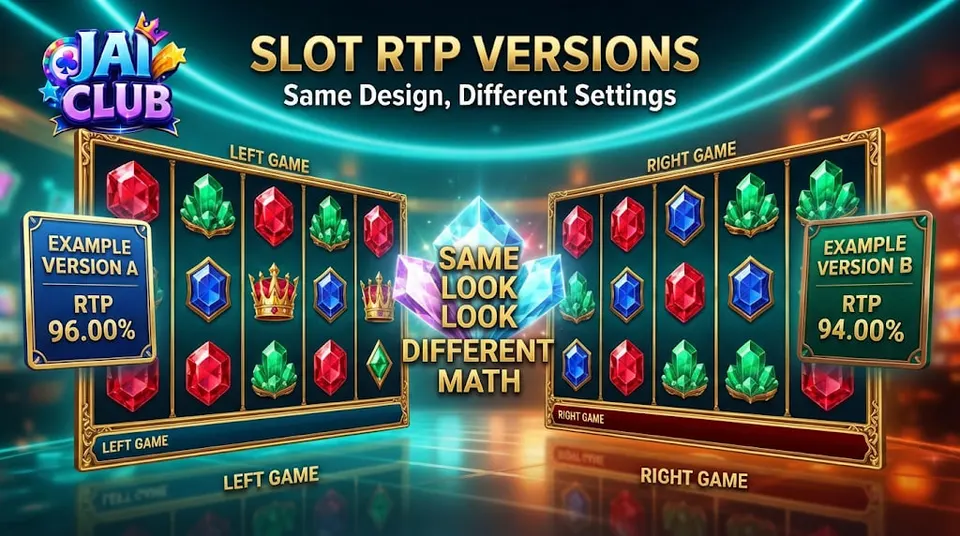
EXAMPLE: Two Fictional RTP Configurations
Imagine a fictional slot called Crystal Journey.
Its developer offers two mathematical configurations.
| Configuration | Theoretical RTP |
|---|---|
| Version A | 96.00% |
| Version B | 94.00% |
Both versions display the same gemstone reels and bonus animations.
The difference lies in their theoretical mathematical settings.
These figures are hypothetical examples. They are not the verified RTP values of a Jai Club slot or a real Crystal Journey game.
The comparison demonstrates why matching artwork cannot establish an identical theoretical return.
Why a Two-Percentage-Point Difference Matters
The difference between 96% and 94% RTP is two percentage points.
Under the simplified theoretical models, the corresponding expected house edges are 4% and 6%.
For a fictional total stake volume of ₹10,000, those models imply expected aggregate returns of ₹9,600 and ₹9,400 respectively.
The theoretical difference is ₹200.
This is an illustration of expected values, not a prediction of anyone's actual balance.
The exact realised results may vary substantially, especially over limited numbers of spins.
A Game Name Is Not a Complete Version Identifier
A slot's displayed title may identify its theme or product family.
However, more specific technical information may be required to establish the exact implementation.
Depending on the developer, that information could include a game identifier, mathematical configuration, release version or documented RTP value.
Different software releases may also change non-mathematical elements such as the interface.
Therefore, not every version number indicates an RTP change.
The relevant information must identify the actual mathematical model, not simply a general application update.
Game Version vs RTP Configuration
A software version can describe changes to code, graphics or compatibility.
An RTP configuration describes the game's theoretical return model.
These concepts can overlap, but they are not identical.
For example, a developer might release an interface update without changing the RTP.
Conversely, different mathematical configurations could share almost identical visual designs.
A reader should not treat an app version string as conclusive evidence of a specific payout model.
A valid comparison requires documentation linking the actual game configuration to the stated RTP.
What Can a Game Information Screen Establish?
Some games provide information pages describing rules, paytables and theoretical returns.
If the information is genuinely supplied by the relevant developer or licensed implementation, it may be useful for identifying the configuration.
However, screenshots of those pages can be cropped, outdated or taken from another version.
A percentage displayed in an online image is not automatically evidence that the same configuration is active on a different website.
The source, version and scope must be considered together.
Why Screenshots Are Limited Evidence
Imagine two promotional screenshots showing the same slot name.
One displays 96% RTP and the other shows 94%.
This apparent conflict could have several explanations.
The screenshots might represent different mathematical configurations.
One could be outdated, incorrectly labelled or edited.
They may also refer to different game releases.
Without independent supporting information, the pictures do not establish which explanation is correct.
A screenshot is evidence of what was displayed, subject to its authenticity. It is not a complete technical audit.
Does a Certification Logo Prove the RTP?
Not by itself.
Testing organisations may assess game software or mathematical models within a defined scope.
However, a copied logo or certificate image does not establish that a particular live implementation uses the tested configuration.
A meaningful verification requires a genuine report or other reliable evidence identifying the tested game, version, scope and relevant findings.
Readers should not assume that a generic certification badge applies to every release of a game.
It is also important not to invent report numbers or testing results that have not been independently established.
RTP and Volatility Are Different
RTP describes a theoretical long-term average.
Volatility concerns the variation in the size and frequency of outcomes.
Two games could theoretically have similar RTP values while producing different patterns of returns.
A game may have frequent smaller outcomes or less frequent larger ones.
Therefore, the RTP percentage alone does not explain the complete experience of a slot.
The underlying distribution matters.
A claim about RTP should not be presented as a complete measure of financial risk.
RTP vs Hit Frequency
Hit frequency is commonly used to describe the proportion of spins producing a defined type of winning outcome.
It is not interchangeable with RTP.
For example, two hypothetical games might return the same total expected amount through different combinations of result frequency and payment size.
A higher hit frequency does not necessarily mean higher theoretical RTP.
Likewise, a higher RTP does not guarantee more frequent winning spins.
These are distinct mathematical characteristics.
Does a Different RTP Change Every Spin?
Not necessarily.
Different configurations may alter the overall mathematical distribution without changing every visible mechanic.
A particular symbol combination could still exist in both versions.
However, the probabilities, payout values or other features may differ according to the actual design.
The exact mechanism cannot be inferred merely by comparing a few spins.
A large theoretical sample and reliable technical documentation are needed to understand the configuration.
Can Past Results Reveal the RTP Version?
A small history of completed spins cannot reliably identify the exact theoretical RTP.
Short sequences are heavily influenced by variation.
A player might experience several favourable outcomes in a lower-RTP configuration or several poor outcomes in a higher-RTP configuration.
Neither experience changes the underlying model.
Trying to identify a mathematical configuration from a few screenshots or anecdotal results can produce misleading conclusions.
The correct approach is to seek trustworthy version-specific information.
RTP Claims on Third-Party Websites
A website might publish a familiar slot title alongside a specific RTP percentage.
However, the origin of that figure may be unclear.
It could refer to one of several developer configurations, a different market or an outdated release.
A page that does not identify its source should not be treated as definitive technical evidence.
Similarly, a promotional claim of an unusually high RTP requires verification.
A trustworthy explanation distinguishes publicly documented figures from estimates or unverified advertising.
Does a Higher RTP Guarantee Profit?
No.
A theoretical RTP is not a guaranteed account result.
For example, a 96% model still has an expected loss of 4% of total stakes under its assumptions.
Individual outcomes can vary widely.
A higher theoretical return is not proof that a particular session will be profitable.
The risk of losing the entire amount staked can remain significant.
RTP should therefore be understood as a property of the model, not as a strategy for guaranteed winnings.
Are Jai Club Slot RTP Versions Verified Here?
No specific Jai Club slot configuration is being certified in this article.
The purpose is to explain how different mathematical versions can exist and why visual comparisons are insufficient.
A valid claim about a particular game would require its exact identity and reliable configuration-specific documentation.
Without such evidence, the correct conclusion is that the active RTP version remains unverified.
For related slot mechanics, read Slot Cascading Reels Explained.
Frequently Asked Questions
Can two identical-looking slots have different RTP values?
Yes, if their developer offers different mathematical configurations.
Does the same slot name guarantee the same RTP?
No. The title alone may not identify the exact configuration.
Is a 96% RTP a guarantee of receiving ₹96 after spending ₹100?
No. It describes a theoretical long-term expectation.
Is RTP the same as volatility?
No. RTP concerns theoretical return, while volatility concerns the distribution of outcomes.
Can an app update change RTP?
A particular update could change a configuration, but not every software update changes the mathematics.
Does a screenshot prove which RTP version is active?
Not independently. The exact configuration and source need verification.
Does a testing logo verify every release?
No. The actual testing scope and relevant version matter.
Can a few spins establish the true RTP?
No. Limited samples are not reliable evidence of an exact theoretical return.
Does higher RTP guarantee winning?
No. Individual outcomes remain uncertain.
What to Compare Before Trusting an RTP Number
The useful comparison is not simply between two percentages displayed on separate websites.
It is between clearly identified game configurations supported by reliable documentation.
A correct version reference, genuine developer information and a clearly defined testing scope provide stronger evidence than visual similarity.
If these details are missing, an RTP claim should remain unverified rather than being presented as a confirmed fact.
Editorial note: All RTP percentages and rupee examples are fictional mathematical illustrations. No specific Jai Club slot version or certification has been independently verified.