K3 Triple Numbers Explained: 111 Se 666 Tak Dice Results Ka Maths
Understand K3 Lottery triple numbers from 111 to 666, how three matching dice work, why triples differ from doubles and ordinary combinations, and what their theoretical probabilities mean.
In this article
- K3 Triple Numbers Ka Matlab
- K3 Triple Number List: 111 to 666
- Why There Are Only Six Triple Combinations
- Triple vs Double: Same Nahi Hai
- K3 Triple Sum Calculation
- Same Sum, Different Dice
- Total Possible K3 Outcomes
- Probability of One Specific Triple
- Probability of Any Triple
- K3 Triple vs Ordinary Three-Dice Results
- Why Triple Results Look Rare
- Triple Numbers Aur Prediction Claims
- K3 Triple Result History Kaise Read Karein
- Can Digital K3 Results Be Different From Physical Dice?
- Triple Result and Payout Are Different Concepts
- K3 Triple Numbers FAQ
- What are K3 triple numbers?
- How many triple combinations exist?
- Is 111 a K3 triple?
- Is 666 a triple?
- Is 223 a triple?
- What is the sum of 444?
- Can another combination have the same sum as 333?
- What is the probability of any triple?
- Does a long gap make a triple more likely?
- Are these the verified Jai Club K3 probabilities?
- Conclusion
K3 triple numbers are a special mathematical category within three-dice result formats. A triple occurs when all three dice show the same value. Examples include 1-1-1, 2-2-2 and 6-6-6. These outcomes are easy to recognise, but they are different from ordinary dice combinations that contain two or three different values.
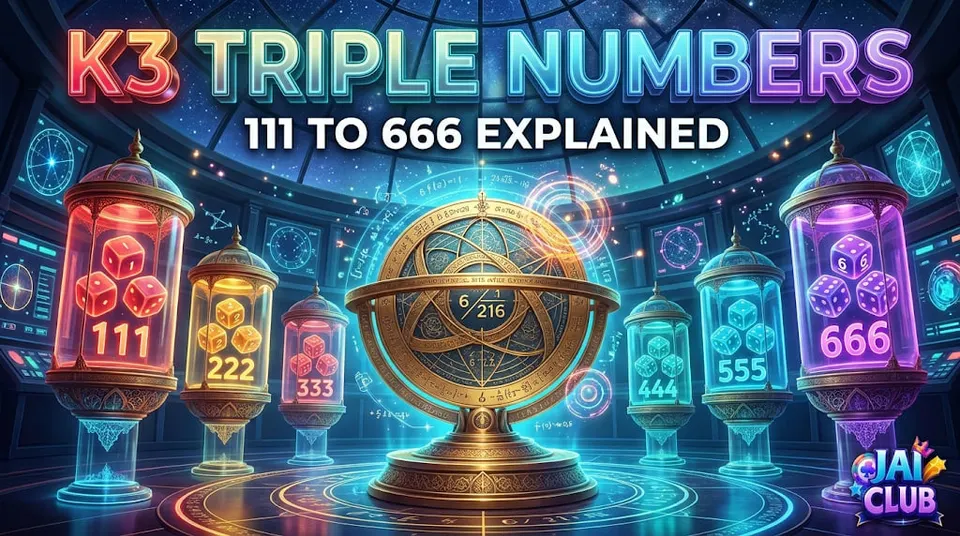
Quick answer: A standard three-dice format has six possible triple combinations: 111, 222, 333, 444, 555 and 666. Under the mathematical model of three independent, fair, six-sided dice, there are 216 possible ordered outcomes, and only six of them are triples.
This guide explains how K3 triple results work, their sums, the difference between triples and doubles, and the probabilities involved in a standard mathematical model. The article does not claim to verify the actual random-number system or payout structure of a particular Jai Club K3 game.
K3 Triple Numbers Ka Matlab
A triple means that all three dice display an identical face value.
For example, a result of 4, 4 and 4 is a triple because every die shows 4.
By contrast, a result of 4, 4 and 5 is not a triple. It contains two matching values and one different value.
A result of 2, 4 and 6 is also not a triple because all three values differ.
The definition concerns the relationship between the three dice, not just the sum of their values.
K3 Triple Number List: 111 to 666
A standard six-sided die can show values from 1 to 6. If all three dice must match, each permitted face value creates one possible triple.
| Triple result | Dice values | Sum |
|---|---|---|
| 111 | 1 + 1 + 1 | 3 |
| 222 | 2 + 2 + 2 | 6 |
| 333 | 3 + 3 + 3 | 9 |
| 444 | 4 + 4 + 4 | 12 |
| 555 | 5 + 5 + 5 | 15 |
| 666 | 6 + 6 + 6 | 18 |
The six results are the complete triple set under the standard three-dice model.
Their sums increase by three because each higher triple increases all three dice by one.
The table describes mathematical possibilities rather than actual game results from any particular period.
Why There Are Only Six Triple Combinations
Each of the three dice has six possible face values. For a triple, however, all dice must match.
Once the first die's value is chosen, the other two values are determined by the matching condition.
If the first die is 1, the triple must be 111. If it is 2, the triple must be 222.
Continuing this pattern through 6 produces exactly six combinations.
There are no additional triples such as 777 in a standard six-sided dice format because a die does not contain the face value 7.
This mathematical limit is independent of any prediction claim or result history.
Triple vs Double: Same Nahi Hai
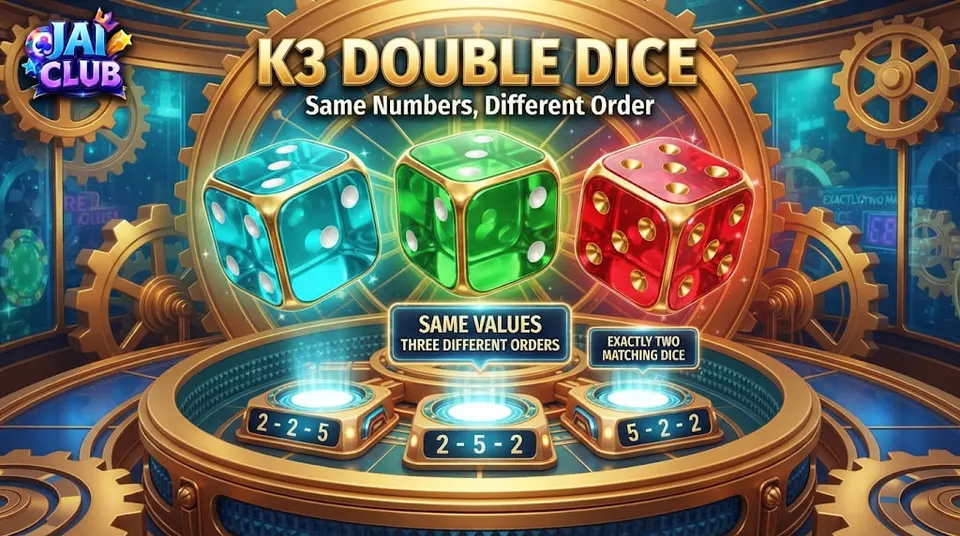
A double contains exactly two dice with the same value and a third die with a different value.
For example, 2-2-5 is a double because two dice show 2 while the third shows 5.
A triple such as 2-2-2 contains three matching dice.
These are distinct result categories.
| Result | Classification | Reason |
|---|---|---|
| 3-3-3 | Triple | All three dice match |
| 3-3-5 | Double | Exactly two dice match |
| 3-5-3 | Double | Exactly two dice match |
| 1-2-3 | All different | No matching pair |
| 6-6-6 | Triple | All three dice match |
Rearranging the position of a double does not make it a triple. The number of matching values remains the defining feature.
K3 Triple Sum Calculation
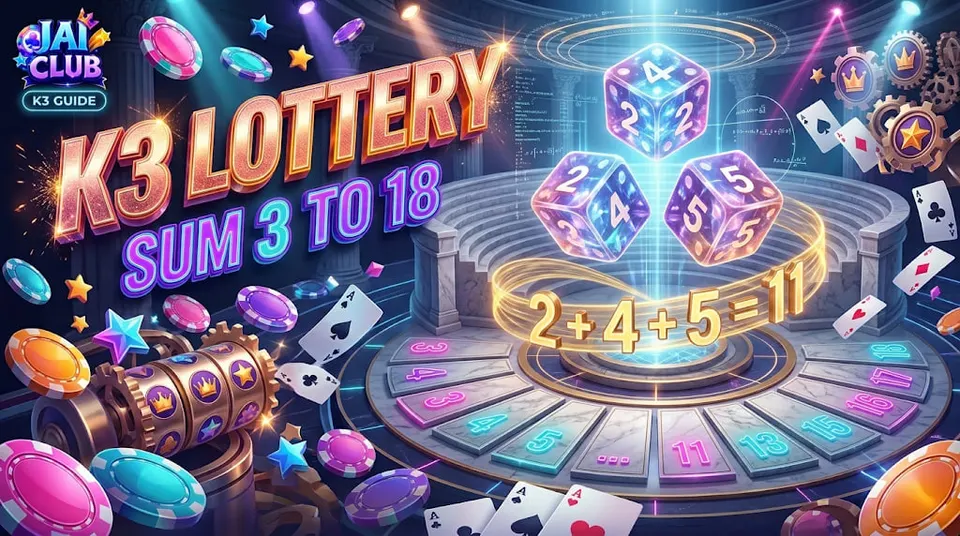
The total of a triple is obtained by adding the three identical dice values.
If the dice show 5, 5 and 5, the sum is:
5 + 5 + 5 = 15
The same calculation applies to every triple.
A 111 result has a sum of 3, while a 666 result has a sum of 18.
This explains why the six triple totals are 3, 6, 9, 12, 15 and 18.
However, the sum alone does not always identify a triple. Some of those totals can also be produced by non-triple combinations.
Same Sum, Different Dice
Consider the total 9.
The triple 3-3-3 produces a sum of 9.
However, 1-2-6 and 2-3-4 also produce a sum of 9.
The three outcomes have the same total but different dice arrangements.
This means that seeing the sum 9 is not enough to conclude that the result was a triple.
The individual dice must be examined.
The difference is especially important when an interface displays both the three numbers and a separately calculated sum.
Total Possible K3 Outcomes
Under the model of three distinguishable six-sided dice, each die has six possible values.
The number of ordered outcomes is:
6 × 6 × 6 = 216
These outcomes include triples, doubles and results where all three dice differ.
The word ordered means that the positions of the dice are considered separately.
For example, 1-2-3 and 3-2-1 are different ordered outcomes, even though they contain the same three values and have the same sum.
Triples are unusual in this structure because rearranging identical values does not create a new ordered result.
Probability of One Specific Triple
Suppose three dice are fair and their results are independent.
The probability that the first die shows 1 is one in six. The same is true for the second and third dice.
Therefore, the probability of the specific triple 111 is:
[ \frac{1}{6}\times\frac{1}{6}\times\frac{1}{6} =\frac{1}{216} ]
This is approximately 0.463%.
The same probability applies to each specified triple under the fair, independent model.
These calculations are theoretical and should not be treated as verified percentages for any particular digital game.
Probability of Any Triple
There are six possible triple outcomes among the 216 ordered outcomes.
Under the same fair, independent three-dice assumptions, the probability of obtaining any triple is:
[ \frac{6}{216}=\frac{1}{36} ]
This is approximately 2.778%.
The complementary probability of not obtaining a triple is 35/36, or approximately 97.222%.
These values describe the mathematical model. They do not establish the actual payout rules or confirm how a named gaming service generates results.
K3 Triple vs Ordinary Three-Dice Results
A triple has three identical values. A double has exactly two matching values, and an all-different result contains three distinct values.
These categories divide the 216 ordered outcomes in a fair three-dice model.
| Category | Number of ordered outcomes |
|---|---|
| Triple | 6 |
| Exactly one pair | 90 |
| All different | 120 |
| Total | 216 |
The counts can be checked mathematically.
For exactly one pair, choose the repeated value in six ways, the different value in five ways and the different die's position in three ways. This gives 6 × 5 × 3 = 90.
For three distinct values, choose the first die in six ways, the second in five and the third in four. This gives 6 × 5 × 4 = 120.
Adding 6, 90 and 120 gives 216.
Why Triple Results Look Rare
Triples occupy only six of the 216 possible ordered outcomes in the standard mathematical model.
This makes them less common as a group than results containing exactly one pair or three distinct values.
However, rare does not mean impossible. A triple can occur during any round under a model that permits all the relevant combinations.
It also does not mean that a triple must appear after a certain number of non-triple results.
Probability describes the distribution of possible outcomes, not a fixed waiting schedule.
Triple Numbers Aur Prediction Claims
Historical charts sometimes highlight triples because they are visually distinctive. A sequence without a triple may encourage claims that one must appear soon.
This is an example of treating an absence as a prediction signal.
In an independent process, earlier non-triple results do not force the next outcome to be a triple.
Similarly, a triple appearing in one round does not automatically make another triple more or less likely in the next round.
Any forecasting claim requires evidence about the actual result-generation mechanism.
A historical list alone cannot provide that evidence.
K3 Triple Result History Kaise Read Karein
A K3 history panel may display individual dice values, a sum and a round identifier.
To identify a triple, examine the three dice values in the completed result.
If all three match, the result meets the mathematical definition of a triple.
If the displayed sum is 12, for example, that does not prove the result was 444. Other dice combinations can also total 12.
The individual values remain essential.
For background on K3 and other game formats, see the Jai Club Games Guide.
Can Digital K3 Results Be Different From Physical Dice?
A physical three-dice demonstration uses actual dice, while a digital game may use software to determine outcomes.
The mathematical sample space can be the same when both use three values from 1 to 6. However, the distribution depends on how the actual system is implemented.
A digital interface displaying three dice does not independently prove that the underlying results are fair, independent or uniformly distributed.
Those properties require appropriate technical evidence.
Therefore, theoretical probabilities should be presented as mathematical examples rather than confirmed operator statistics.
Triple Result and Payout Are Different Concepts
A triple is a type of dice outcome. A payout is an amount calculated under the rules of a particular game selection.
The existence of a triple does not automatically establish what any participant receives.
Some gaming formats may distinguish between different triple-related categories, but the exact selection rules and multipliers must be documented.
This article does not invent Jai Club K3 payout amounts or claim that any triple provides a guaranteed financial return.
The correct approach is to separate the mathematical definition of the result from the operator's settlement conditions.
K3 Triple Numbers FAQ
What are K3 triple numbers?
They are results in which all three dice display the same value.
How many triple combinations exist?
There are six in the standard three six-sided dice model.
Is 111 a K3 triple?
Yes. All three dice show 1.
Is 666 a triple?
Yes. All three dice show 6.
Is 223 a triple?
No. It contains exactly two matching dice, making it a double.
What is the sum of 444?
The total is 12.
Can another combination have the same sum as 333?
Yes. The sum 9 can also be produced by several non-triple combinations.
What is the probability of any triple?
Under a fair, independent three-dice model, it is 1/36, or approximately 2.778%.
Does a long gap make a triple more likely?
Not in an independent model. Previous results do not force a future triple.
Are these the verified Jai Club K3 probabilities?
No. These are theoretical probabilities for three independent fair six-sided dice.
Conclusion
K3 triple numbers are simple to identify because all three dice must show the same value. The complete set is 111, 222, 333, 444, 555 and 666.
These combinations have distinct mathematical properties. Under a fair three-dice model, there are six triples among 216 ordered outcomes.
Understanding this structure helps readers interpret recorded dice results correctly, but it does not establish future predictions or guarantee a financial result.
Explore the Jai Club Games Guide for further explanations of K3 and other number-based game formats.
Editorial note: All calculations are based on the mathematical model of three independent fair six-sided dice. They do not certify the random-number system or payout conditions of any specific Jai Club K3 service.