K3 Double Dice Combinations: Same Numbers, Different Result Order
Learn how K3 double dice combinations work, why two matching dice form a pair, how dice order changes results and how doubles differ mathematically from triples.
In this article
- K3 Double Dice Ka Meaning
- Why Exactly Two Matching Dice Matter
- Same Numbers, Different Dice Order
- Double Dice Example Table
- How Many K3 Double Dice Outcomes Exist?
- Probability of Getting Any Double
- Probability of a Specific Pair Pattern
- Double Dice vs Triple Dice
- Doubles vs Three Different Numbers
- Why Dice Order Matters in Probability
- Double Dice and Sum Results
- Why Double Dice Results Can Repeat
- What Does a K3 History Record Actually Show?
- Double Dice and Financial Outcomes
- Common Mistakes in Double Dice Analysis
- Frequently Asked Questions
- What is a K3 double dice result?
- Is 2-2-5 a double?
- Is 3-3-3 a double?
- Does 2-2-5 equal 2-5-2?
- How many ordered double outcomes exist?
- What is the theoretical probability of any double?
- Can a double have the same sum as a triple?
- Does a long gap make a double more likely?
- Are these verified Jai Club K3 probabilities?
- Conclusion
K3 double dice combinations occur when exactly two of the three dice display the same value. A result such as 2-2-5 contains a matching pair, while the third die shows a different number. Although this sounds simple, the distinction between the dice values and their order is important when counting possible outcomes.
Quick answer: In a standard three-dice mathematical model, a double contains exactly two equal values and one different value. Results such as 2-2-5, 2-5-2 and 5-2-2 have the same collection of values but are different ordered outcomes.
This guide explains K3 doubles, the difference between doubles and triples, the number of possible pair combinations and the relevant mathematical probabilities. Examples are based on three independent fair six-sided dice unless stated otherwise. They are not verified results from a particular Jai Club game.
K3 Double Dice Ka Meaning
A double is a three-dice outcome in which two values match and the third value differs.
For example, 4-4-1 is a double because the first two dice show 4 and the final die shows 1.
A result of 4-4-4 is not a double under the exact-pair definition because all three dice match. It is a triple.
A result of 1-3-5 is also not a double because all three values are different.
This classification depends on how many dice match rather than the total obtained by adding them.
Why Exactly Two Matching Dice Matter
The word exactly separates doubles from triples.
Without that condition, someone could incorrectly include 6-6-6 in a category intended for one matching pair and one different die.
In probability calculations, this would produce the wrong count because triples form a separate group.
The standard mathematical classification divides three-dice outcomes into three broad types: exactly one matching pair, three matching values or all three values different.
Each possible ordered outcome belongs to exactly one of these groups.
This makes the classification clear and prevents double counting.
Same Numbers, Different Dice Order
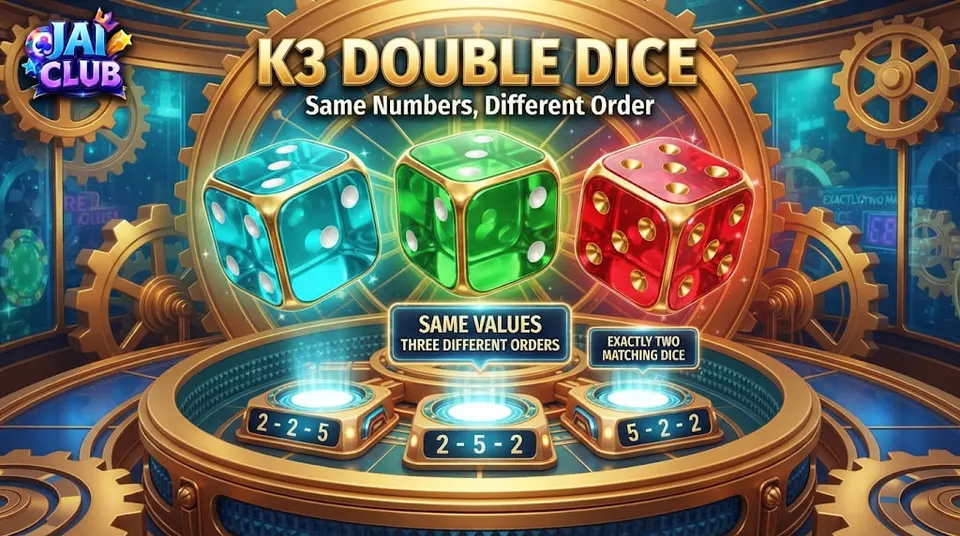
Consider the values 2, 2 and 5.
They can appear in three different orders: 2-2-5, 2-5-2 and 5-2-2.
All three are doubles, and all have a sum of 9.
However, they are distinct ordered outcomes when the three dice are considered separately.
This matters for counting probability, although a game category based only on the presence of a pair may classify all three in the same way.
A result category involving particular positions could treat them differently. Such game-specific conditions need verification.
Double Dice Example Table
| Dice outcome | Matching value | Different value | Total |
|---|---|---|---|
| 2-2-5 | 2 | 5 | 9 |
| 2-5-2 | 2 | 5 | 9 |
| 5-2-2 | 2 | 5 | 9 |
| 3-3-1 | 3 | 1 | 7 |
| 6-4-6 | 6 | 4 | 16 |
| 1-5-5 | 5 | 1 | 11 |
These examples are mathematical illustrations, not actual Jai Club K3 results.
Notice that the total changes when the values change, but rearranging the same values does not change their sum.
The category double is determined by the repeated value, not the sum alone.
How Many K3 Double Dice Outcomes Exist?
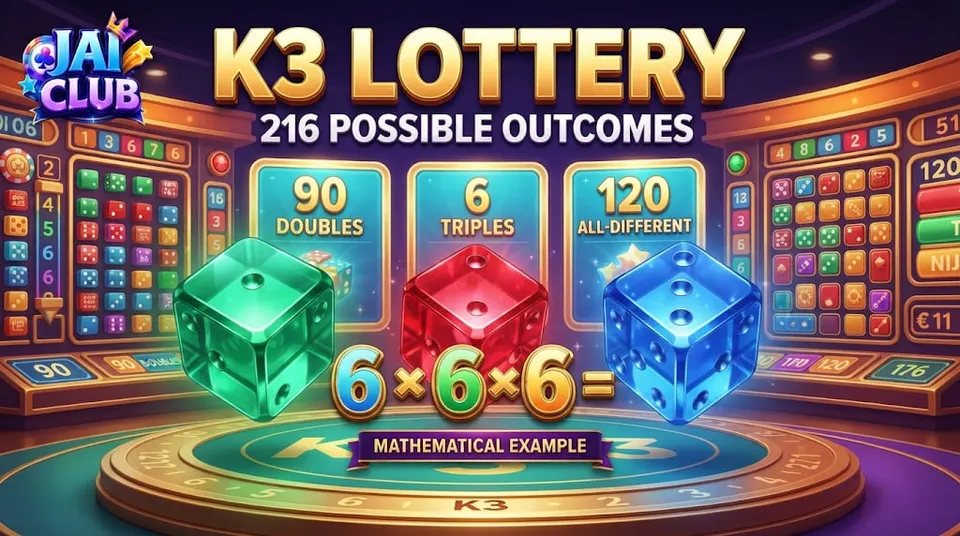
Under a standard model of three distinguishable six-sided dice, there are 216 possible ordered outcomes.
To count exactly one pair, first choose which value appears twice. There are six choices because the repeated number can be any integer from 1 to 6.
Next, choose a different value for the third die. There are five remaining choices.
Finally, select which of the three positions contains the different value. There are three possibilities.
The calculation is:
6 × 5 × 3 = 90
Therefore, there are 90 ordered outcomes containing exactly one pair.
Probability of Getting Any Double
If the three dice are fair and independent, every ordered outcome has a probability of 1/216.
Because there are 90 outcomes containing exactly one pair, the probability of any double is:
[ P(\text{exactly one pair})=\frac{90}{216}=\frac{5}{12} ]
This is approximately 41.67%.
The result is a theoretical calculation for fair physical or equivalent mathematical dice. It does not establish that a particular digital gaming service uses this probability distribution.
Actual software behaviour requires separate evidence.
Probability of a Specific Pair Pattern
Suppose the required outcome contains two 2s and one 5, in any order.
There are three ordered arrangements: 2-2-5, 2-5-2 and 5-2-2.
Under the same fair and independent model, the probability of obtaining one of those arrangements is:
[ \frac{3}{216}=\frac{1}{72} ]
That is approximately 1.39%.
If a result instead requires one exact order, such as 2-2-5 only, the theoretical probability is 1/216.
This illustrates why the precise definition of a category matters.
Double Dice vs Triple Dice
A double contains exactly two equal dice. A triple contains three equal dice.
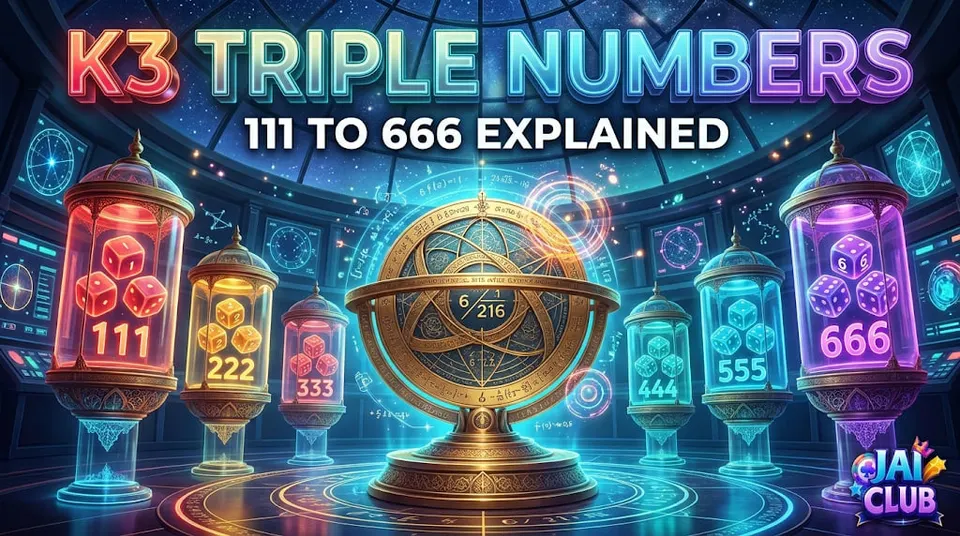
There are 90 ordered double outcomes but only six triple outcomes under the standard fair three-dice model.
| Feature | Double dice | Triple dice |
|---|---|---|
| Matching values | Exactly two | All three |
| Example | 4-4-2 | 4-4-4 |
| Ordered outcomes | 90 | 6 |
| Theoretical probability | 90/216 | 6/216 |
| Mathematical sum | Depends on values | Three times repeated value |
The counts describe outcome categories, not the payout rules of a specific K3 game.
For more information about triples, read the K3 Triple Numbers Guide.
Doubles vs Three Different Numbers
Another possible category is an outcome where all three dice have different values.
For example, 1-3-6 contains no repeated number.
The total number of ordered outcomes with three different values is:
6 × 5 × 4 = 120
This can be understood by choosing six possibilities for the first die, five different possibilities for the second and four remaining possibilities for the third.
The full mathematical sample space can therefore be divided into 90 doubles, six triples and 120 all-different outcomes.
Their sum is 216, which confirms that the categories cover every possible ordered outcome without overlap.
Why Dice Order Matters in Probability
The three dice may be displayed as separate positions.
Under a model of distinguishable dice, 1-1-4 and 1-4-1 count as different outcomes because the positions differ.
However, whether a particular game pays differently for those arrangements depends on its selection rules.
A category involving any matching pair may group them together. A position-specific category may distinguish them.
Without a verified game rulebook, it would be misleading to assign an operator-specific financial meaning to the arrangement.
The mathematical distinction can still be explained independently.
Double Dice and Sum Results
A double outcome also produces a sum obtained by adding all three values.
For example, 3-3-6 gives a total of 12. The result 4-4-4 also totals 12 but belongs to the triple category.
Therefore, the total alone cannot always determine whether the outcome was a double.
Readers need the individual dice values to classify the result accurately.
This is particularly important when reviewing a history panel that shows the sum more prominently than the three dice.
A result labelled 12 should not automatically be interpreted as any specific combination.
Why Double Dice Results Can Repeat
A sequence of completed rounds may contain several doubles in succession.
Under an independent mathematical model, previous outcomes do not force the next round to avoid a particular category.
Likewise, a long gap without a double does not mean the category is due to appear.
Historical frequency can describe what happened in a selected sample, but it does not independently establish future results.
This distinction matters because some prediction charts use repeated or missing doubles as forecasting signals.
Such claims require evidence beyond the visible history.
What Does a K3 History Record Actually Show?
A result history may display the individual dice, the sum and a period identifier.
To determine whether a recorded result contains a double, examine all three dice values rather than relying solely on the total.
Next, make sure the values belong to the same completed round.
A screenshot showing partial information may be insufficient to determine the exact result category.
The correct interpretation should be based on the full recorded outcome and the current game's documented rules.
For a general overview of K3 and other formats, visit the Jai Club Games Guide.
Double Dice and Financial Outcomes
Mathematical probability does not establish whether a particular selection is financially favourable.
A game can define payouts, fees or settlement rules independently of the basic dice combination count.
For example, the fact that the double category has a theoretical probability of 5/12 under fair independent dice does not reveal its payout multiplier.
Without the actual conditions, no claim about expected financial return can be made.
This guide explains mathematics rather than recommending wagers.
Common Mistakes in Double Dice Analysis
One common mistake is classifying a triple as a double merely because it contains two matching dice.
Another is counting 2-2-5 only once when calculating ordered outcomes and forgetting its other arrangements.
A third is using a sum such as 9 to identify the combination without checking the individual dice.
Readers may also mistake theoretical probabilities for measured probabilities from a particular gaming service.
Keeping the assumptions clear prevents these errors.
Frequently Asked Questions
What is a K3 double dice result?
It is an outcome where exactly two of the three dice show the same value.
Is 2-2-5 a double?
Yes. Two dice show 2 and the third shows 5.
Is 3-3-3 a double?
No. It is a triple because all three dice match.
Does 2-2-5 equal 2-5-2?
They contain the same values and have the same sum but are different ordered outcomes.
How many ordered double outcomes exist?
There are 90 under the standard three six-sided dice model.
What is the theoretical probability of any double?
For three fair independent dice, it is 5/12, or about 41.67%.
Can a double have the same sum as a triple?
Yes. Different dice combinations can produce the same total.
Does a long gap make a double more likely?
Not in an independent model. Earlier results do not force a future outcome.
Are these verified Jai Club K3 probabilities?
No. They are mathematical probabilities under stated assumptions.
Conclusion
K3 double dice combinations contain exactly one matching pair and one different value. Understanding this distinction helps separate doubles from triples and other three-dice outcomes.
Under the fair independent dice model, 90 of the 216 ordered outcomes contain exactly one pair. The arrangement of dice matters when counting individual outcomes, even though rearranging the same values does not change their sum.
These calculations support accurate reading of game results but do not establish future predictions or operator-specific payout rules.
Editorial note: All examples and probability calculations are educational mathematical models. No actual Jai Club K3 result history or payout rate is claimed.