K3 Lottery 216 Outcomes: Understanding the Full Dice Sample Space
Learn why three six-sided dice produce 216 ordered outcomes, how totals from 3 to 18 are counted, and why doubles, triples and all-different results have different probabilities.
In this article
- What Are the 216 K3 Lottery Outcomes?
- Why Ordered Results Matter
- Dice Sums Range From 3 to 18
- Complete K3 Sum Probability Table
- Why Sums 10 and 11 Have More Combinations
- Double Dice Outcomes
- Triple Dice Outcomes
- All-Different Dice Outcomes
- What About Straight Combinations?
- Does 216 Mean All Results Have the Same Chance?
- How the Sample Space Helps Read K3 History
- Mathematical Probability vs Actual Digital Game Results
- Can the 216 Outcomes Predict the Next Result?
- Common K3 Probability Mistakes
- Frequently Asked Questions
- Why does K3 have 216 outcomes?
- Are there 216 different sums?
- Which sums have the most combinations?
- Which sums have the fewest combinations?
- How many double dice outcomes exist?
- How many triples are possible?
- How many outcomes contain three different values?
- Does 123 differ from 321?
- Is every digital K3 game guaranteed to follow this probability distribution?
- Can historical results guarantee the next K3 number?
- Conclusion
K3 Lottery is commonly discussed as a three-dice number game. Each die displays a value from 1 to 6, and the three values can be examined individually or added to produce a total.
One of the most useful mathematical facts about three ordinary six-sided dice is that they produce 216 possible ordered outcomes.
However, this number is often misunderstood. It does not mean there are 216 different sums, nor does it mean every possible total occurs with the same frequency.
Quick answer: Three distinguishable six-sided dice have 6 × 6 × 6 = 216 possible ordered outcomes. Their sums range from 3 to 18, with different numbers of combinations producing each sum. Under a fair independent dice model, the middle totals are more common than the extreme totals.
This article explains the full mathematical sample space, dice combinations, repeated numbers and sum probabilities. It does not claim that any specific Jai Club K3 software has been independently verified to use fair, independent dice.
What Are the 216 K3 Lottery Outcomes?
An outcome is one possible result produced by the three dice.
Consider three dice labelled A, B and C.
Die A can show any integer from 1 to 6. Die B also has six possible values, and so does Die C.
The multiplication rule gives:
6 × 6 × 6 = 216
These 216 outcomes include every ordered arrangement, from (1,1,1) to (6,6,6).
The word ordered matters because the three dice occupy separate positions. The result (1,2,3) is counted separately from (3,2,1).
Both contain the same numbers and have the same sum, but their positions differ.
Why Ordered Results Matter
Suppose a round shows the dice values 2, 4 and 6.
There are six arrangements of those three different values:
(2,4,6), (2,6,4), (4,2,6), (4,6,2), (6,2,4) and (6,4,2).
All six arrangements have a total of 12.
However, they represent six different outcomes when the dice are identified separately.
If a game category considers only the total, these outcomes may fall into the same group.
If a category concerns a particular dice position, their differences may matter.
The actual game rules determine the relevance of each classification.
Dice Sums Range From 3 to 18
The smallest total occurs when all three dice show 1.
1 + 1 + 1 = 3
The largest total occurs when all three dice show 6.
6 + 6 + 6 = 18
Every integer between 3 and 18 can be produced by at least one three-dice combination.
Therefore, there are 16 possible sum values.
These sums are not equally likely under a fair independent model, because different totals have different numbers of ordered combinations.
Complete K3 Sum Probability Table
The following table describes the mathematical model of three fair, independent six-sided dice.
| Sum | Ordered outcomes | Probability |
|---|---|---|
| 3 | 1 | 0.46% |
| 4 | 3 | 1.39% |
| 5 | 6 | 2.78% |
| 6 | 10 | 4.63% |
| 7 | 15 | 6.94% |
| 8 | 21 | 9.72% |
| 9 | 25 | 11.57% |
| 10 | 27 | 12.50% |
| 11 | 27 | 12.50% |
| 12 | 25 | 11.57% |
| 13 | 21 | 9.72% |
| 14 | 15 | 6.94% |
| 15 | 10 | 4.63% |
| 16 | 6 | 2.78% |
| 17 | 3 | 1.39% |
| 18 | 1 | 0.46% |
| Total | 216 | 100% before rounding |
The percentages are rounded to two decimal places.
The table shows that 10 and 11 each have 27 ordered outcomes, while 3 and 18 have only one each.
This difference is a property of combinatorial mathematics, not evidence about any particular operator's live result distribution.
Why Sums 10 and 11 Have More Combinations
A middle sum can be produced by many different arrangements.
For example, a sum of 10 can arise from (1,3,6), (2,3,5), (2,4,4) and several other value groups and arrangements.
By contrast, a sum of 3 is possible only when all three dice show 1.
Likewise, a sum of 18 requires all three dice to show 6.
The middle totals have more combinations because there are more ways for three values to add to a moderate number without exceeding the range of the dice.
This explains the shape of the theoretical sum distribution.
Double Dice Outcomes
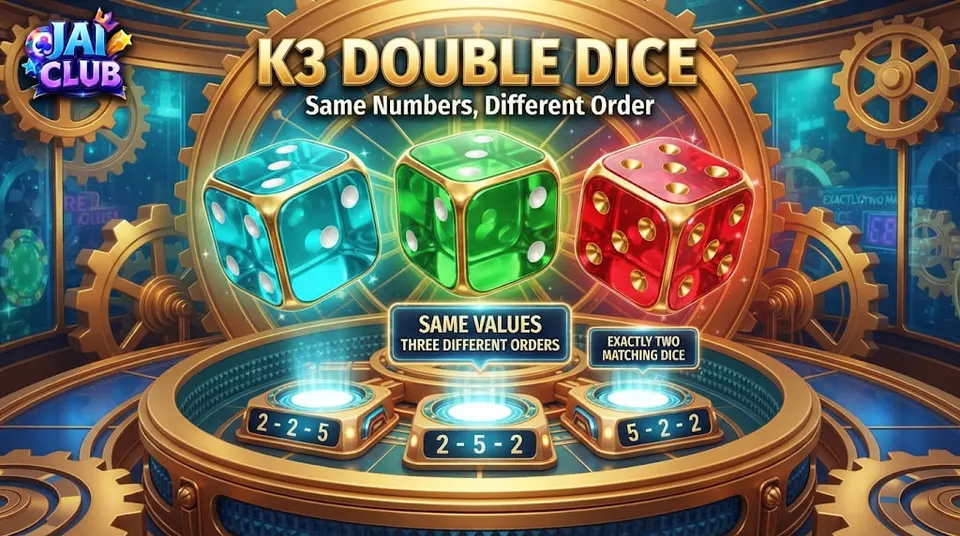
A double means exactly two of the three dice show the same value.
For example, (3,3,5) is a double because two dice show 3 and the remaining die shows 5.
To count all ordered double outcomes, choose the repeated value in six ways.
Next, choose a different value for the third die in five ways.
Finally, choose which of the three positions contains the different value.
The calculation is:
6 × 5 × 3 = 90
Therefore, 90 of the 216 ordered outcomes contain exactly one matching pair.
The theoretical probability is:
90 ÷ 216 = 41.67% approximately.
Triple Dice Outcomes
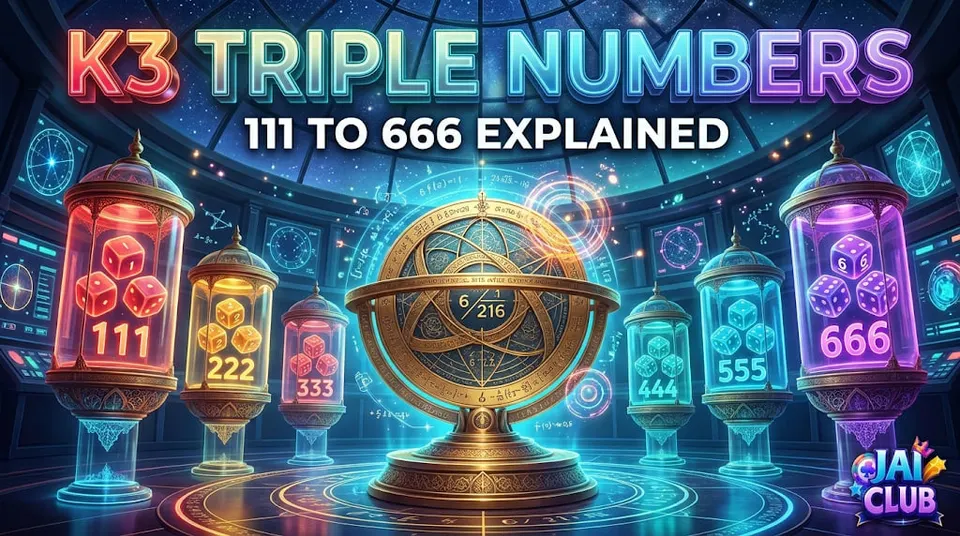
A triple contains three matching values.
The possible triples are (1,1,1), (2,2,2), (3,3,3), (4,4,4), (5,5,5) and (6,6,6).
There are six such outcomes.
The theoretical probability of obtaining any triple is:
6 ÷ 216 = 2.78% approximately.
A triple should not be counted as an exact double, even though it contains matching dice.
The definitions must remain separate to avoid counting the same outcome twice.
All-Different Dice Outcomes
An all-different result contains three distinct values.
For example, (1,4,6) has no repeated digit.
Choose the first die in six ways, the second in five remaining ways and the third in four remaining ways.
The calculation becomes:
6 × 5 × 4 = 120
The theoretical probability is:
120 ÷ 216 = 55.56% approximately.
The three main classifications cover the entire sample space:
| Category | Ordered outcomes |
|---|---|
| Exactly one pair | 90 |
| All three equal | 6 |
| All three different | 120 |
| Total | 216 |
Together, these categories account for every ordered outcome exactly once.
What About Straight Combinations?
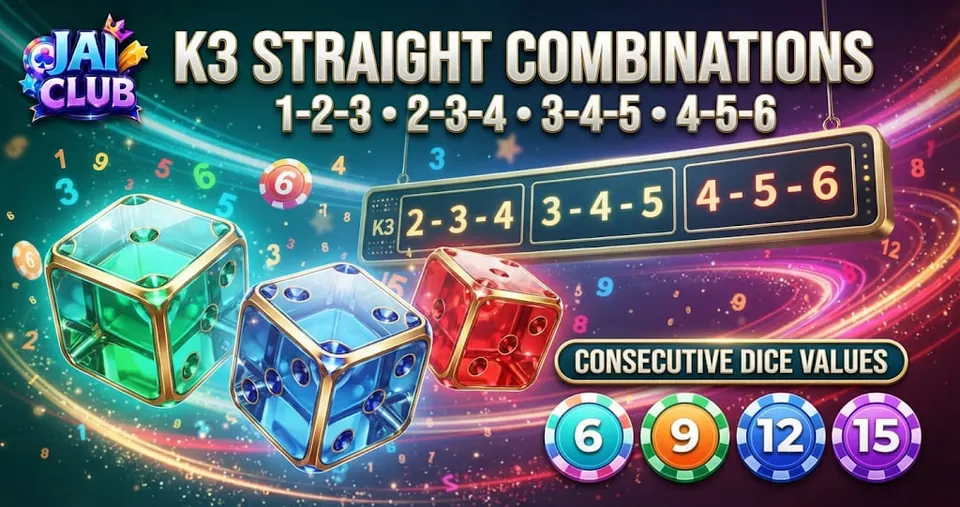
Some mathematical discussions use the term straight for three consecutive dice values.
Examples include 1-2-3, 2-3-4, 3-4-5 and 4-5-6.
Each set has six possible arrangements, producing 24 ordered outcomes when any arrangement qualifies.
These outcomes belong to the all-different category.
A straight is therefore a narrower classification, not a fourth group that should be added on top of the previous 216 outcomes.
Whether a particular game uses Straight as an official selection must be checked separately.
Does 216 Mean All Results Have the Same Chance?
Under the fair independent dice model, each ordered three-dice outcome has probability 1/216.
However, each sum does not have probability 1/216 because many different ordered outcomes share the same total.
For example, the exact ordered outcome (1,1,1) has one possibility.
The total 10 includes 27 ordered possibilities.
This is why the theoretical probability of the total 10 is 27/216 rather than 1/216.
Confusing outcomes with sum categories is one of the most common errors in three-dice probability calculations.
How the Sample Space Helps Read K3 History
A game-history panel may display three individual dice and their combined total.
The full dice values provide more information than the total alone.
For example, (2,2,6) and (1,3,6) both produce 10.
However, the first is a double and the second contains three different values.
A reader who sees only the sum cannot always identify the exact category of the individual dice.
For more information about adding dice values, read the K3 Lottery Sum Guide.
Mathematical Probability vs Actual Digital Game Results
The calculations in this guide assume three distinguishable, independent and fair six-sided dice.
A digital game may display dice images while using software to generate outcomes.
The visual appearance of the dice does not prove that the underlying software follows the same distribution.
A reliable claim about a particular operator would require evidence about the implemented game version and result-generation method.
Therefore, the mathematical probabilities here should not be presented as independently verified Jai Club K3 probabilities.
Can the 216 Outcomes Predict the Next Result?
No. Knowing the complete sample space does not identify which outcome will occur next.
It helps describe the possible outcomes and their probabilities under a mathematical model.
A series of historical results may contain repeated totals, doubles or triples.
However, an independent random model does not force a missing category to appear merely because it has been absent for several rounds.
Past frequencies may be analysed descriptively, but they do not automatically reveal future outcomes.
Common K3 Probability Mistakes
One frequent mistake is treating the 16 possible sums as equally likely.
Another is confusing 216 ordered outcomes with the much smaller number of unordered combinations.
Some readers count all triples as doubles, which produces incorrect totals.
Others assume the sum of 10 must always represent one specific dice arrangement.
A final mistake is treating the fair-dice probabilities as verified payout odds for a particular digital platform.
Clear mathematical assumptions help prevent these errors.
Frequently Asked Questions
Why does K3 have 216 outcomes?
Because three six-sided dice have 6 × 6 × 6 ordered possibilities.
Are there 216 different sums?
No. The possible sums are the 16 integers from 3 through 18.
Which sums have the most combinations?
Sums 10 and 11 each have 27 ordered outcomes.
Which sums have the fewest combinations?
Sums 3 and 18 each have one ordered outcome.
How many double dice outcomes exist?
There are 90 ordered outcomes containing exactly one matching pair.
How many triples are possible?
There are six: 111 through 666.
How many outcomes contain three different values?
There are 120 ordered outcomes with all three dice different.
Does 123 differ from 321?
Yes, as ordered outcomes. They contain the same values but in different positions.
Is every digital K3 game guaranteed to follow this probability distribution?
No. The distribution describes a mathematical model under specified assumptions.
Can historical results guarantee the next K3 number?
No. A historical pattern does not establish a certain future result.
Conclusion
The 216 outcomes of a three-dice model provide a useful foundation for understanding K3 Lottery mathematics.
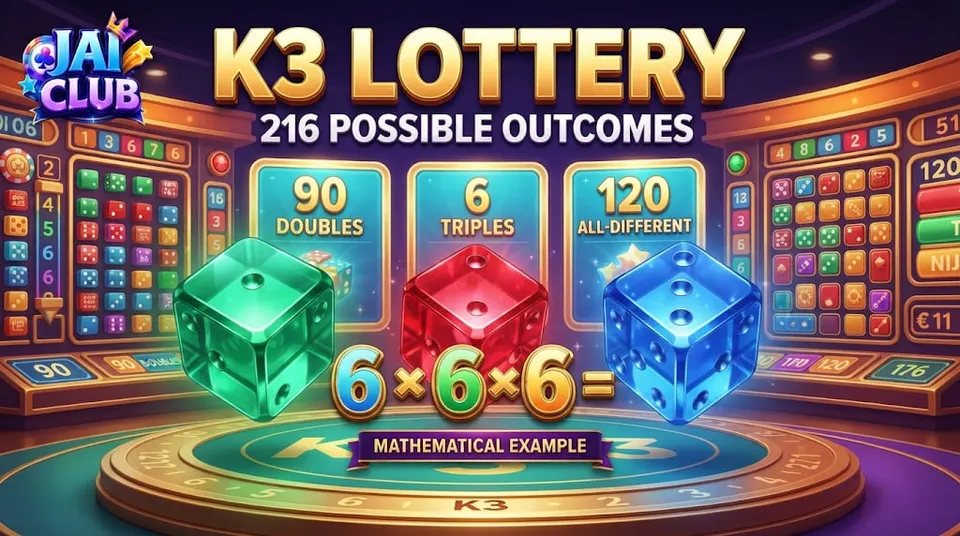
The sample space contains 90 exact doubles, six triples and 120 all-different outcomes.
Although there are 216 ordered possibilities, only 16 distinct totals exist, and those totals are not equally likely under fair independent dice.
Knowing these facts helps readers interpret dice histories, combination counts and probability claims accurately.
For other game-format explanations, visit the Jai Club Games Guide.
Editorial note: The probability calculations describe three fair, independent six-sided dice. They are not a certification of the result-generation system or financial settlement rules of a particular Jai Club game.