K3 Straight Combinations: Reading 1-2-3, 2-3-4 and Consecutive Dice
Understand three-dice straight combinations, consecutive number sequences, different dice orders, mathematical probabilities and why a straight is not the same as a double or triple.
In this article
- What Is a K3 Straight Combination?
- Why Consecutive Numbers Matter
- Four Possible Straight Sets
- Does Dice Order Matter?
- All Arrangements of One Straight Set
- How Many Ordered Straight Outcomes Exist?
- Probability of a Straight
- K3 Straight vs Double Dice
- K3 Straight vs Triple Dice
- Straight Combinations and Dice Sums
- Why the Total Alone Is Not Enough
- Exact Order vs Any Order
- Why Historical Straights Do Not Predict Future Outcomes
- Digital K3 Games and Mathematical Models
- Straight Patterns and Financial Decisions
- Common Mistakes in Straight Classification
- Frequently Asked Questions
- What is a three-dice straight?
- Is 1-2-3 a straight?
- Is 3-2-1 a straight?
- Is 1-3-5 a straight?
- How many straight sets are possible with six-sided dice?
- How many ordered straight outcomes exist?
- What is the theoretical probability of any-order straights?
- Does a sum of 9 prove a straight?
- Does Jai Club K3 officially offer a Straight selection?
- Can past straight results predict future rounds?
- Conclusion
Three-dice games can produce many different number arrangements. Some combinations contain matching values, while others contain three different values. Another useful mathematical pattern involves three consecutive numbers, such as 1-2-3 or 2-3-4.
These arrangements are often described informally as straights because the values form a consecutive sequence.
Quick answer: A three-dice straight is a combination of three consecutive values under an explicitly defined mathematical classification. Examples include 1-2-3, 2-3-4, 3-4-5 and 4-5-6. Whether the values must appear in that exact order, or may appear in any order, depends on the definition being used.
This article explains the mathematics of straight combinations in a standard fair three-dice model. It does not claim that Jai Club K3 officially offers a selectable Straight category or a specific payout for these results.
What Is a K3 Straight Combination?
A straight is a sequence of consecutive values.
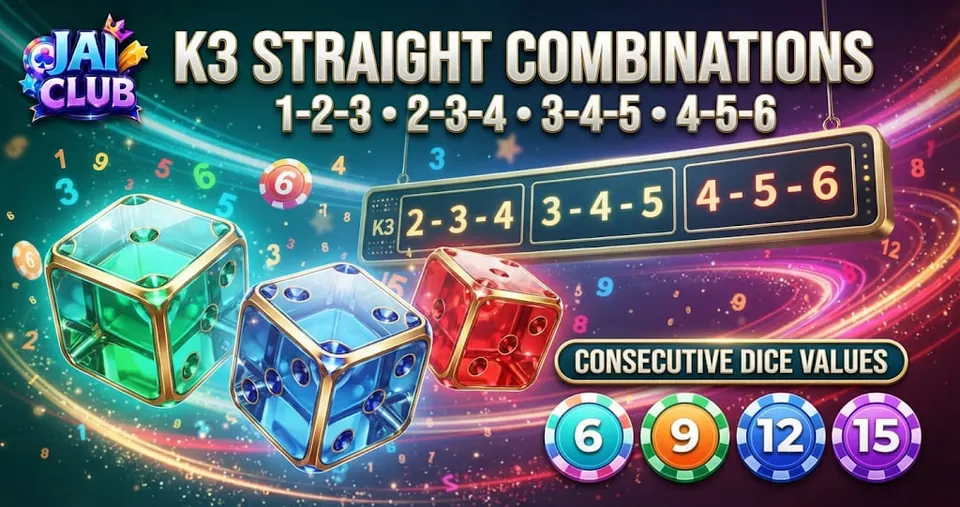
For standard six-sided dice, the possible sets of three consecutive numbers are 1-2-3, 2-3-4, 3-4-5 and 4-5-6.
Each set contains three different numbers with no numerical gap between them.
The sequence 1-3-4 is not a straight because the value 2 is missing.
Similarly, 2-2-3 does not meet the definition because one value is repeated.
The term is useful for describing number patterns, but its status as a game category must be established through actual rules rather than assumed from terminology.
Why Consecutive Numbers Matter
Consecutive numbers differ by one unit.
In the set 2, 3 and 4, the first difference is one and the second difference is also one.
This creates a simple arithmetic pattern.
A three-dice combination such as 2-3-5 contains three different numbers, but it is not consecutive because the difference between 3 and 5 is two.
The distinction is mathematical rather than predictive.
A historical record containing several consecutive sequences does not establish that another such result must appear next.
Four Possible Straight Sets
Under an ordinary six-sided dice model, exactly four groups of three consecutive values are possible.
| Straight set | Lowest value | Highest value | Sum |
|---|---|---|---|
| 1-2-3 | 1 | 3 | 6 |
| 2-3-4 | 2 | 4 | 9 |
| 3-4-5 | 3 | 5 | 12 |
| 4-5-6 | 4 | 6 | 15 |
These are all the possible three-value consecutive sets using digits from 1 through 6.
The table describes mathematical combinations, not a verified K3 selection menu.
Does Dice Order Matter?
Dice order matters when distinguishing individual ordered outcomes.
For example, the values 1, 2 and 3 can appear in several different arrangements.
The exact outcome 1-2-3 is different from 2-1-3 when each die is identified by position.
However, both contain the same set of consecutive values.
If the mathematical definition of a straight ignores order, both qualify.
If an event requires the exact visible order 1-2-3, only that particular arrangement qualifies.
This distinction changes the probability calculation.
All Arrangements of One Straight Set
Consider the set 1, 2 and 3.
Because all three numbers are different, there are six possible ordered arrangements:
| Arrangement | Consecutive set? |
|---|---|
| 1-2-3 | Yes |
| 1-3-2 | Yes |
| 2-1-3 | Yes |
| 2-3-1 | Yes |
| 3-1-2 | Yes |
| 3-2-1 | Yes |
All six arrangements contain the same three values.
Under an order-independent definition, they belong to the same straight group.
Under a strictly ascending definition, only 1-2-3 would qualify.
The definition must be stated before any probability is calculated.
How Many Ordered Straight Outcomes Exist?
A standard model of three distinguishable, independent, fair six-sided dice has 216 possible ordered outcomes.
There are four sets of three consecutive values.
Each set contains three different numbers that can be arranged in six orders.
Therefore, under an order-independent straight classification:
4 × 6 = 24 ordered outcomes
This count applies to all three-dice outcomes containing one of the four consecutive sets, regardless of displayed order.
It does not imply that a particular digital game implements or pays for this classification.
Probability of a Straight
Under the same fair and independent dice assumptions, each ordered result has probability 1/216.
Because 24 ordered outcomes contain three consecutive values, the probability is:
[ P(\text{consecutive set, any order})=\frac{24}{216}=\frac{1}{9} ]
This is approximately 11.11%.
If the mathematical definition instead requires one of the four strictly ascending sequences, the probability becomes:
[ P(\text{strictly ascending consecutive})=\frac{4}{216}=\frac{1}{54} ]
That is approximately 1.85%.
The difference shows why the definition of straight must be clear.
K3 Straight vs Double Dice
A straight contains three different consecutive values.
A double contains exactly two matching values and one different value.
For example, 1-2-3 is a straight, while 2-2-3 is a double.
The two groups do not overlap under these definitions because a straight cannot contain repeated values.
In the standard three-dice mathematical model, exactly one matching pair occurs in 90 of the 216 ordered outcomes.
The 24 consecutive-set outcomes form part of the larger group in which all three dice have different values.
For related pair calculations, see the K3 Lottery Sum Guide.
K3 Straight vs Triple Dice
A triple contains three identical values, such as 4-4-4.
A straight contains three different consecutive values, such as 3-4-5.
These groups are mathematically distinct.
Under the standard fair three-dice model, only six ordered outcomes are triples: 1-1-1 through 6-6-6.
A triple cannot also be a straight because it does not contain three different consecutive values.
This distinction helps readers avoid mixing several different result-classification concepts.
Straight Combinations and Dice Sums
Every three-dice straight has a sum.
The four consecutive sets produce totals of 6, 9, 12 and 15.
However, a sum of 9 does not prove that the dice formed 2-3-4.
For example, 1-3-5 also totals 9, but its values are not consecutive.
Similarly, 3-3-3 totals 9 and belongs to the triple category.
A sum describes the total, while a straight describes the relationship between individual values.
Both pieces of information must be considered separately.
Why the Total Alone Is Not Enough
A result-history table may display the sum more prominently than the underlying three dice.
If a reader sees the total 12, several combinations may be possible.
The straight 3-4-5 produces 12, but so does the triple 4-4-4 and the double 2-5-5.
Therefore, the number 12 alone cannot identify the result category.
A classification based on individual dice values requires all three values.
The period number is also important when comparing one historical outcome with another.
Exact Order vs Any Order
Some mathematical problems ask for one precise sequence, while others ask whether the set of values meets a condition.
For example, rolling exactly 1-2-3 in a specified order is one ordered outcome.
Rolling the values 1, 2 and 3 in any order includes six outcomes.
The probabilities differ because the events contain different numbers of possible outcomes.
A reader should be careful when using terms such as combination and sequence, which may be used informally in game descriptions.
The actual condition must be expressed clearly before mathematical reasoning can be applied.
Why Historical Straights Do Not Predict Future Outcomes
Suppose a fictional history shows two consecutive-number sets appearing in nearby rounds.
That observation describes what happened in the sample.
Under an independent fair dice model, it does not force the next round to include or exclude a straight.
The same applies when no straight has appeared for several rounds.
The absence of a pattern does not make it due.
Historical charts are useful for describing past observations but do not automatically provide a reliable method for predicting future outcomes.
Digital K3 Games and Mathematical Models
Digital K3-style games may simulate three dice rather than use physical dice.
Their actual result distributions depend on the implemented rules and outcome-generation system.
The mathematical model in this guide assumes three fair independent six-sided dice.
Those assumptions cannot be established simply by observing an interface that displays dice images.
A service could also use different category definitions or settlement rules.
For that reason, the numerical probabilities in this article should not be represented as independently verified Jai Club K3 odds.
Straight Patterns and Financial Decisions
A mathematical probability is not the same thing as expected financial return.
A game may have different payment conditions, fees or category definitions.
Even if a particular event has a known theoretical probability, its financial value cannot be evaluated without the applicable settlement terms.
No recommended wager follows from the straight-combination calculations in this article.
The goal is to understand number patterns accurately rather than assume that recognising a pattern creates an advantage.
Common Mistakes in Straight Classification
One mistake is treating any three different numbers as a straight.
Another is overlooking that 1-3-4 contains a gap.
Some readers count only the ascending version of a straight while claiming that order does not matter.
Others treat the sum 9 or 12 as proof that a straight occurred.
The correct approach is to define the event and then examine the individual dice values.
Clear definitions prevent incorrect probability calculations.
Frequently Asked Questions
What is a three-dice straight?
It is a group of three consecutive values under the stated mathematical definition.
Is 1-2-3 a straight?
Yes. The three values are consecutive.
Is 3-2-1 a straight?
Yes, under an order-independent definition; it is not strictly ascending.
Is 1-3-5 a straight?
No. The values are not consecutive.
How many straight sets are possible with six-sided dice?
Four: 123, 234, 345 and 456.
How many ordered straight outcomes exist?
There are 24 if all arrangements of the four consecutive sets qualify.
What is the theoretical probability of any-order straights?
It is 1/9, approximately 11.11%, for three fair independent six-sided dice.
Does a sum of 9 prove a straight?
No. Several non-straight combinations also total 9.
Does Jai Club K3 officially offer a Straight selection?
This guide does not independently verify such a selectable category.
Can past straight results predict future rounds?
No reliable prediction follows from past patterns alone.
Conclusion
Three-dice straight combinations are based on consecutive values rather than matching numbers or sums.
Under a standard mathematical model, four consecutive sets are possible, and they have 24 ordered arrangements when any order is accepted.
Understanding the difference between ordered results and unordered sets is essential for calculating probabilities correctly.
These calculations explain a mathematical pattern without claiming official Jai Club K3 payout rules or guaranteed future outcomes.
Editorial note: The Straight category discussed here is mathematical. It has not been verified as an official selection in the current Jai Club K3 implementation.