5D Lottery Number Order: Same Digits, Different Results
Understand why five-digit sequences with the same numbers can represent different 5D Lottery results, how ABCDE positions work and why a matching sum does not mean matching positions.
In this article
- Why Number Order Matters in 5D Lottery
- Same Digits Do Not Mean the Same Result
- Five-Digit Sequence vs Digit Combination
- Comparing Three Fictional Results
- Why the Digit Sum Stays the Same
- Position A vs Position E
- How Repeated Digits Affect Number Order
- Leading Zeros Must Stay in Their Positions
- How Many Sequences Can Five Different Digits Form?
- What Changes When Digits Repeat?
- Can Two Results With the Same Sum Be Completely Different?
- Why Result History Should Preserve Order
- Position-Based Analysis vs Prediction
- Common Number Order Mistakes
- Frequently Asked Questions
- Is 12345 the same 5D result as 54321?
- Why do both sequences have the same sum?
- What do A, B, C, D and E represent?
- Does swapping two digits create another result?
- How many arrangements can five distinct digits form?
- What if two digits are identical?
- Can leading zeros affect the order?
- Can different numbers have the same digit sum?
- Does number-order analysis predict future 5D outcomes?
- Are these verified Jai Club payout rules?
- Conclusion
A 5D Lottery result may contain five digits arranged in a fixed order. At first glance, two results with exactly the same digits can look identical, especially when readers focus on the number combination rather than individual positions.
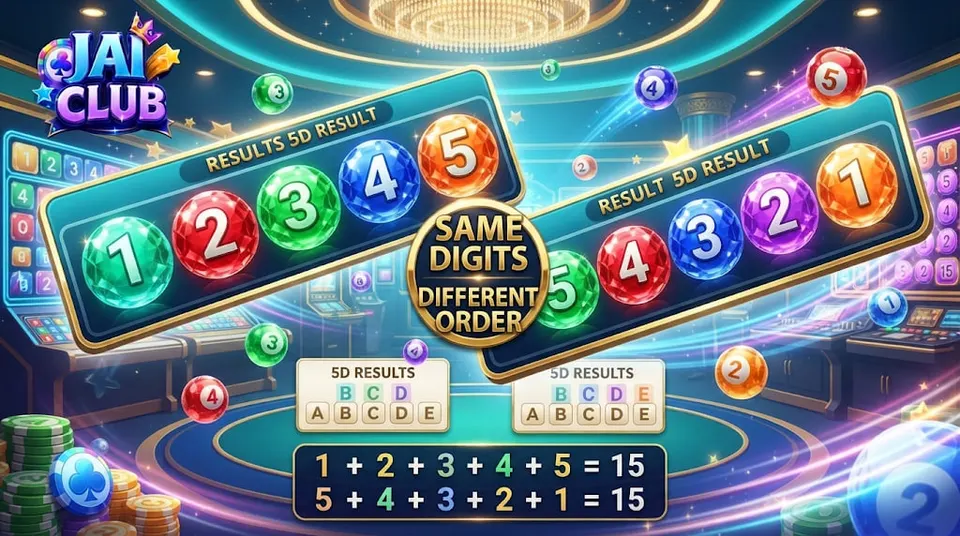
However, 12345 and 54321 are different five-position sequences, even though they contain the same digits and have the same total when added together.
This distinction is essential for understanding number order, position-based categories and result-history records.
Quick answer: In a five-position result, the value in each position matters. Rearranging the same digits produces a different ordered sequence. A matching digit sum does not mean two results have identical position values.
This guide explains the difference through clear mathematical examples. The examples describe general five-digit formats and should not be treated as verified Jai Club game results or payout conditions.
Why Number Order Matters in 5D Lottery
A five-digit result contains five ordered positions.
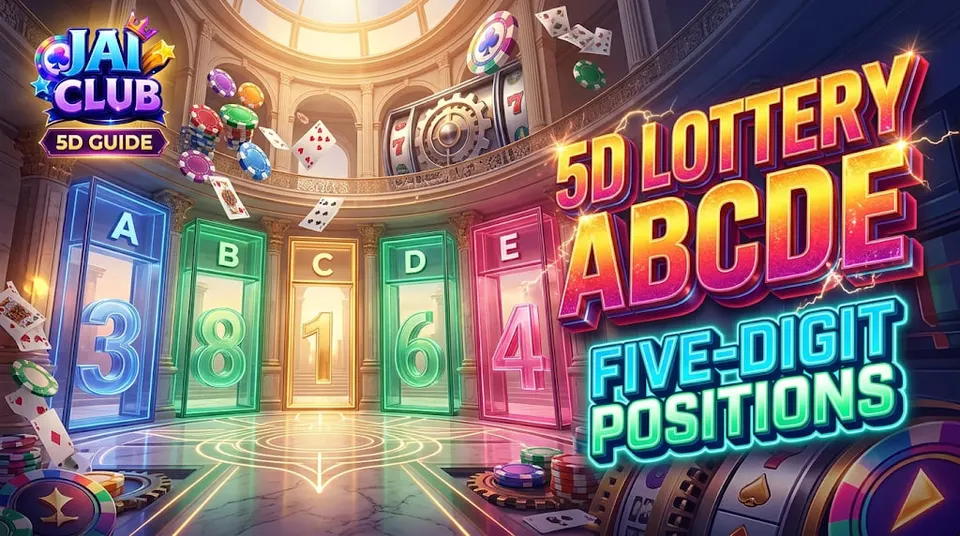
These may be labelled A, B, C, D and E, beginning with the first digit on the left and ending with the fifth digit on the right.
For example, the fictional result 12345 can be separated as follows:
| Position | Digit |
|---|---|
| A | 1 |
| B | 2 |
| C | 3 |
| D | 4 |
| E | 5 |
The result 54321 contains exactly the same five values, but their positions are reversed.
In the second sequence, A contains 5 and E contains 1.
This difference matters whenever a game or record uses position labels to identify individual values.
Same Digits Do Not Mean the Same Result
The phrase same digits only describes the collection of numbers present in a sequence.
It does not establish that each digit occupies the same position.
Consider these fictional results:
12345
21345
Both contain one occurrence each of 1, 2, 3, 4 and 5.
However, the first two positions are different.
In 12345, A is 1 and B is 2. In 21345, A is 2 and B is 1.
A category involving the first position would therefore distinguish the two sequences.
This is why readers should not compare five-digit records merely by sorting their digits.
Five-Digit Sequence vs Digit Combination
In everyday language, people often use number combination and number sequence interchangeably.
Mathematically, they can describe different ideas.
An ordered sequence preserves the position of every digit. A collection of digits without order describes which values are present but not where they appear.
For example, 13579 and 97531 contain the same collection of five digits.
Yet they are different ordered sequences.
When a result record is presented in five positions, retaining the exact order is necessary for accurate interpretation.
Comparing Three Fictional Results
| Result | A | B | C | D | E | Sum |
|---|---|---|---|---|---|---|
| 12345 | 1 | 2 | 3 | 4 | 5 | 15 |
| 54321 | 5 | 4 | 3 | 2 | 1 | 15 |
| 21345 | 2 | 1 | 3 | 4 | 5 | 15 |
All three examples have the same digit sum of 15.
They also contain the same collection of digits.
However, their position values are different.
The table demonstrates why a sum chart cannot replace the original five-digit record.
Why the Digit Sum Stays the Same
Addition does not depend on the order of the values being added.
For example:
1 + 2 + 3 + 4 + 5 = 15
Reversing the values produces:
5 + 4 + 3 + 2 + 1 = 15
The arithmetic total remains 15.
This property is useful when checking calculations, but it creates an important limitation for result interpretation.
A digit sum does not preserve the exact order of the original sequence.
If a record only contains the sum, readers cannot reconstruct the full five-position result from that information alone.
Position A vs Position E
The first and fifth positions are often easiest to confuse when the sequence is copied or reversed.
In 28641, the first digit is 2 and the final digit is 1.
In 14682, those values appear in different positions.
If a hypothetical rule refers to position A, the relevant value is the first digit of the original sequence.
If it refers to position E, the relevant value is the fifth digit.
These positions cannot be swapped merely because the complete set of digits remains unchanged.
The full ABCDE format is explained further in the 5D Lottery Position Guide.
How Repeated Digits Affect Number Order
Repeated digits can make two sequences look even more similar.
Consider the fictional results 11234 and 12134.
Both contain two occurrences of the digit 1.
Their digit sums are identical:
1 + 1 + 2 + 3 + 4 = 11
However, the repeated digits occupy different positions.
In 11234, positions A and B contain 1.
In 12134, positions A and C contain 1.
The distinction may matter for any game feature that uses individual positions.
A reader must therefore preserve repeated digits as well as their order.
Leading Zeros Must Stay in Their Positions
A five-position result can begin with zero if the relevant format permits it.
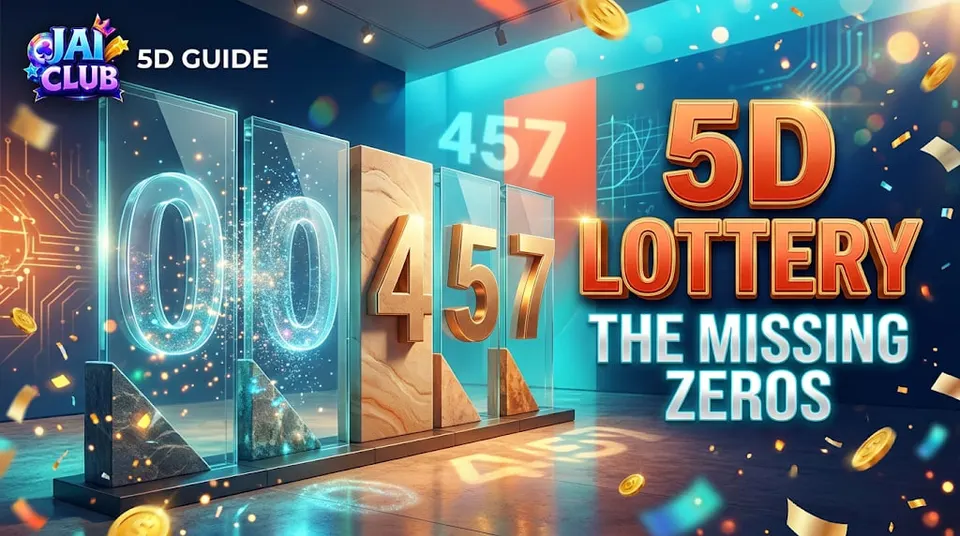
For example, 00457 contains five explicit characters.
A spreadsheet may display the same characters as the ordinary integer 457, but that shorter representation does not preserve the visible five-position structure.
The sequence 00457 has zeros in A and B.
The sequence 04570 has the same collection of digits but places zero in A and E.
They are different ordered results, even though their digit sums are both 16.
This is a useful example of how number order and number formatting can affect interpretation independently of arithmetic.
How Many Sequences Can Five Different Digits Form?
Suppose a set contains five distinct digits, such as 1, 2, 3, 4 and 5.
There are five choices for the first position, four choices for the second, three for the third, two for the fourth and one for the final position.
The number of distinct arrangements is:
[ 5 \times 4 \times 3 \times 2 \times 1 = 120 ]
Therefore, five different digits can produce 120 ordered sequences.
This is a mathematical result, not a statement about actual Jai Club selection categories.
The calculation illustrates why one collection of numbers can correspond to many distinct five-position records.
What Changes When Digits Repeat?
If some digits repeat, there are fewer distinct arrangements.
Consider the collection 1, 1, 2, 3 and 4.
Because the two occurrences of 1 are identical, swapping those two identical values does not produce a new visible sequence.
The number of distinct arrangements is:
[ \frac{5!}{2!} = 60 ]
If all five digits are identical, as in 77777, only one distinct visible arrangement exists.
These calculations describe permutations of a selected collection of digits.
They do not determine the full probability distribution of a digital game without knowing its outcome-generation rules.
Can Two Results With the Same Sum Be Completely Different?
Yes.
For example, 12345 has a sum of 15.
The sequence 60036 also has a sum of 15:
6 + 0 + 0 + 3 + 6 = 15
The results do not even contain the same collection of digits.
This demonstrates that equal sums are a weaker relationship than equal digit collections.
Two sequences can have the same sum for many different reasons.
A history chart showing only totals may therefore group together outcomes that are very different when examined position by position.
Why Result History Should Preserve Order
A result history is useful when it identifies the completed round and the full sequence associated with it.
If an exported record sorts digits, removes leading zeros or changes their positions, it may no longer represent the original display correctly.
Such changes can happen through manual copying or inappropriate spreadsheet formatting.
The round identifier should also remain attached to its corresponding sequence.
Otherwise, a reader may accidentally compare digits from different periods.
A complete ordered record is more informative than a list of isolated digits or totals.
Position-Based Analysis vs Prediction
A historical dataset can be analysed to count how often particular digits appeared in different positions.
For example, a researcher might count the number of times zero appeared in position A within a selected collection of completed results.
That is a descriptive calculation.
It does not establish which digit will appear next.
If outcomes are generated independently under a stable random model, previous position frequencies do not force future values to compensate for earlier results.
Therefore, the existence of a detailed position chart should not be confused with verified prediction ability.
Common Number Order Mistakes
One mistake is treating two results as identical because they contain the same digits.
Another is assuming that an equal sum means the complete sequence is the same.
Some users also reverse a sequence when copying it from a right-to-left layout or incorrectly remove leading zeros.
A more subtle error is sorting the digits from smallest to largest before storing the result.
That destroys the original position order.
The safest record preserves the five characters exactly as they appeared, along with the correct round identifier.
Frequently Asked Questions
Is 12345 the same 5D result as 54321?
No. They contain the same digits but in different positions.
Why do both sequences have the same sum?
Addition produces the same total regardless of the order of its terms.
What do A, B, C, D and E represent?
They identify the first through fifth positions of a five-digit result.
Does swapping two digits create another result?
It creates a different ordered sequence when the swapped digits have different values.
How many arrangements can five distinct digits form?
There are 120 possible permutations.
What if two digits are identical?
The number of distinct visible arrangements decreases.
Can leading zeros affect the order?
Yes. A zero occupies a position and should not be discarded from a fixed-width result.
Can different numbers have the same digit sum?
Yes. Many unrelated sequences can produce the same arithmetic total.
Does number-order analysis predict future 5D outcomes?
Not by itself. Historical patterns are descriptive rather than guarantees.
Are these verified Jai Club payout rules?
No. This guide explains mathematical ordering and position concepts.
Conclusion
The order of digits is essential when interpreting five-position results.
Two sequences may contain identical numbers and have identical sums while still representing different position values.
Understanding this distinction helps readers compare result histories, preserve leading zeros and avoid mistakes when copying numerical records.
A five-digit sequence should be treated as an ordered set of positions rather than merely a collection of numbers.
For related gaming terminology, visit the Jai Club Games Guide.
Editorial note: All examples are fictional mathematical illustrations. They do not establish any operator-specific payout or prediction rule.