5D Lottery ABCDE Explained: Har Digit Ki Position Kaise Read Karein
Learn how the five positions A, B, C, D and E work in a 5D Lottery result. Understand digit order, leading zeros, position labels and common reading mistakes.
In this article
- 5D Lottery ABCDE Ka Matlab
- How Five-Digit Results Are Displayed
- Understanding Positions A, B, C, D and E
- 5D Result Me Position Kyu Important Hai
- Full Sequence vs Single Position
- Does Changing the Order Change the Result?
- Leading Zero in 5D Lottery
- Five Digits vs One Large Number
- 5D Digit Sum vs Position Values
- How Many Possible Five-Digit Sequences Exist?
- Repeated Digits in 5D Results
- Reading a 5D Result History
- Why Different Screens May Show Different Formatting
- 5D Lottery and Number Prediction Claims
- Common 5D Reading Mistakes
- 5D Lottery ABCDE FAQ
- What does ABCDE mean in 5D Lottery?
- How many digits are in a 5D result?
- Can the first digit be zero?
- Is 00457 a five-digit sequence?
- Does the order of digits matter?
- Is the digit sum the same as the full result?
- Can a 5D sequence contain repeated numbers?
- Are there 100,000 possible five-digit sequences?
- Does this confirm every Jai Club 5D game rule?
- Conclusion
5D Lottery is a five-digit number game format often mentioned in Jai Club game guides. A result may contain five numerical positions, sometimes labelled A, B, C, D and E. Although the format looks simple, reading each position correctly is important because changing the order of digits changes the displayed sequence.
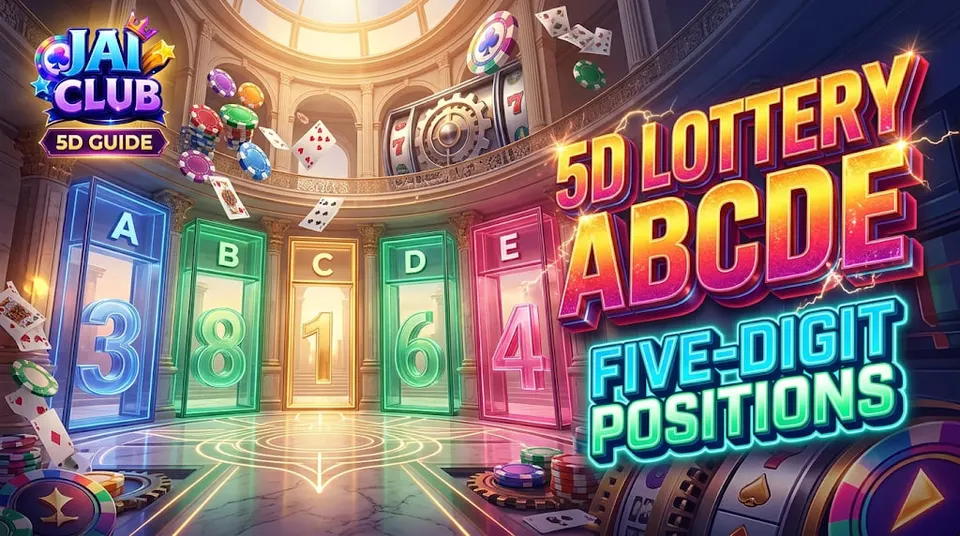
Quick answer: In a five-position number format, each position contains one digit. For example, the sequence 3-8-1-6-4 contains five positions. A is 3, B is 8, C is 1, D is 6 and E is 4. The letters are position labels, not additional numbers.
This guide explains the ABCDE structure, digit order, leading zeros and how to distinguish an entire five-digit sequence from one of its individual positions. The examples are mathematical illustrations. Actual game selections, payouts and result classifications depend on the verified version of the game.
5D Lottery ABCDE Ka Matlab
The term 5D is commonly used to describe a format involving five numerical positions. The letters A, B, C, D and E provide a convenient way to identify each position separately.
For example, the result 4-2-7-0-9 can be described as A = 4, B = 2, C = 7, D = 0 and E = 9.
The letters are not values selected from the alphabet. They are labels associated with the positions occupied by digits.
This distinction helps readers discuss a specific position without repeating the entire sequence.
A guide referring to position C, for example, is discussing the third digit rather than the complete five-digit number.
How Five-Digit Results Are Displayed
A five-digit sequence can be displayed as a continuous group, such as 42709, or with separators, such as 4-2-7-0-9.
Both presentations contain the same five digits in the same order.
However, some interfaces may use separate boxes for each position. A result history might also display position labels above the digits.
The formatting can change without changing the actual sequence.
When reading a 5D result, it is important to preserve the order and position of every digit rather than treating the display as an unordered set.
Understanding Positions A, B, C, D and E
The ABCDE structure separates a five-position sequence into individual fields.
Consider the fictional result 3-8-1-6-4.
| Position | Digit | Meaning |
|---|---|---|
| A | 3 | First digit |
| B | 8 | Second digit |
| C | 1 | Third digit |
| D | 6 | Fourth digit |
| E | 4 | Fifth digit |
This example makes it possible to identify each part of the sequence independently.
A reference to position B in this result means the digit 8. A reference to position E means the digit 4.
The exact meaning of any game category associated with those positions must be checked against the particular operator's rules.
5D Result Me Position Kyu Important Hai
Position matters because two sequences can contain the same digits but arrange them differently.
For example, 38164 and 83164 contain the same five digit values, but their first two positions have changed.
In the first sequence, A = 3 and B = 8. In the second, A = 8 and B = 3.
The full sequences are therefore different.
This distinction becomes important whenever a result format refers to exact positions. A category involving the first digit is not necessarily equivalent to one involving the second digit.
Full Sequence vs Single Position
A complete five-digit result and an individual digit position are different pieces of information.
The full sequence identifies all five values together. A single position identifies only one component.
For example, the result 5-1-9-2-7 contains the entire five-position sequence. If someone asks for position D, the relevant digit is 2.
The remaining four digits do not change which value occupies D.
A game interface may present both the full result and individual position-related information, but they should not be confused.
Does Changing the Order Change the Result?
Yes. Changing the order changes the five-position sequence.
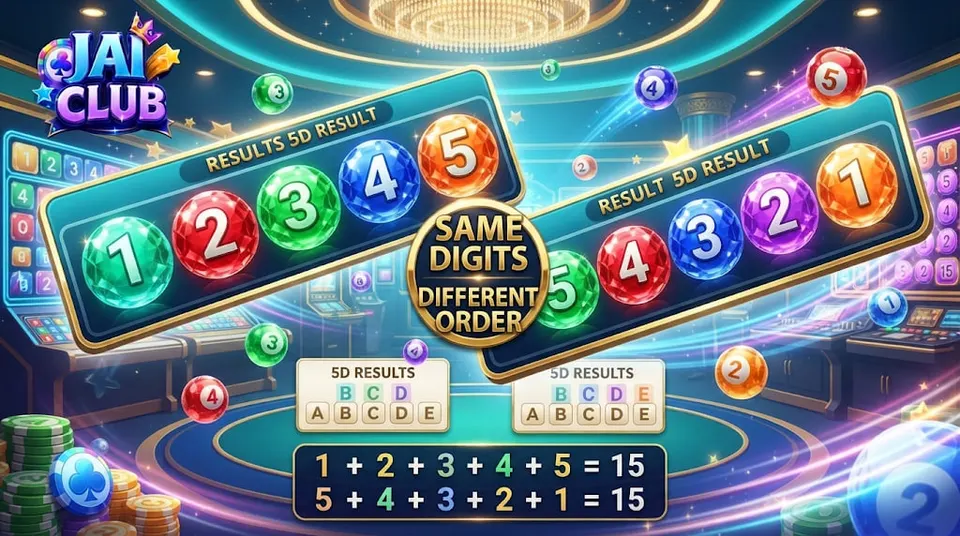
Consider two fictional results:
1-2-3-4-5
5-4-3-2-1
They contain the same collection of digits but occupy different positions.
The first has A = 1 and E = 5. The second has A = 5 and E = 1.
This means they are not the same ordered result.
Whether a game offers separate conditions involving order is determined by its published rules. The mathematical difference between the sequences, however, is clear.
Leading Zero in 5D Lottery
One common source of confusion is the use of zero at the beginning of a five-digit sequence.
Suppose the displayed result is 0-0-4-5-7. It still contains five positions even though its first two digits are zero.
If the sequence is treated as an ordinary integer, leading zeros may disappear. The value might then be written as 457.
But in a five-position game format, the representation 00457 and the number 457 are not equivalent as formatted results.
The first preserves five positions, while the second contains only three visible digits.
This is why a result history should retain leading zeros where the game treats positions as significant.
Five Digits vs One Large Number
A 5D result can look like a five-digit integer, but it may be more useful to treat it as a sequence of five separate digits.
For example, 12345 can be read as the number twelve thousand three hundred and forty-five in ordinary arithmetic.
In a position-based game, however, the important information may be that A = 1, B = 2, C = 3, D = 4 and E = 5.
Both descriptions are mathematically possible, but they serve different purposes.
When examining result rules, the position-based interpretation should not be replaced with ordinary place-value assumptions unless the documentation supports that interpretation.
5D Digit Sum vs Position Values
A digit sum is obtained by adding the digits together. This is different from reading the five-position sequence.
For example, the sequence 3-8-1-6-4 has a digit sum of:
3 + 8 + 1 + 6 + 4 = 22
The result still contains the five digits 3, 8, 1, 6 and 4. The sum of 22 is a separately calculated value.
A result display may show the sequence and its total if the relevant game format includes that information.
However, the existence of a digit sum does not mean that every operator settles outcomes according to that value.
The sum and the positions should be understood as distinct concepts.
How Many Possible Five-Digit Sequences Exist?
If a format contains five positions and each position can independently contain one of the ten digits from 0 to 9, the total number of possible ordered sequences is:
10 × 10 × 10 × 10 × 10 = 100,000
These possibilities range from 00000 to 99999 when the five-position formatting is preserved.
The calculation describes the size of the mathematical sample space. It does not establish that every sequence is equally likely in a particular game.
Equal probability would require additional assumptions about how each position is generated.
The actual outcome-generation method must be verified separately.
Repeated Digits in 5D Results
A five-position sequence may contain repeated digits.
For example, 4-4-1-4-7 contains the digit 4 in three different positions. The repetition does not reduce the number of positions.
Likewise, a sequence such as 0-0-0-0-0 still contains five position values.
Repeated digits are mathematically valid within a format that permits each position to take any digit from 0 to 9.
A result should therefore not be considered invalid merely because some or all of its digits are repeated.
Reading a 5D Result History
A result history may contain a round identifier followed by the five-digit result. Some interfaces may display additional labels or calculated categories.
When reviewing the history, first identify the specific round. Then read the five digits from left to right while preserving zeros and repetitions.
This makes it easier to compare the displayed sequence with any separately listed position values.
If the interface shows a calculation based on the digits, that calculation can be checked independently.
However, a result history should not be treated as evidence that future sequences can be predicted from previous ones.
For broader information about the available gaming categories, read the Jai Club Games Guide.
Why Different Screens May Show Different Formatting
A mobile application, webpage and exported file may display numbers differently.
One interface might place the digits in separate boxes, while another uses a continuous five-character string. A spreadsheet could even remove leading zeros when it automatically interprets the data as a number.
These formatting differences can create apparent mismatches even when the underlying sequence is identical.
To compare records accurately, use a consistent five-position representation.
If a result has been copied into another program, confirm that its order and leading zeros were preserved.
5D Lottery and Number Prediction Claims
The existence of five digit positions does not establish that future outcomes can be predicted.
A chart may show earlier sequences and highlight repeated digits, but those observations do not automatically reveal the next result.
In an independently generated process, historical patterns do not force a particular sequence to appear.
Claims about guaranteed 5D predictions, secret formulas or permanently accurate number signals should therefore be treated cautiously.
Understanding the result format is useful for interpreting completed events, not for guaranteeing future financial outcomes.
Common 5D Reading Mistakes
A common mistake is ignoring the position labels and treating the digits as an unordered collection. This can lead to confusion when comparing two sequences with the same digit values in different orders.
Another mistake is removing leading zeros, which changes the five-position representation.
Some readers also confuse the digit sum with the sequence itself or mistake the round identifier for the five-digit outcome.
The clearest way to avoid these errors is to read the values consistently from A through E and identify each field according to the displayed rules.
5D Lottery ABCDE FAQ
What does ABCDE mean in 5D Lottery?
The letters identify the five digit positions, from the first through the fifth.
How many digits are in a 5D result?
A five-position result contains five digits.
Can the first digit be zero?
Yes, in a mathematical five-position format that allows each position to contain digits from 0 to 9.
Is 00457 a five-digit sequence?
Yes. It contains five positions when the leading zeros are preserved.
Does the order of digits matter?
Yes. Different digit orders produce different ordered sequences.
Is the digit sum the same as the full result?
No. The sum is calculated from the individual digits.
Can a 5D sequence contain repeated numbers?
Yes. Repeated digits are valid in a format that permits them.
Are there 100,000 possible five-digit sequences?
Yes, if all five positions can independently take any of the ten digits from 0 to 9.
Does this confirm every Jai Club 5D game rule?
No. This article explains the underlying number format. Exact game conditions must be verified separately.
Conclusion
A 5D Lottery result can be understood as five ordered numerical positions labelled A, B, C, D and E.
Each position has its own value, and changing the order changes the full sequence. Leading zeros and repeated digits should be preserved when interpreting a result.
These simple mathematical principles help readers understand game interfaces and historical records without confusing individual digits, calculated sums and round identifiers.
For more educational information about Jai Club game formats, visit JaiClubGame.com and the Jai Club Games Guide.
Editorial note: This article uses fictional sequences to explain five-position number formats. It does not provide game predictions or claim to verify a particular operator's complete 5D rulebook.