5D Lottery Sum Calculation: Adding Five Digit Positions Correctly
Learn how to calculate a 5D Lottery digit sum using five positions, why zeros and repeated numbers matter, and how to avoid confusing a five-digit result with its calculated total.

In this article
- What Is a 5D Lottery Sum?
- 5D Lottery Sum Kaise Calculate Hota Hai
- Understanding Positions A, B, C, D and E
- Why the Digit Sum Is Different From the Result Number
- 5D Sum Example Table
- Minimum and Maximum 5D Digit Sums
- Leading Zero Aur Sum Calculation
- Repeated Digits in a 5D Sum
- Does Digit Order Change the Sum?
- Why Different 5D Results Can Share a Sum
- Five-Digit Number vs Place Value
- How to Check a 5D Sum in a Spreadsheet
- Can a 5D Sum Calculator Predict Results?
- Theoretical Sum Distribution
- Common Mistakes When Adding 5D Digits
- Understanding Game-Specific Sum Rules
- Frequently Asked Questions
- What is a 5D Lottery sum?
- How do I calculate the sum of 38164?
- What is the sum of 00457?
- What is the highest possible five-digit sum?
- What is the minimum possible sum?
- Does changing the digit order change the sum?
- Do repeated numbers count more than once?
- Can different 5D numbers have the same sum?
- Does a sum calculator predict the next 5D result?
- Are these verified Jai Club payout rules?
- Conclusion
A 5D Lottery result is commonly represented as a sequence containing five numerical positions. In some guides, these positions are labelled A, B, C, D and E. Readers may also encounter a calculated sum, which is the total obtained by adding the five individual digits.
Quick answer: To calculate the digit sum of a five-position result, add all five values separately. For example, the fictional result 3-8-1-6-4 has a digit sum of 22 because 3 + 8 + 1 + 6 + 4 = 22.
This guide explains 5D sum calculations step by step, including the treatment of zeros, repeated digits and common formatting errors. The arithmetic applies to any five-digit sequence. Whether a specific Jai Club 5D version uses the sum as a game category or settlement condition must be checked against its actual rules.
What Is a 5D Lottery Sum?
A digit sum is the total of the individual values within a number sequence.
In a five-position format, each position contains one digit. Adding these five digits produces the sum.
For example, a fictional result of 2-5-0-7-1 gives:
2 + 5 + 0 + 7 + 1 = 15
The complete result remains 25071 when written as a continuous five-character sequence.
The sum of 15 is a separately calculated property of that result.
This distinction is important because the five-digit number and its digit sum are not interchangeable.
5D Lottery Sum Kaise Calculate Hota Hai
The calculation follows ordinary addition.
Begin by identifying the five digits in their displayed order. Each digit should be considered separately rather than treating the entire sequence as one large integer.
Next, add the values one at a time.
For the fictional result 4-1-6-0-8, begin with 4 + 1 = 5. Add 6 to obtain 11. Add 0, which leaves the total unchanged. Finally, add 8 to obtain 19.
The final sum is therefore 19.
The arithmetic is straightforward, but care is needed when reading results that contain leading zeros or closely spaced digits.
Understanding Positions A, B, C, D and E
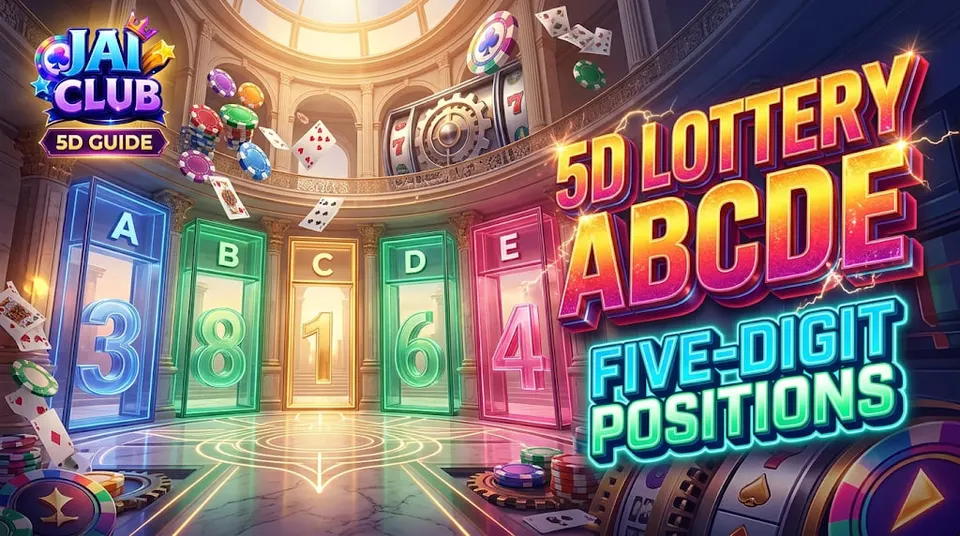
The labels A, B, C, D and E help identify the five positions independently.
Consider the result 3-8-1-6-4.
| Position | Value |
|---|---|
| A | 3 |
| B | 8 |
| C | 1 |
| D | 6 |
| E | 4 |
| Total | 22 |
The position labels identify where the digits appear, but the sum is obtained by adding the values rather than adding the letters.
For ordinary digit addition, changing the order of these five values does not change their sum.
However, it does change the complete five-position sequence.
Why the Digit Sum Is Different From the Result Number
A five-digit result and its digit sum answer different questions.
The sequence 38164 identifies five ordered digits. The number 22 describes the total of those digits.
Another sequence may have the same sum while containing a different arrangement or completely different values.
For example, 1-4-5-6-6 also has a digit sum of 22 because 1 + 4 + 5 + 6 + 6 = 22.
The two sequences are not the same result.
Therefore, a displayed sum cannot normally identify the complete five-digit outcome without additional information.
5D Sum Example Table
The following examples are fictional and demonstrate ordinary arithmetic.
| Five-digit sequence | Calculation | Digit sum |
|---|---|---|
| 38164 | 3 + 8 + 1 + 6 + 4 | 22 |
| 42017 | 4 + 2 + 0 + 1 + 7 | 14 |
| 55555 | 5 + 5 + 5 + 5 + 5 | 25 |
| 00457 | 0 + 0 + 4 + 5 + 7 | 16 |
| 99999 | 9 + 9 + 9 + 9 + 9 | 45 |
| 00000 | 0 + 0 + 0 + 0 + 0 | 0 |
| 72036 | 7 + 2 + 0 + 3 + 6 | 18 |
| 12345 | 1 + 2 + 3 + 4 + 5 | 15 |
These calculations are mathematical examples rather than actual Jai Club records.
The table illustrates that many different sequences can produce the same sum.
Minimum and Maximum 5D Digit Sums
Suppose a five-position format allows each position to contain any digit from 0 to 9.
The lowest possible sum is obtained when every position contains zero:
0 + 0 + 0 + 0 + 0 = 0
The highest possible sum is obtained when every position contains nine:
9 + 9 + 9 + 9 + 9 = 45
Under these assumptions, the mathematical digit-sum range is 0 through 45.
That range describes possible arithmetic totals. It does not prove that a particular gaming service uses every sum as a selectable category.
Leading Zero Aur Sum Calculation
A leading zero is a zero at the beginning of a digit sequence.
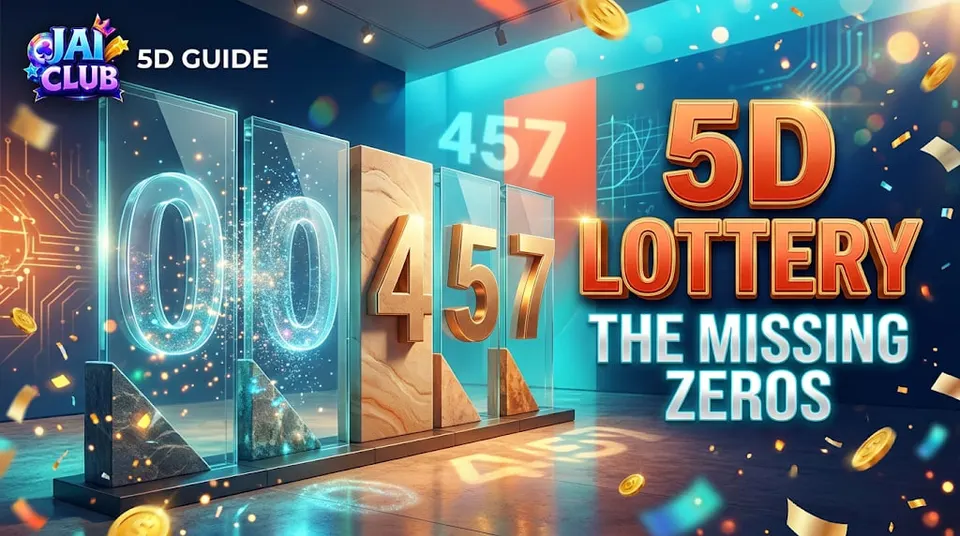
In a five-position format, the result 00457 contains five characters even though an ordinary calculator may display it as the integer 457.
For digit-sum calculation, the two leading zeros contribute nothing to the arithmetic total:
0 + 0 + 4 + 5 + 7 = 16
However, the zeros still matter when preserving the original five-position representation.
Removing them may cause confusion when identifying positions A through E.
For more information about position labels, read the 5D Lottery ABCDE Guide.
Repeated Digits in a 5D Sum
Repeated values must be counted each time they appear.
For example, the sequence 7-7-1-7-2 contains three appearances of the digit 7.
Its sum is:
7 + 7 + 1 + 7 + 2 = 24
A common mistake is adding the repeated value only once because the number appears several times.
That would produce an incorrect result.
Each of the five positions contributes one value to the total, including repeated digits.
The sum depends on the five individual positions, not on the number of distinct digit labels.
Does Digit Order Change the Sum?
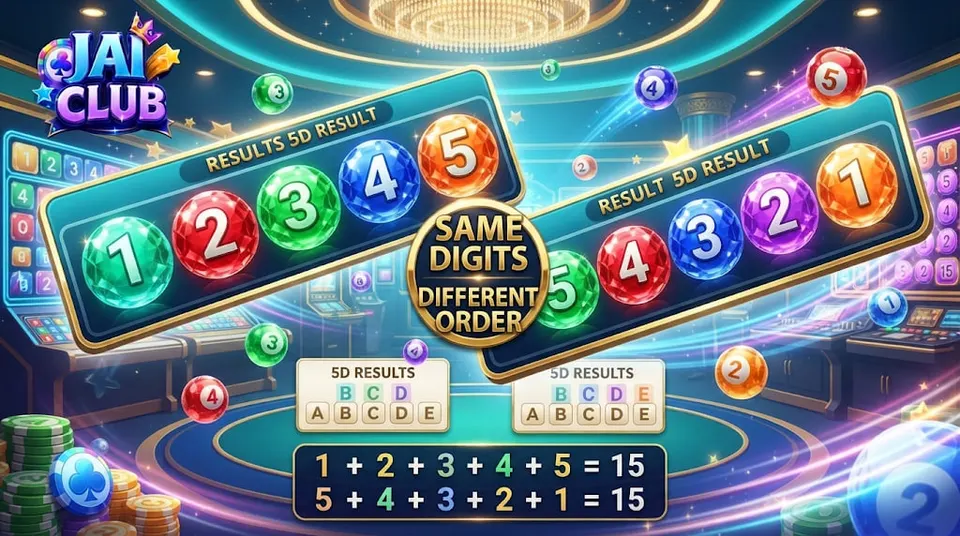
No. Ordinary addition produces the same total when the same values are rearranged.
For example:
1 + 2 + 3 + 4 + 5 = 15
The reversed order also produces 15:
5 + 4 + 3 + 2 + 1 = 15
However, the sequences 12345 and 54321 are different ordered results.
This distinction matters if the game uses position-specific categories in addition to a digit sum.
The same total does not mean that two five-position results are identical.
Why Different 5D Results Can Share a Sum
There are many ways to arrange five digits so that they add to the same total.
For example, the sum 10 can be produced by 0-0-0-1-9, 1-1-2-3-3 or 2-2-2-2-2.
Each example has five digits and produces the same total of 10.
However, the exact sequences differ.
A sum chart therefore groups multiple possible sequences into one total.
This is useful for understanding the mathematical structure, but it does not reveal the five digits that will appear in a future result.
Five-Digit Number vs Place Value
The ordinary integer 38164 can be understood using place values: ten-thousands, thousands, hundreds, tens and units.
A 5D digit sum ignores those place-value weights and adds only the individual digits.
The number 38164 is therefore not added as thirty-eight thousand one hundred and sixty-four.
Instead, it is separated into 3, 8, 1, 6 and 4.
This is an important distinction when using calculators or spreadsheets.
A tool configured for ordinary integer addition will not automatically produce the digit sum unless it is designed to separate the digits first.
How to Check a 5D Sum in a Spreadsheet
A spreadsheet can help organise digit values and calculate their total.
If the five positions are stored separately, the calculation is simply the sum of those five cells.
For example, if cells A2 through E2 contain 3, 8, 1, 6 and 4, a conventional spreadsheet formula such as =SUM(A2:E2) returns 22.
This is an illustration of spreadsheet arithmetic, not a gaming prediction formula.
Care should be taken when importing results as one continuous string because leading zeros may disappear if the software treats the value as an ordinary number.
Keeping the original five-position representation preserves the information needed for correct interpretation.
Can a 5D Sum Calculator Predict Results?
A sum calculator performs arithmetic on values supplied to it.
If the five digits are known, it can calculate their total accurately. That is different from predicting which digits will appear in the future.
A calculator showing a future number without a verified forecasting method is generating a suggestion rather than confirming an outcome.
Historical charts can show previous sums, repeated totals and changes in frequency.
However, these observations do not automatically establish a reliable prediction system.
The existence of a correct formula for adding digits does not make future game outcomes predictable.
Theoretical Sum Distribution
Under a model where each of the five positions is generated independently and uniformly from 0 to 9, there are 100,000 possible ordered sequences.
However, the 46 possible digit sums from 0 through 45 are not equally likely under that model.
A sum of zero can arise only from 00000. A middle-range sum can arise from many different sequences.
This means that the number of possible digit sums is not the same as the number of equally likely outcomes.
The actual distribution depends on the assumptions of the model.
These mathematical statements should not be confused with an independent audit of a specific Jai Club game's result generator.
Common Mistakes When Adding 5D Digits
One common mistake is treating the complete five-digit sequence as the sum.
Another is ignoring zeros or repeated numbers when reading individual positions.
A third is copying a result into software that removes leading zeros and then comparing the shortened display with the original five-position record.
Readers may also confuse a round identifier with the actual five-digit outcome.
These mistakes can be avoided by identifying the correct result, separating its five digits and calculating the total independently.
Understanding Game-Specific Sum Rules
Some five-digit game formats may use calculated totals in their result categories.
However, the existence of a digit sum does not establish which selections are available or what settlement rules apply.
The operator's actual documentation should explain whether the sum is used and how it is interpreted.
A general arithmetic article cannot determine payout conditions from the calculation alone.
The same caution applies to claims that particular totals are financially favourable.
Correct mathematics helps readers understand displayed information but does not guarantee any result.
Frequently Asked Questions
What is a 5D Lottery sum?
It is the total obtained by adding the five individual digits of a result.
How do I calculate the sum of 38164?
Add 3 + 8 + 1 + 6 + 4 to obtain 22.
What is the sum of 00457?
It is 16 because 0 + 0 + 4 + 5 + 7 = 16.
What is the highest possible five-digit sum?
It is 45 when all five digits are 9, under the standard 0–9 position model.
What is the minimum possible sum?
It is zero when all five positions contain zero.
Does changing the digit order change the sum?
No. The same values produce the same arithmetic total.
Do repeated numbers count more than once?
Yes. Every position contributes its own value.
Can different 5D numbers have the same sum?
Yes. Many different sequences produce identical totals.
Does a sum calculator predict the next 5D result?
No. Calculating a known total is different from forecasting unknown digits.
Are these verified Jai Club payout rules?
No. They are mathematical explanations; game-specific conditions must be checked separately.
Conclusion
5D Lottery sum calculation is based on simple addition. Each of the five digits contributes its value to the total, including zeros and repeated numbers.
The mathematical sum can range from 0 to 45 under a five-position decimal model. Different five-digit sequences may share the same total, even though their ordered positions are different.
Understanding this arithmetic helps readers interpret completed results and avoid formatting mistakes. It does not establish a method for predicting future outcomes.
For an overview of related formats, read the Jai Club Games Guide.
Editorial note: All sequences and calculations are illustrative. Specific game categories and settlement rules require separate verification.