TRX Wingo Block Number Explained: Reading On-Chain Event References
Understand TRX Wingo block-number terminology, how TRON blockchain heights identify blocks, why a block number differs from a transaction hash and what game-result verification requires.
In this article
- What Is a TRX Wingo Block Number?
- Understanding Blockchain Height
- TRON Block Numbers and TRX
- Block Number vs Block Hash
- Block Number vs Transaction Hash
- Block Number, Hash and Period ID Comparison
- A Fictional Blockchain Example
- Why Block Number Order Matters
- How a Game Might Reference a Blockchain Block
- What a Block Number Can Verify
- What a Block Number Cannot Prove
- Why Timestamp Information Matters
- Block Height and Confirmation Delay
- Can a Block Number Predict the Next Wingo Result?
- Block Number vs Wingo Round Number
- Recognising Incomplete Blockchain Proof Claims
- Why Screenshots Are Not Enough
- TRX Wingo and Other Number-Based Games
- Frequently Asked Questions
- What is a TRX Wingo block number?
- Is a block number the same as a transaction hash?
- Is block height the same as block hash?
- Can one block contain several transactions?
- Is a Wingo period ID a blockchain block number?
- Does a valid block number prove a game result is fair?
- Can block numbers predict future Wingo results?
- Why can blockchain timestamps and game times differ?
- Is every TRX Wingo result verified on TRON?
- Conclusion
TRX Wingo discussions often include technical terms such as block number, block hash, transaction ID and period number. These labels can look similar when they appear beside a game result, but they identify different things.
A block number is especially important because it refers to a particular position within a blockchain's sequence of recorded blocks.
Quick answer: A blockchain block number identifies a block's height or position in the chain. It is not the same as a transaction hash, block hash or Wingo round ID. A real block number can help locate a blockchain record, but it does not automatically prove that a game result was generated from that block.
This guide explains the purpose of block numbers, their relationship with other identifiers and the evidence needed to evaluate a TRX Wingo blockchain claim. It does not assert that Jai Club's current TRX Wingo game uses any specific block-selection algorithm.
What Is a TRX Wingo Block Number?
A block number is a numerical identifier associated with a particular block in a blockchain.
In the TRON network, blocks are arranged in a sequence, and their height indicates their position relative to the beginning of that chain.
The number is useful for locating records and understanding the order in which blocks were produced.
For example, a fictional chain illustration might contain blocks numbered 100, 101 and 102.
These are example identifiers, not live TRON block references.
A block's height can tell readers where it belongs in the network's sequence, but it does not reveal how a particular gaming result was calculated.
Understanding Blockchain Height
Blockchain height is another term used for the position of a block within the chain.
As new blocks are added, the chain's height generally increases.
A higher block number normally refers to a later position in the chain.
However, the number should not be interpreted as a timestamp or a game period by itself.
Block production occurs according to the network's operation, while gaming rounds may use their own scheduling and identifiers.
Two systems can display increasing numbers without those numbers representing the same events.
TRON Block Numbers and TRX
TRON is a blockchain network, while TRX is its native cryptocurrency.
The network records transactions and other supported activity in blocks.
A block can contain multiple transactions or other relevant records, depending on its contents.
Readers may encounter block numbers when examining blockchain information or investigating a claimed association between a public network event and a game outcome.
However, a game using TRX terminology does not automatically establish that its results come from the TRON network.
The actual relationship depends on documented and independently checkable technical rules.
Block Number vs Block Hash
A block number identifies the position of a block.
A block hash is a cryptographic identifier associated with that block.
Although both can refer to the same block, they are not interchangeable.
The block number is usually displayed as an ordinary integer. A block hash is typically a longer encoded value.
A technical description that requires a block hash cannot necessarily be reproduced by supplying only the block number.
The exact input matters if someone claims to calculate a result from blockchain data.
Block Number vs Transaction Hash
A transaction hash identifies an individual blockchain transaction.
A block number identifies a block that may contain multiple transactions.
Therefore, one block can be associated with several transaction identifiers.
A user attempting to verify a specific transaction needs more than a general block number when that block contains many records.
Likewise, finding a real transaction inside a block does not automatically connect it to a particular game round.
The mapping between blockchain records and game outcomes requires independent explanation.
Block Number, Hash and Period ID Comparison
| Identifier | Purpose |
|---|---|
| Block number | Identifies a block's position |
| Block hash | Identifies a particular block cryptographically |
| Transaction hash | Identifies an individual transaction |
| Game period ID | Identifies a game round |
| Game result | Records the outcome associated with a round |
All these fields may be relevant to a technical claim, but each answers a different question.
A meaningful verification process must explain which identifier is used and why.
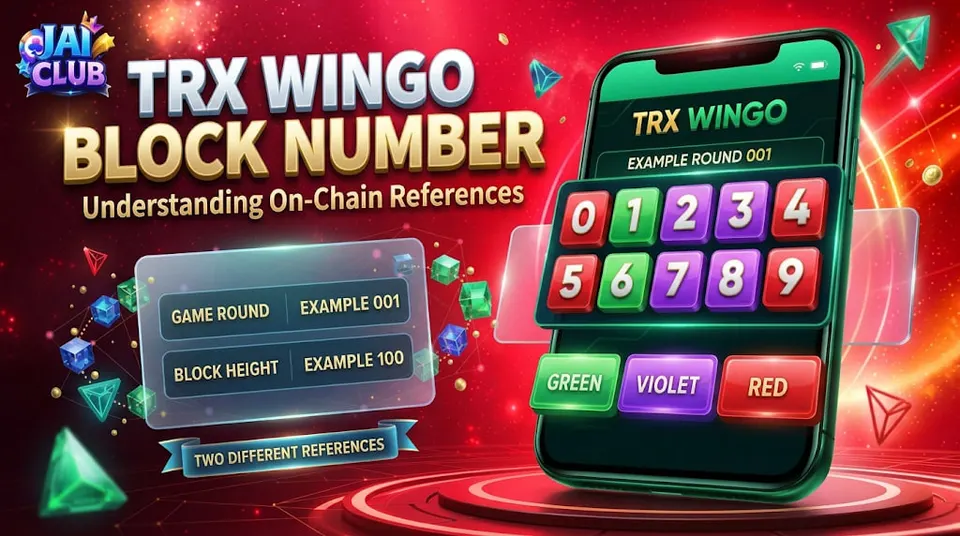
A Fictional Blockchain Example
Imagine a demonstration system that identifies a completed round as EXAMPLE-ROUND-001.
The same interface displays a fictional blockchain reference labelled BLOCK-100.
The first identifier belongs to the game. The second is intended to refer to a blockchain event.
Without a published method, the relationship between them remains unknown.
A reader cannot simply take the final digit of BLOCK-100 and assume that the game result must be zero.
That would be an invented rule rather than a verified calculation.
The example shows why a technical-looking reference is not enough.
Why Block Number Order Matters
Blockchain block numbers help readers understand the sequence of recorded events.
If Block 101 follows Block 100 on the same chain, it belongs to a later height.
However, the network sequence does not necessarily match the number of completed rounds in a gaming system.
A game might have its own round schedule or period format.
Therefore, the next game period should not automatically be matched to the next blockchain block.
Any such relationship must come from the operator's published method.
How a Game Might Reference a Blockchain Block
A hypothetical system could specify a future block as an input to a result calculation.
For example, the rule might identify a block by its height and define which part of its data will be used.
A credible method should also explain when that height is selected and how the final displayed result is derived.
Timing matters because a system that can choose among already known blocks might be able to influence which data becomes the input.
This is a general technical concern, not an allegation about any particular Jai Club implementation.
The game would need to publish sufficient information for independent reproduction.
What a Block Number Can Verify
A genuine block number can help identify a block that exists on the relevant blockchain.
It may also help locate associated network records.
However, that does not prove that an external gaming service selected the block before its contents became known.
Nor does it prove that the game applied a particular result formula correctly.
A verifiable network event and a verifiable game outcome are different concepts.
Both parts must be connected through a documented process.
What a Block Number Cannot Prove
A block number alone does not prove that a game is fair, audited or free from manipulation.
It also does not reveal the probability of future Wingo numbers.
A screenshot showing a block height beside a colour result does not explain the software used to generate the outcome.
The reader would need the actual calculation rule and evidence about the selected source event.
Without that information, the safest conclusion is that a block reference is visible, not that the game has been independently verified.
Why Timestamp Information Matters
Blocks may have timestamps associated with their production.
Game rounds can also have timestamps for opening, closing or result publication.
These times may differ because they refer to separate operations.
Time-zone formatting can create additional confusion.
For example, India Standard Time is five hours and thirty minutes ahead of UTC.
A timestamp of 13:00 UTC and 18:30 IST refers to the same moment.
Therefore, a displayed clock difference should not automatically be interpreted as a delayed or manipulated game result.
Block Height and Confirmation Delay
The latest block height can continue increasing while a particular transaction or record moves through a confirmation process.
Block inclusion and finality are related but distinct concepts.
A blockchain explorer may also take time to display updated information.
A reader should not assume that a game's timer reaching zero means every associated blockchain process, if there is one, has completed.
The precise timing depends on the network and the game's implementation.
This distinction is useful when reading technical claims about TRX Wingo confirmation delays.
Can a Block Number Predict the Next Wingo Result?
A block number by itself does not establish a prediction method.
If a game's documented process uses an unknown future block as a source of input data, knowing the future height would not necessarily reveal the contents of that block.
Similarly, simply observing previous block numbers does not prove that future colour results follow a predictable pattern.
A claim that the final digit of a block number guarantees the next Wingo outcome needs evidence of the actual calculation method.
Without such documentation, it remains an unsupported prediction claim.
Block Number vs Wingo Round Number
A game round number may increase as new periods begin.
A blockchain block number also increases as new blocks are appended.
The superficial similarity can create confusion, especially when both are long numbers.
However, they originate in different systems.
The game operator may define the format of its period identifier, while the blockchain network determines block heights according to its own operation.
A reader should not use one number in place of the other without an explicit mapping.
Recognising Incomplete Blockchain Proof Claims
Some promotional materials may display a block number, transaction hash and screenshot together.
This can create an impression of technical transparency.
However, the material may omit the rule connecting those references to the displayed game result.
A complete explanation should identify the network, relevant block, data-selection method and calculation formula.
It should also allow independent reproduction of the claimed outcome.
A real block reference is useful evidence about the network, but it is not a substitute for these additional requirements.
Why Screenshots Are Not Enough
Screenshots can be edited or cropped.
They can also show a genuine blockchain reference that is unrelated to the claimed game round.
The presence of a recognisable logo or a detailed technical code does not independently establish authenticity.
Readers should distinguish between verifying that a record exists and verifying the broader claim attached to it.
An authorised historical record is generally more informative than an isolated image, but the game-specific mapping still needs documentation.
For related background, read the TRX Wingo Blockchain Proof Guide.
TRX Wingo and Other Number-Based Games
TRX Wingo is discussed using number and colour terminology, while other game formats may use different kinds of results.
K3 Lottery commonly concerns three displayed dice values, and 5D Lottery uses five digit positions.
Moto Racing uses participant rankings.
These differences explain why one game's identifier or result format should not automatically be applied to another.
For a broad overview of these categories, visit the Jai Club Games Guide.
Frequently Asked Questions
What is a TRX Wingo block number?
It is a block-height reference when used to identify a block on the TRON blockchain.
Is a block number the same as a transaction hash?
No. A block number identifies a block's position, while a transaction hash identifies a transaction.
Is block height the same as block hash?
No. Height is a numerical position; a hash is a cryptographic identifier.
Can one block contain several transactions?
Yes. A blockchain block can contain multiple transactions.
Is a Wingo period ID a blockchain block number?
Not automatically. They belong to different recordkeeping systems unless a documented mapping connects them.
Does a valid block number prove a game result is fair?
No. The selection and calculation method must also be verified.
Can block numbers predict future Wingo results?
No reliable prediction follows from block numbers alone.
Why can blockchain timestamps and game times differ?
They may represent different events or use different time zones.
Is every TRX Wingo result verified on TRON?
This article does not independently confirm that a particular operator uses TRON blocks to generate all outcomes.
Conclusion
A TRX Wingo block number is a technical reference that should be distinguished from block hashes, transaction IDs and game period identifiers.
A real blockchain record can establish facts about the network, but it does not automatically establish how a gaming service generated its result.
Independent verification requires a clear mapping between the selected source event and the displayed outcome.
Understanding these distinctions helps readers interpret technical claims without mistaking blockchain terminology for guaranteed fairness or prediction accuracy.
Editorial note: All fictional block and round references are explanatory examples, not live Jai Club results.