TRX Wingo Blockchain Proof Ka Sach: What a Transaction Hash Really Shows
Understand TRX Wingo blockchain claims, transaction hashes, TRON records and what an on-chain transaction can actually prove about a game result.
In this article
- TRX Wingo Blockchain Proof Ka Matlab
- TRX and TRON: Understanding the Difference
- What Is a Transaction Hash?
- Transaction Hash vs Block Hash
- What Can a TRON Explorer Verify?
- Blockchain Record vs Game Claim
- TRX Wingo Hash Se Number Kaise Banta Hai
- Why a Valid Hash Does Not Prove a Fair Result
- What Is a Deterministic Result Formula?
- Blockchain Transparency vs Game Fairness
- The Importance of Result Timing
- TRX Wingo Round ID vs Transaction ID
- Blockchain Screenshot vs On-Chain Evidence
- What About TRX Wingo Prediction Bots?
- What Evidence Would Support a Strong Verification Claim?
- TRX Wingo and Account Transactions
- TRX Wingo Blockchain FAQ
- What is TRX Wingo?
- What is a TRX transaction hash?
- Does a valid hash prove a game result is fair?
- Can a blockchain explorer show transaction details?
- Is a transaction hash the same as a period ID?
- Can blockchain data be used to calculate a game result?
- Does this article confirm Jai Club's result algorithm?
- Can TRX Wingo future results be guaranteed by a bot?
- Is every TRX payment a game result proof?
- Conclusion
TRX Wingo is a term often found in searches about number-based games, cryptocurrency and blockchain result verification. Some gaming-related websites use technical words such as transaction hash, TRON block, blockchain proof and transparent results. These terms can make a game appear technically verifiable, but their actual meaning needs to be understood carefully.
Quick answer: A blockchain transaction hash can identify a transaction recorded on a blockchain, provided it is a genuine transaction identifier. However, the existence of a hash does not automatically prove that a game result was generated fairly, calculated correctly or linked to that transaction under a published rule.
This guide explains what TRX, TRON, transaction hashes and on-chain records mean. It also shows what evidence would be needed to verify a claim connecting blockchain data to a Wingo-style number result. The article does not claim that Jai Club's current TRX Wingo system has been independently audited.
TRX Wingo Blockchain Proof Ka Matlab
The phrase blockchain proof is often used when a service claims that its results can be checked using public blockchain information.
A blockchain can record transactions and other network events in a way that allows people to examine the published data. This can make certain claims independently checkable.
However, there is an important difference between verifying a blockchain record and verifying an entire game.
A record may show that a transaction exists. It does not necessarily show how a game selected its result, when the operator committed to a particular rule or whether the displayed outcome was calculated correctly.
Those questions require additional evidence beyond a transaction identifier.
TRX and TRON: Understanding the Difference
TRON is a blockchain network, while TRX is its native cryptocurrency.
TRX can be used within the TRON ecosystem, including for network operations and transactions. Blockchain explorers can display information about activity recorded on the network.
Some gaming services use TRX or TRON terminology in product names or explanations. However, a game carrying the letters TRX does not by itself establish that its outcomes are generated from genuine TRON blockchain events.
The actual relationship must be documented and independently verifiable.
Readers should distinguish the network, the cryptocurrency, the game interface and the operator's result-generation rules.
What Is a Transaction Hash?
A transaction hash, often called a transaction ID or TXID, is an identifier used to reference a particular blockchain transaction.
In many blockchain systems, a transaction hash can be entered into a compatible explorer to locate information about the transaction.
The resulting page may display details such as the transaction's status, associated addresses, recorded value, block information and other available data.
The precise fields depend on the network, transaction type and explorer.
A genuine identifier is useful because it can connect a claim to a specific public record. However, an unrelated transaction can still be presented alongside a game screenshot without proving a meaningful connection.
Transaction Hash vs Block Hash
Transaction hashes and block hashes are related to blockchain records but identify different things.
A transaction hash refers to a particular transaction. A block hash identifies a block within the blockchain structure.
A block can contain multiple transactions, so these identifiers should not be treated as interchangeable.
The distinction matters when a gaming interface claims to use a particular blockchain value as the basis for a result.
If the published method specifies a block hash but the displayed proof contains only a transaction ID, the available evidence may not be sufficient to reproduce the result.
What Can a TRON Explorer Verify?
A blockchain explorer provides a way to examine publicly available blockchain records.
If a transaction hash is genuine and belongs to the relevant network, an explorer may show whether the transaction was recorded and what information is publicly associated with it.
This can help confirm that a particular on-chain event exists.
However, the explorer cannot automatically establish why a gaming platform selected that event or whether the game followed its advertised settlement rules.
The operator must supply a clear link between the on-chain data and the outcome being claimed.
Blockchain Record vs Game Claim
| Information | What it may establish |
|---|---|
| Transaction hash | Identity of an on-chain transaction |
| Transaction status | Whether the transaction is recorded or confirmed |
| Block reference | The block containing the event |
| Blockchain timestamp | Time associated with the recorded block |
| Game period ID | The game's own round identifier |
| Result mapping rule | How a stated blockchain value is converted into a game result |
| Independent audit | Evidence about the implementation and controls |
A real blockchain record does not independently verify the last three items.
TRX Wingo Hash Se Number Kaise Banta Hai
A game claiming to calculate results from blockchain information needs a specific, published method that converts source data into an outcome.
For example, a fictional system might state that it extracts a defined part of a blockchain record and applies a mathematical transformation to obtain a number.
The method would need to explain which record is used, when it is selected, which fields matter and how the result is calculated.
Without those details, observers cannot reproduce the calculation.
This article does not provide an invented Jai Club formula because the actual source-selection and number-mapping rules have not been independently verified.
A credible explanation must use the real operator's documented method rather than a formula guessed from displayed results.
Why a Valid Hash Does Not Prove a Fair Result
A valid blockchain transaction can exist independently of a gaming service.
An operator could display a genuine transaction hash that was never used to calculate the actual outcome. The hash might be selected only after the result was already known.
Therefore, the mere presence of a valid hash does not prove that the game was fair.
A stronger verification process would need to establish that the source event was selected according to a defined rule and that the operator could not change the selection after observing the outcome.
The method also needs to produce the published result when independently reproduced.
What Is a Deterministic Result Formula?
A deterministic formula produces the same output when given the same inputs.
For a blockchain-based gaming claim, this property can be useful because an independent observer should be able to repeat the calculation.
If the operator provides a transaction hash, a published formula and the necessary settings, two people applying the same method should obtain the same result.
However, reproducibility alone does not guarantee fairness. The operator's choice of input, timing and ability to influence the selected data also matter.
A reproducible calculation can still be based on a biased or selectively chosen input.
Blockchain Transparency vs Game Fairness
Transparency means that relevant information can be inspected. Fairness concerns whether the game behaves according to justified rules without improper manipulation.
These concepts overlap but are not identical.
A transparent transaction record may help readers inspect certain technical claims. However, it does not reveal every internal decision made by the gaming service.
Likewise, a system using a public blockchain may still contain private software components that determine which event is selected and how account transactions are settled.
A credible fairness claim should therefore explain its full scope rather than rely on the word blockchain alone.
The Importance of Result Timing
Timing can be central to evaluating blockchain-based result claims.
Suppose an operator states that a particular future block will determine the result of a round. A meaningful verification process would need to establish when that block was selected relative to when its contents became known.
If the operator can choose among several known records after the fact, the selection process may introduce opportunities for manipulation.
This is a general concern in systems using external randomness or public data. It is not an accusation about any specific Jai Club implementation.
The actual design must be assessed using genuine technical documentation.
TRX Wingo Round ID vs Transaction ID
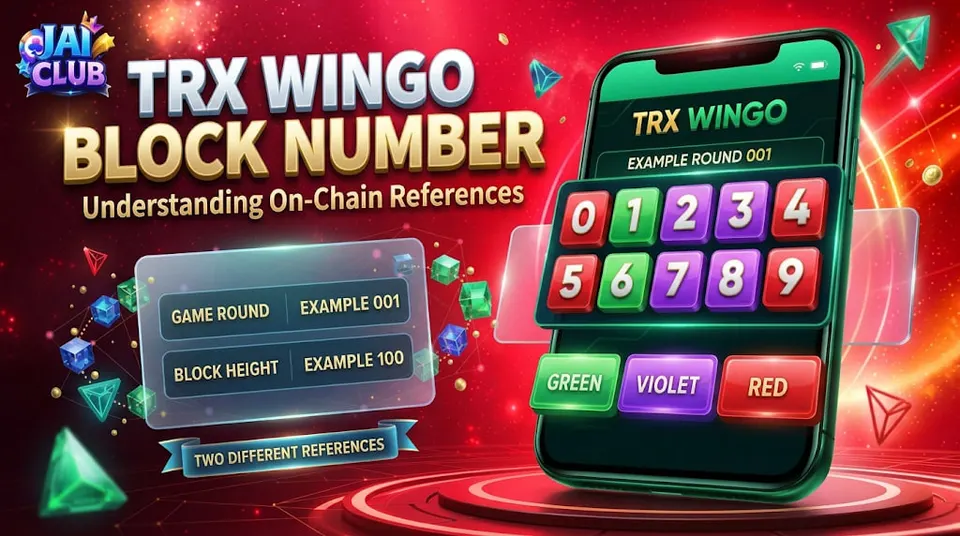
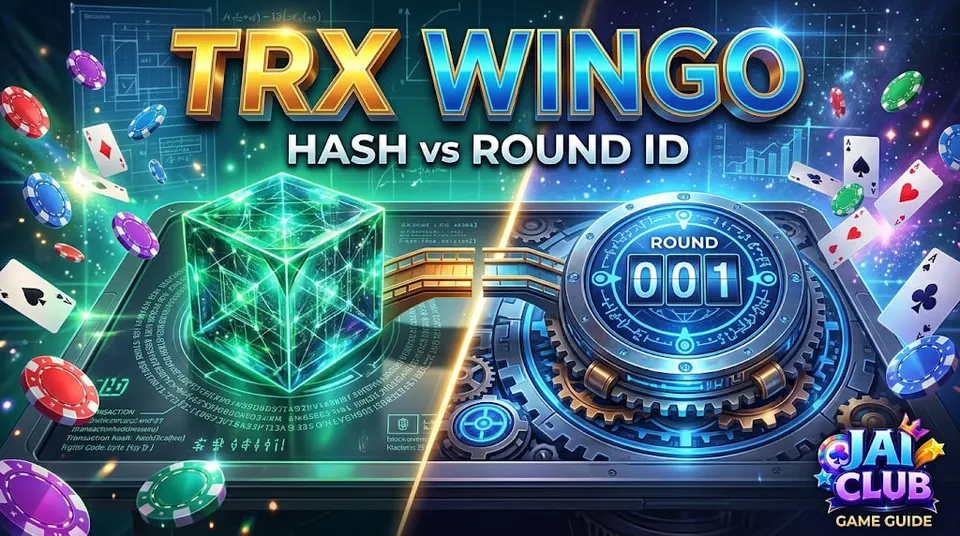
A game period ID and a blockchain transaction ID can both appear as long strings of numbers or letters. However, their purposes are different.
The period ID identifies a game round inside the operator's system. The transaction ID identifies an event on a blockchain network.
A credible verification page should explain how a particular round is linked to a particular transaction or block.
Without that connection, users may see two impressive-looking identifiers that do not establish any mathematical relationship.
For related game terminology, visit the Jai Club Games Guide.
Blockchain Screenshot vs On-Chain Evidence
A screenshot of a blockchain explorer may look convincing, but an image is not the same as a live, independently verifiable record.
Screenshots can omit important information or show unrelated transactions. The existence of a logo, block number or status label within an image does not establish the authenticity of the claim.
The relevant record should be independently locatable through a trustworthy explorer, using the precise network and identifier.
Even then, the game mapping rule and source-selection process must be checked separately.
The safest interpretation is that a screenshot supports a claim only to the extent that its underlying data can be verified.
What About TRX Wingo Prediction Bots?
Some prediction services claim that blockchain data makes future game results easier to calculate.
However, a transparent method for verifying completed outcomes does not necessarily provide advance knowledge of future outcomes.
If a game uses data that is unavailable until a future event occurs, publishing the verification method does not reveal the future input.
Claims that a bot can guarantee future results through a public transaction hash should therefore be treated with caution.
The existence of blockchain technology does not remove the uncertainty of a properly designed future random event.
What Evidence Would Support a Strong Verification Claim?
A meaningful technical explanation would identify the blockchain network, source record, selection time and calculation method.
It should also show how a reader can independently reproduce the displayed outcome from genuine data.
Clear examples using historical records would be helpful, particularly if the records and rules were published before their corresponding outcomes.
An independent security or fairness assessment could provide additional evidence, but its scope would need to be stated accurately.
Without this documentation, the claim remains unverified rather than proven or disproven.
TRX Wingo and Account Transactions
The word TRX can also appear in discussions about cryptocurrency payments. These should not automatically be confused with a result-generation system.
A transaction involving cryptocurrency may record a transfer of value. A game result may use a separate outcome-generation process.
The presence of a crypto payment feature does not prove that the game itself uses blockchain data to determine results.
Similarly, an on-chain transfer being confirmed does not establish that a gaming account's internal balance or withdrawal rules are correct.
These are distinct technical and financial processes.
TRX Wingo Blockchain FAQ
What is TRX Wingo?
It is a term used for a Wingo-related game format associated in some descriptions with TRX or blockchain concepts.
What is a TRX transaction hash?
A transaction hash identifies a particular transaction recorded on a blockchain such as TRON.
Does a valid hash prove a game result is fair?
No. The relationship between the hash and the result must be established through a reproducible, properly controlled method.
Can a blockchain explorer show transaction details?
Yes. An explorer can display publicly available information associated with an on-chain transaction.
Is a transaction hash the same as a period ID?
No. They normally serve different identification purposes.
Can blockchain data be used to calculate a game result?
It can be used in a defined calculation, but the actual method and input-selection controls must be verified.
Does this article confirm Jai Club's result algorithm?
No. The current internal result-generation rules have not been independently verified here.
Can TRX Wingo future results be guaranteed by a bot?
A guarantee requires credible evidence, and the existence of blockchain records does not establish such an ability.
Is every TRX payment a game result proof?
No. A cryptocurrency transfer and a game outcome are separate matters.
Conclusion
A TRX Wingo transaction hash can be a useful technical reference when it identifies a genuine blockchain event. However, an authentic transaction does not automatically prove that a gaming outcome was calculated correctly or generated fairly.
Meaningful verification requires a documented source-selection process, a reproducible mapping rule and evidence connecting the blockchain record to the specific game round.
Readers should distinguish transparent on-chain information from claims about private game logic and avoid treating technical labels as guarantees.
For more educational explanations of Jai Club game formats, visit JaiClubGame.com and the related Jai Club Games Guide.
Editorial note: This article does not claim that Jai Club TRX Wingo has passed an independent blockchain audit. No operator-specific algorithm or transaction record has been invented.