TRX Wingo Hash vs Round ID: Dono Codes Ka Difference Explained
Understand the difference between a TRX Wingo transaction hash and a game round ID, including blockchain references, period numbers, verification claims and common identification mistakes.
In this article
- TRX Wingo Hash vs Round ID Ka Basic Difference
- What Is a TRX Wingo Transaction Hash?
- What Is a Wingo Round ID?
- Transaction Hash Aur Period Number Same Nahi Hain
- Comparison of TRX Hash and Round ID
- Why Transaction Hashes Look More Complicated
- How a Blockchain Transaction Becomes Relevant to a Game
- A Fictional Hash and Round ID Example
- Does a Round ID Contain the Winning Number?
- Can a TRX Hash Predict Future Results?
- Hash Verification vs Result Verification
- Why Timestamps Matter
- Common Mistakes When Reading TRX Wingo Codes
- When a Hash Is Not Found
- A Better Way to Read TRX Wingo Result Records
- Frequently Asked Questions
- Is a TRX Wingo hash the same as a round ID?
- Can I search a period number on a blockchain explorer?
- Does a transaction hash prove the winning number?
- What is the difference between a block hash and a transaction hash?
- Can the same game round have both codes?
- Does a longer code mean stronger security?
- Can a TRX hash guarantee the next Wingo result?
- Are Jai Club TRX Wingo algorithms verified here?
- Conclusion
A TRX Wingo result page may contain several long numbers or codes. Some are described as a transaction hash, while others identify a game round or period. Because both can appear beside result information, readers sometimes assume that they represent the same thing.
Quick answer: A transaction hash identifies an event recorded on a blockchain, provided it is a genuine identifier from the relevant network. A round ID identifies an event within a gaming system. The two identifiers may be connected by a published method, but they are not interchangeable.
This guide explains their different purposes, how to interpret them and what evidence would be needed to connect a particular game result to a blockchain record. The examples are fictional and do not claim access to Jai Club's internal systems.
TRX Wingo Hash vs Round ID Ka Basic Difference
The main difference is the system in which each identifier is used.
A transaction hash belongs to blockchain recordkeeping. It can identify a transaction that has been submitted to or recorded on a compatible network.
A round ID belongs to a game or service. It helps distinguish one completed or ongoing round from another.
One identifier may be publicly searchable on a blockchain explorer, while the other may be meaningful only within the gaming operator's database.
A round ID is therefore not automatically a blockchain transaction number, and a blockchain transaction hash is not automatically a game result.
What Is a TRX Wingo Transaction Hash?
TRX is the native cryptocurrency of the TRON blockchain network. A blockchain transaction may receive a unique transaction identifier, often called a transaction hash or TXID.
A genuine transaction hash can be used to locate the corresponding on-chain record through a compatible blockchain explorer.
Depending on the transaction, the record may include status information, associated addresses, block references and other public data.
However, the existence of a transaction does not prove that a particular Wingo outcome was calculated from it.
A gaming service would need to explain why that transaction was selected and how its data was converted into a result.
What Is a Wingo Round ID?
A round ID, also called a period number in some interfaces, identifies one game event.
It is commonly used to organise histories and prevent results from different rounds being confused with one another.
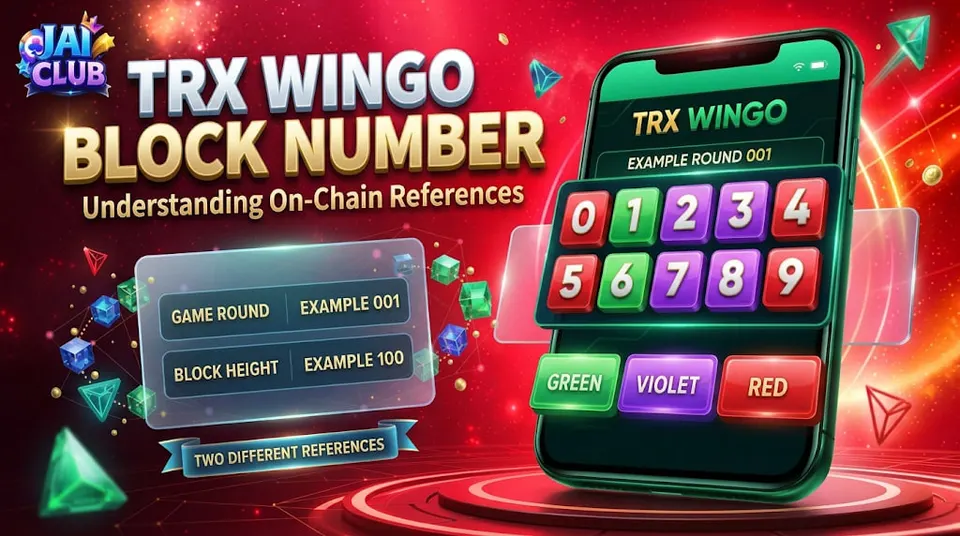
For example, a fictional system could label three consecutive rounds as ROUND-001, ROUND-002 and ROUND-003. The labels identify their order but do not reveal the corresponding outcome.
An actual period identifier may use numbers, timestamps or other internal formatting.
Its exact structure depends on the game system, so readers should not assume that a long numeric period contains a hidden winning-number formula.
Transaction Hash Aur Period Number Same Nahi Hain
A game may display a period identifier beside a transaction hash. This can make the records appear connected.
However, displaying the values together does not establish how they are related.
The period number might be created by the operator's game server, while the transaction hash refers to an event recorded on a separate network.
A clear verification method would need to identify which blockchain transaction belongs to the period, when that transaction was selected and how its data affected the outcome.
Without those rules, the connection remains an unverified claim.
Comparison of TRX Hash and Round ID
| Feature | Transaction hash | Round ID |
|---|---|---|
| Main purpose | Identify a blockchain transaction | Identify a game round |
| Created within | Blockchain transaction process | Gaming service |
| Typical format | Long encoded identifier | Operator-defined number or code |
| Public lookup | Often possible on a compatible explorer | Depends on the gaming service |
| Proves a game result? | Not by itself | Not by itself |
| Can identify a specific record? | Yes, on the relevant network | Yes, within the relevant game |
This comparison describes their general roles. It does not certify any particular TRX Wingo implementation.
Why Transaction Hashes Look More Complicated
A transaction hash is commonly represented as a long string of characters. Its format is designed for machine processing and reference within the relevant blockchain system.
A game round ID may look simpler because the operator can choose a format that is convenient for displaying results or organising events.
Complexity does not indicate greater reliability.
A long hash-looking string may be fabricated, mistyped or unrelated to the game round being discussed.
Likewise, an ordinary-looking period ID can still be a valid identifier within the service.
The important question is whether the code can be verified in the system that claims to use it.
How a Blockchain Transaction Becomes Relevant to a Game
For a blockchain record to support a game-result claim, the operator must provide a reproducible connection between the two.
A hypothetical method could specify that a particular future blockchain event is selected for a particular round. It would then define how data from that event is converted into the displayed number.
The method would also need to address timing and the operator's ability to choose among possible records.
If the operator can select a convenient transaction after seeing its contents, a public hash alone does not eliminate the possibility of selective input choice.
A reliable verification procedure must therefore examine the full selection and calculation process, not just the final code.
A Fictional Hash and Round ID Example
Imagine a demonstration system that displays the following information:
| Field | Fictional value |
|---|---|
| Game round | EXAMPLE-ROUND-001 |
| Displayed number | 7 |
| Blockchain reference | EXAMPLE-TXID-ABC |
| Mapping method | Not supplied |
In this illustration, the round identifier and transaction reference are clearly different.
The displayed number may be recorded accurately as part of the fictional game. However, the information does not show how the number 7 was obtained from the transaction reference.
The missing mapping method prevents independent reproduction.
This is precisely why a screenshot containing several codes should not automatically be described as blockchain proof of a fair game.
Does a Round ID Contain the Winning Number?
A round ID is primarily an identifier. Its visible digits should not automatically be interpreted as an outcome.
An ordered identifier may increase between consecutive rounds, even when the game results vary unpredictably.
For example, ROUND-010 and ROUND-011 could correspond to different numerical outcomes without any relationship between the final digits of the IDs and the displayed results.
Claims about a hidden formula require actual technical evidence.
A pattern noticed in several previous periods does not establish that future outcomes can be calculated from the period number.
Can a TRX Hash Predict Future Results?
A blockchain transaction hash is not inherently a prediction tool.
In a hypothetical system that uses a future blockchain event as a source of randomness, the necessary input may not exist or be known until that event occurs.
Knowing the calculation method would not automatically reveal an unavailable future input.
Conversely, if an operator claims that a result can be known from a transaction already available before a round starts, the full timing and selection rules would need examination.
Neither a transaction hash nor a round ID should be sold as a guaranteed way to predict future results.
Hash Verification vs Result Verification
Hash verification concerns whether a particular blockchain record exists and contains the expected information.
Result verification is broader. It asks whether the game used the claimed source, applied the published formula correctly and recorded the outcome according to its rules.
A reader might verify a real transaction and still be unable to confirm the game result because the operator has not disclosed the mapping method.
Similarly, a correct period ID can identify a historical result without proving how that result was generated.
These checks answer different questions and should be reported separately.
Why Timestamps Matter
Blockchain records and gaming systems may contain timestamps.
A blockchain timestamp is associated with the network record, while a game timestamp may indicate a round's opening, closing or settlement event.
Even when both are genuine, they can differ because they refer to separate operations.
Time-zone formatting can create additional confusion. A timestamp in UTC may appear different from the same moment displayed in Indian Standard Time.
A reliable comparison therefore identifies both the meaning and time zone of each field.
An apparent timing mismatch is not automatically evidence that an outcome was manipulated.
Common Mistakes When Reading TRX Wingo Codes
One mistake is copying a round ID into a blockchain explorer and expecting it to return a transaction.
Another is seeing a valid blockchain transaction and assuming that it determines the game result without checking the source-selection rules.
A third mistake is confusing a transaction hash with a block hash. These identifiers refer to different kinds of blockchain records.
Some users may also rely on edited screenshots rather than independently checking the original information.
All these errors can make a claim appear stronger than the available evidence supports.
When a Hash Is Not Found
A transaction lookup may fail because the wrong network or identifier has been used, the string was copied incorrectly or the relevant record is unavailable through the selected source.
A failed lookup should not immediately be interpreted as proof of fraud.
The first task is to confirm what kind of identifier has been supplied and which system is meant to recognise it.
If the code is only a game period number, it may never be searchable as a blockchain transaction.
If it is presented as an on-chain transaction, independent verification requires accurate information about the relevant network.
A Better Way to Read TRX Wingo Result Records
Treat each field according to its purpose.
The round ID identifies the game event. The displayed result identifies the outcome recorded for that event. The blockchain reference, if genuinely relevant, identifies a separate network event.
The mapping rules would explain how the network event and result are connected.
Without a published mapping, readers can describe the available records but should not claim to have independently verified the game's fairness.
For further context, read the TRX Wingo Blockchain Proof Guide and the Jai Club Games Guide.
Frequently Asked Questions
Is a TRX Wingo hash the same as a round ID?
No. A hash identifies a blockchain record, while a round ID identifies a game event.
Can I search a period number on a blockchain explorer?
Not necessarily. A period number is not automatically a valid blockchain transaction identifier.
Does a transaction hash prove the winning number?
No. A reproducible method is needed to link the blockchain data to the displayed number.
What is the difference between a block hash and a transaction hash?
A block hash identifies a block, while a transaction hash identifies an individual transaction.
Can the same game round have both codes?
A service may display both identifiers, but their relationship needs to be documented.
Does a longer code mean stronger security?
No. The appearance or length of a code does not establish its authenticity.
Can a TRX hash guarantee the next Wingo result?
No reliable guarantee follows from the presence of a blockchain identifier.
Are Jai Club TRX Wingo algorithms verified here?
No. This article explains general identifiers without claiming an independent audit of the operator's implementation.
Conclusion
TRX Wingo transaction hashes and round IDs have different roles. A transaction hash is associated with blockchain records, while a round ID identifies an event within a gaming system.
A complete verification claim must connect both through a documented and reproducible process. Displaying two codes together is not enough to establish that a result was generated fairly.
Understanding this difference helps readers interpret game records, recognise incomplete proof claims and avoid confusing technical identifiers with prediction methods.
Editorial note: All example identifiers are fictional. This article does not present a live transaction or an audited Jai Club result.