K3 Extreme Totals: Why 3 and 18 Have Only One Combination Each
Understand why three-dice totals of 3 and 18 are mathematical extremes, how their probabilities compare with middle totals and why uncommon results are not impossible or overdue.
In this article
- What Are Extreme Totals in K3?
- Why Sum 3 Has Only One Combination
- Why Sum 18 Also Has One Combination
- The 216-Outcome Sample Space
- EXAMPLE: Extreme and Middle Totals
- How Rare Is a Total of 3?
- Combined Probability of Either Extreme
- Why Probability Is Not a Schedule
- Why Middle Totals Are Different
- Extreme Totals and Triple Dice
- Are All Triples Equally Likely?
- Why an Extreme Result Can Appear Consecutively
- EXAMPLE: Two Consecutive Maximum Totals
- What a Short K3 History Can Tell You
- Digital Dice vs Physical Dice
- Does an Extreme Total Offer a Better Strategy?
- Common Misunderstandings About Extreme Totals
- Frequently Asked Questions
- Why is 3 the smallest K3 sum?
- Why is 18 the highest sum?
- How many combinations produce a total of 3?
- How many combinations produce a total of 18?
- What is the probability of either extreme?
- Are extreme totals impossible?
- Is every triple an extreme total?
- Does a rare total become due after many rounds?
- Are these official Jai Club K3 probabilities?
- What the Extremes Tell Us About Three Dice
When three six-sided dice are added together, the smallest possible total is 3 and the largest possible total is 18.
Both values are mathematically important because they sit at opposite ends of the three-dice sum distribution.
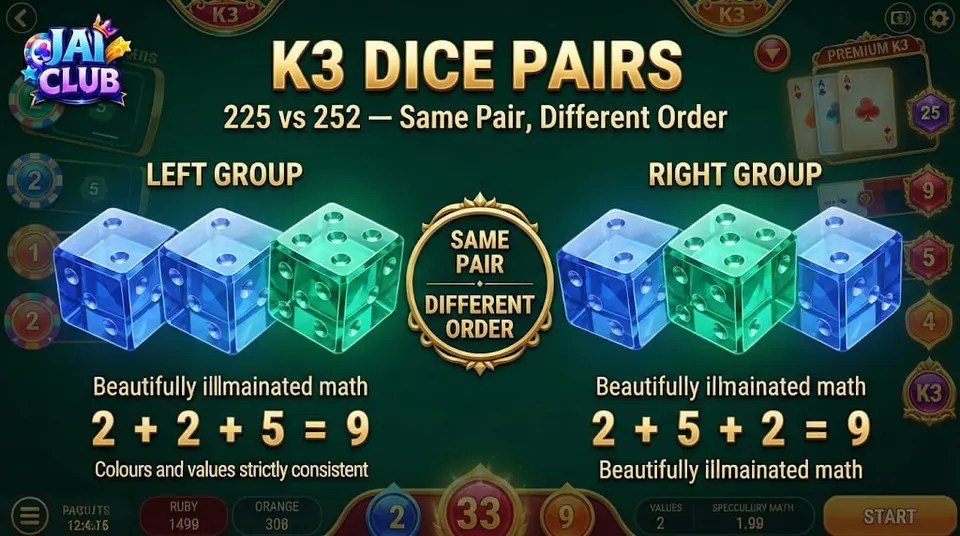
They are also unusual. Unlike middle totals, which can be formed through many different combinations, each extreme total has only one possible ordered outcome.
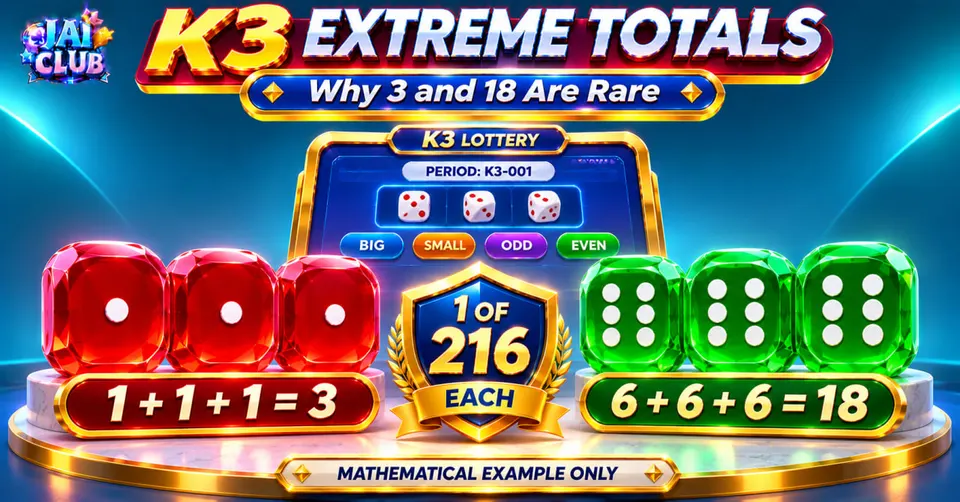
Quick answer: A total of 3 requires the dice to show 1-1-1, while a total of 18 requires 6-6-6. Under a fair independent three-dice model, each exact outcome has a probability of 1/216, approximately 0.463%.
This guide explains extreme totals, their relationship with the full sample space and why uncommon outcomes should not be mistaken for impossible or predictable results.
The calculations describe standard mathematical dice. They do not independently verify the outcome-generation system of a particular Jai Club K3 game.
What Are Extreme Totals in K3?
An extreme total is a sum at one end of the possible range.
For three ordinary six-sided dice, every die has a minimum face value of 1 and a maximum face value of 6.
Adding the minimum values gives:
1 + 1 + 1 = 3.
Adding the maximum values gives:
6 + 6 + 6 = 18.
There is no way to obtain a smaller or larger total using these dice.
Therefore, 3 and 18 are the two mathematical extremes.
Why Sum 3 Has Only One Combination
To obtain a total of 3, each die must show 1.
If even one die showed 2, the smallest possible sum would become:
2 + 1 + 1 = 4.
This means the result 1-1-1 is the only possible combination producing 3.
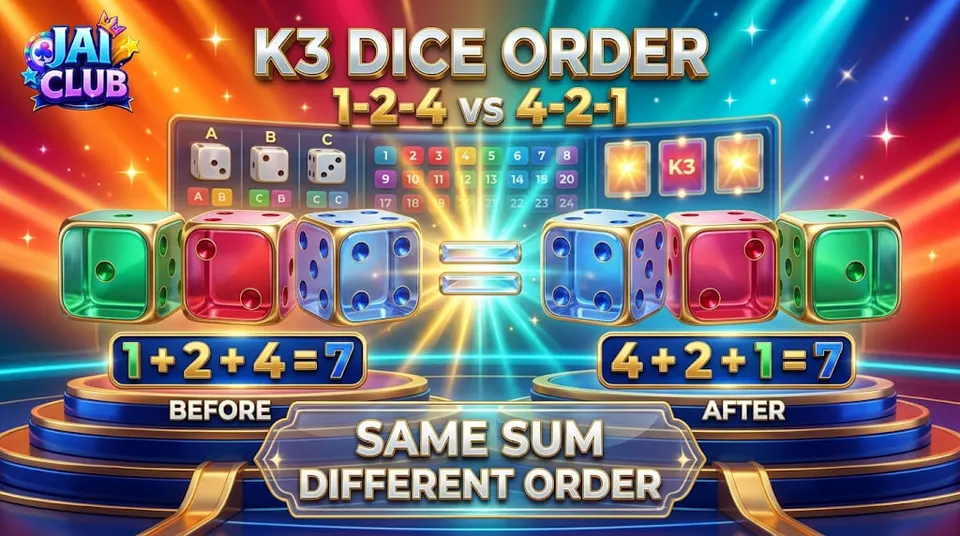
Rearranging the dice does not create a new visible result because all three values are identical.
Under a model with distinguishable dice, 1-1-1 still counts as one ordered outcome.
This explains why the lowest total has only one combination.
Why Sum 18 Also Has One Combination
The same principle applies to the maximum total.
All three dice must show 6.
If one die showed 5, the largest possible total would become:
6 + 6 + 5 = 17.
Therefore, only 6-6-6 produces 18.
Like 1-1-1, this result is a triple containing three identical values.
It has only one distinct arrangement.
The two extremes are symmetrical under the mathematical model.
The 216-Outcome Sample Space
Three distinguishable six-sided dice produce:
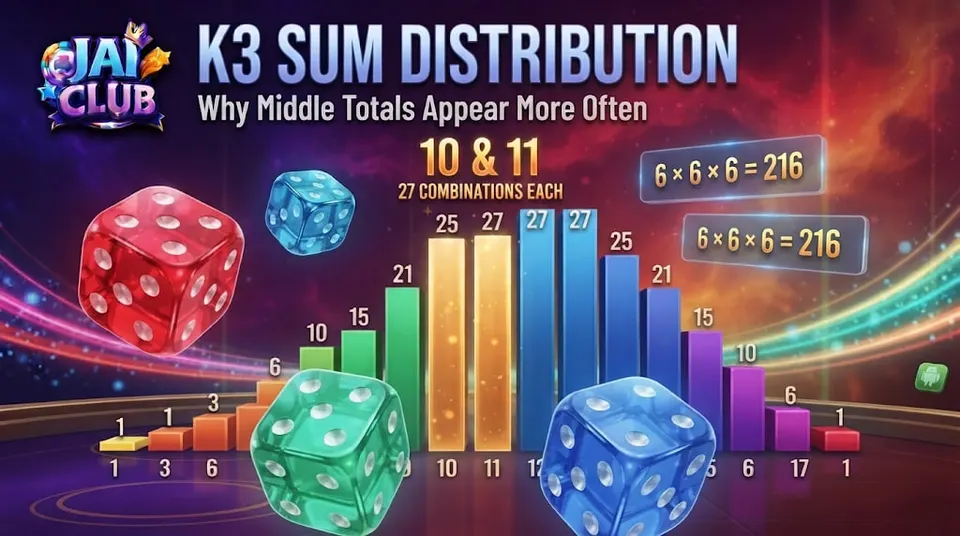
6 × 6 × 6 = 216
possible ordered outcomes.
Every ordered result has the same theoretical probability if the dice are independent and fair.
However, different sums contain different numbers of outcomes.
For example, the sum of 10 can be produced by 27 ordered combinations.
The sum of 3 has only one.
This difference explains why the sum distribution is not uniform.
EXAMPLE: Extreme and Middle Totals
| Sum | Ordered combinations | Theoretical probability |
|---|---|---|
| 3 | 1 | 0.463% |
| 4 | 3 | 1.389% |
| 5 | 6 | 2.778% |
| 9 | 25 | 11.574% |
| 10 | 27 | 12.500% |
| 11 | 27 | 12.500% |
| 12 | 25 | 11.574% |
| 16 | 6 | 2.778% |
| 17 | 3 | 1.389% |
| 18 | 1 | 0.463% |
Percentages are rounded.
The table demonstrates that totals near the middle have more possible combinations than totals at either end.
It does not represent observed Jai Club results.
How Rare Is a Total of 3?
Under fair independent dice:
P(sum = 3) = 1/216.
This is approximately 0.463%.
The same probability applies to the total 18.
A probability below 1% is relatively small, but it is not zero.
An uncommon mathematical outcome can still occur.
It would be incorrect to describe 1-1-1 or 6-6-6 as impossible.
Combined Probability of Either Extreme
The events sum 3 and sum 18 cannot happen simultaneously in one three-dice result.
Therefore, their probabilities can be added.
There are two qualifying ordered outcomes:
1-1-1 and 6-6-6.
The combined probability is:
2/216 = 1/108.
This is approximately 0.926%.
The calculation describes the chance of either extreme occurring on one roll under the fair independent model.
It does not mean an extreme must appear once in every 108 rounds.
Why Probability Is Not a Schedule
A probability of 1/216 does not create a fixed interval between appearances.
For example, a total of 3 could occur twice within a short sequence of rolls.
It could also remain absent across hundreds of rolls.
Neither situation automatically contradicts the fair mathematical model.
Random outcomes do not follow a schedule that guarantees one occurrence after a specific number of attempts.
The fraction 1/216 describes the theoretical probability of each individual roll.
It is not a countdown to the next appearance.
Why Middle Totals Are Different
A middle total can be produced by many combinations of dice values.
For example, 1-3-6, 2-3-5 and 2-4-4 all produce a sum of 10.
Each group may also have several distinct arrangements.
Together, these produce 27 ordered outcomes for a sum of 10.
By comparison, no alternative dice values can produce the extreme total of 3.
The difference is not caused by the appearance of the dice.
It follows directly from the arithmetic restrictions of values from 1 through 6.
Extreme Totals and Triple Dice
Both extreme totals are triples.
However, not every triple produces an extreme total.
The six possible triples are:
1-1-1, 2-2-2, 3-3-3, 4-4-4, 5-5-5 and 6-6-6.
Their sums are 3, 6, 9, 12, 15 and 18.
Only the first and last are extremes.
Therefore, the category of triple dice is broader than the category of extreme totals.
Confusing the two categories would produce incorrect probability calculations.
Are All Triples Equally Likely?
Under the fair independent dice model, each exact triple has probability 1/216.
The exact outcome 1-1-1 is therefore no more likely than 4-4-4.
However, the total 12 is more likely than the total 3 because many non-triple combinations also produce 12.
This distinction matters.
An exact sequence and a sum category are different mathematical events.
A reader must identify which event is being measured before comparing probabilities.
Why an Extreme Result Can Appear Consecutively
Independent outcomes do not remember earlier rolls.
Under the fair model, the probability of an extreme result on the next roll remains the same regardless of the previous result.
For example, observing 6-6-6 does not make another 6-6-6 impossible.
It also does not make it more likely under the independent model.
An unusual sequence of repeated extreme outcomes may attract attention, but its appearance does not automatically establish a predictable pattern.
Historical frequency and future probability should be interpreted separately.
EXAMPLE: Two Consecutive Maximum Totals
Imagine two independent fair rolls.
The probability that both show the exact outcome 6-6-6 is:
(1/216) × (1/216) = 1/46,656.
That is approximately 0.00214%.
This is a small probability for one specifically defined two-roll sequence.
However, there are many different unusual sequences that could be noticed after they occur.
Identifying a surprising pattern after observing it does not mean its probability was known to be uniquely important beforehand.
What a Short K3 History Can Tell You
A historical record can show whether particular totals appeared in previous rounds.
Readers may count how often 3 and 18 occurred within a selected dataset.
However, the observed frequency may differ from the theoretical probability.
A small sample is especially likely to contain variation.
Even a large sample does not guarantee exact agreement with the theoretical percentages.
A history table should therefore be described as observed data rather than proof of a future sequence.
Digital Dice vs Physical Dice
The mathematical model assumes fair, independent six-sided dice.
A digital K3-style game may display dice images while generating the outcome through software.
The visual representation alone does not establish that every ordered outcome has probability 1/216.
A claim about the actual distribution requires trustworthy information about the particular software implementation.
Therefore, the calculations in this guide should not be presented as independently verified Jai Club K3 odds.
The mathematical principles remain useful for understanding the standard three-dice sample space.
Does an Extreme Total Offer a Better Strategy?
An uncommon total is not automatically a favourable financial selection.
The attractiveness of a particular selection would depend on its probability, payout terms and relevant costs.
Those conditions are not determined by rarity alone.
A game might apply a particular payment rule, but the actual terms must be verified.
This article does not recommend choosing extreme totals or claim they offer superior financial outcomes.
Its purpose is to explain why the underlying combinations are uncommon.
Common Misunderstandings About Extreme Totals
One misunderstanding is that 3 and 18 cannot appear because they are rare.
Another is that an extreme total becomes more likely after being absent for a long period.
Some readers also confuse the probability of 6-6-6 with the probability of any triple.
Others believe a sum chart must show exact theoretical percentages over a short sample.
These ideas overlook the distinction between individual probabilities, broader categories and observed sequences.
Frequently Asked Questions
Why is 3 the smallest K3 sum?
Because the lowest value on each standard die is 1, giving 1 + 1 + 1 = 3.
Why is 18 the highest sum?
Because the maximum on each die is 6, giving 6 + 6 + 6 = 18.
How many combinations produce a total of 3?
Only one: 1-1-1.
How many combinations produce a total of 18?
Only one: 6-6-6.
What is the probability of either extreme?
It is 2/216, approximately 0.926%, under fair independent dice.
Are extreme totals impossible?
No. They are possible but uncommon under the mathematical model.
Is every triple an extreme total?
No. Only 1-1-1 and 6-6-6 produce the minimum and maximum sums.
Does a rare total become due after many rounds?
No. Independent dice do not follow a guaranteed appearance schedule.
Are these official Jai Club K3 probabilities?
No. They describe a mathematical model, not a certified digital game implementation.
What the Extremes Tell Us About Three Dice
Totals 3 and 18 are useful because they reveal how combination counting works at the boundaries of a three-dice system.
Each has only one possible outcome, while middle totals have many.
That mathematical structure explains their relative rarity without implying that either outcome is impossible or predictable.
For related three-dice mathematics, see the K3 sum guide: https://jaiclubgame.com/jai-club-k3-lottery-sum-three-dice
Editorial note: All probabilities assume fair, independent six-sided dice. They do not establish operator-specific payouts or certified digital game odds.