K3 Dice Pairs: Why 2-2-5 and 2-5-2 Are Different Outcomes
Understand three-dice results containing exactly one matching pair, how their positions affect ordered outcomes, and why a double can have three distinct arrangements.
In this article
- What Is a K3 Dice Pair?
- Understanding 2-2-5
- What Changes in 2-5-2?
- All Three Arrangements of One Pair
- Why the Pair Has Three Arrangements
- How Many Exact Doubles Exist?
- Probability of Any Exact Pair
- Probability of the Specific Group 2-2-5
- Pair Classification vs Sum Classification
- Why Triples Are Separate
- Pair Positions and Game Rules
- EXAMPLE: A Position-Specific Pair
- Pair Patterns in Historical Results
- Why Order Matters for Data Recording
- Frequently Asked Questions
- Is 225 the same as 252?
- How many arrangements does an exact pair have?
- What is the sum of 225?
- How many exact double outcomes exist?
- What is the theoretical probability of any exact pair?
- What is the chance of 225 in any order?
- Is 222 an exact double?
- Can the sum alone identify a pair?
- Does a recent pair predict another pair?
- The Position Changes, Even When the Sum Does Not
In a three-dice result, two dice may display the same number while the remaining die shows a different value.
For example, the outcomes 2-2-5, 2-5-2 and 5-2-2 all contain two occurrences of 2 and one occurrence of 5.
They also have the same sum of 9.
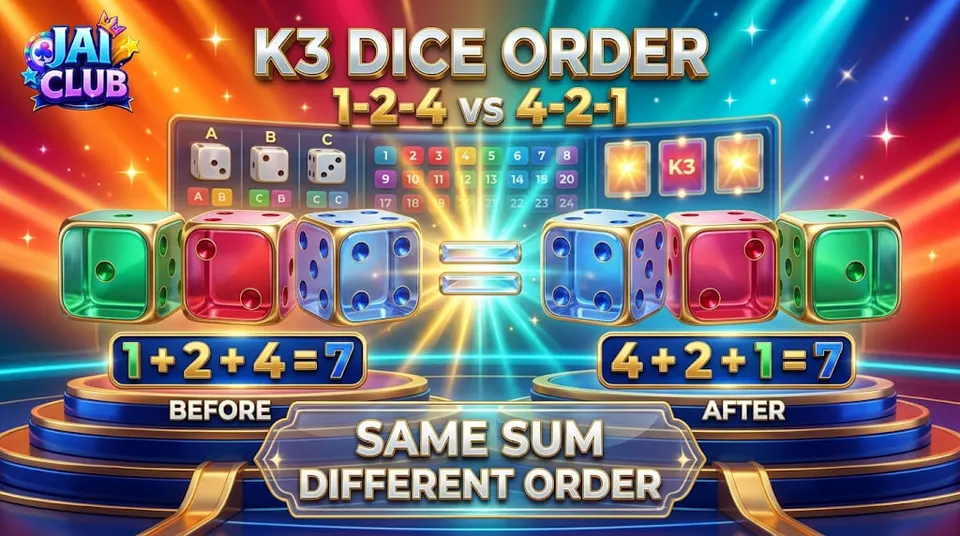
However, they are different ordered outcomes when the three dice occupy identifiable positions.
Quick answer: The outcomes 2-2-5, 2-5-2 and 5-2-2 belong to the same unordered double-dice group, but they represent three distinct ordered results. The position of the different die changes while the collection of values remains the same.
This article explains why a matching pair has three possible arrangements, how to count all exact doubles and when the order matters mathematically.
The calculations assume three fair, independent, distinguishable six-sided dice. They are not verified odds for a particular Jai Club K3 implementation.
What Is a K3 Dice Pair?
A dice pair, also called an exact double in this context, contains exactly two matching values and one different value.
For example, 4-4-1 contains a pair of 4s.
The result 4-4-4 is not an exact double because all three values match.
The result 1-2-3 contains no matching pair because all values differ.
These distinctions are useful when classifying three-dice outcomes.
However, a game may use different category names, so mathematical definitions should not automatically be presented as official selection rules.
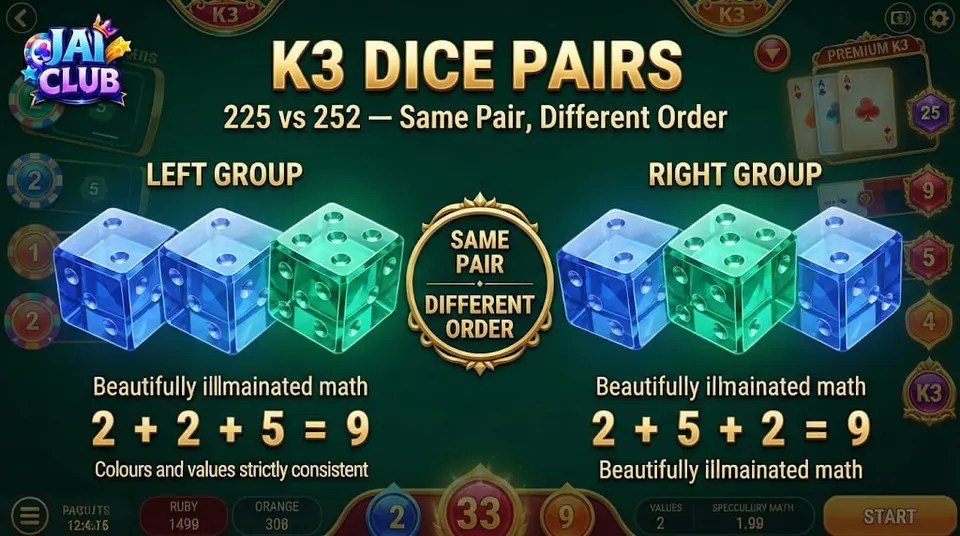
Understanding 2-2-5
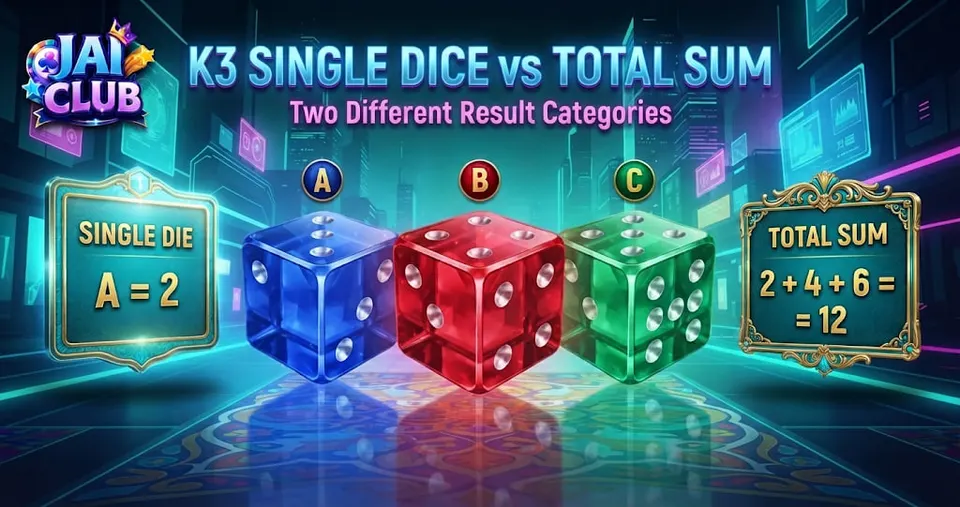
Consider three positions labelled A, B and C.
The ordered outcome 2-2-5 means Die A shows 2, Die B shows 2 and Die C shows 5.
The matching values occupy the first two positions.
The remaining die is different.
The sum is:
2 + 2 + 5 = 9
This result contains one exact pair.
The outcome remains mathematically distinct from another arrangement in which the 5 occupies a different position.
What Changes in 2-5-2?
In 2-5-2, Die A shows 2, Die B shows 5 and Die C shows 2.
The matching values now occupy the first and third positions.
The sum remains 9 because the same values are being added.
However, the ordered arrangement has changed.
If a mathematical event requires a pair in the first two positions, 2-2-5 qualifies but 2-5-2 does not.
If the event only requires any exact pair, both qualify.
The definition of the event determines whether the difference matters.
All Three Arrangements of One Pair
| Outcome | Matching positions | Sum |
|---|---|---|
| 2-2-5 | A and B | 9 |
| 2-5-2 | A and C | 9 |
| 5-2-2 | B and C | 9 |
The three outcomes form one unordered value group.
However, each is a different ordered result.
There are no further distinct arrangements of the values 2, 2 and 5.
Swapping the two identical 2s does not create a new visible sequence.
This explains why a pair group has three permutations rather than six.
Why the Pair Has Three Arrangements
For three different values, the number of arrangements is:
3! = 6
But when two values are identical, their interchange does not create a distinct outcome.
Therefore, the count is:
[ \frac{3!}{2!}=3 ]
This gives three ordered arrangements.
The result applies to any exact pair consisting of two identical values and one different value.
For example, 1-1-6 also has three arrangements: 116, 161 and 611.
How Many Exact Doubles Exist?
To count all exact doubles in a standard three-dice model, choose the repeated number first.
There are six possible repeated values.
Next, choose the different number. Because it cannot equal the repeated value, there are five choices.
Finally, choose which of the three positions contains the different number.
The total is:
6 × 5 × 3 = 90
There are therefore 90 ordered outcomes containing exactly one matching pair.
This count excludes all triples.
Probability of Any Exact Pair
Under the fair independent three-dice model, there are 216 equally likely ordered outcomes.
Ninety of those outcomes contain exactly one matching pair.
The theoretical probability is:
[ P(\text{exactly one pair})=\frac{90}{216}=\frac{5}{12} ]
That is approximately 41.67%.
This is the probability of obtaining any exact pair, not the probability of obtaining one specific pair such as two 2s and one 5.
Different events contain different numbers of qualifying outcomes.
Probability of the Specific Group 2-2-5
The values 2, 2 and 5 have three distinct arrangements.
Under the fair independent model, each ordered result has probability 1/216.
Therefore, the probability of obtaining this exact collection of values in any order is:
[ \frac{3}{216}=\frac{1}{72} ]
This is approximately 1.389%.
The probability of the exact ordered outcome 2-2-5 is only 1/216, approximately 0.463%.
These are different probabilities because the events include different numbers of outcomes.
Pair Classification vs Sum Classification
The outcome 2-2-5 has a sum of 9.
However, not every result with a sum of 9 contains a pair.
For example, 1-3-5 also totals 9 but contains three different values.
The triple 3-3-3 also totals 9.
Therefore, knowing only the sum cannot determine whether the original result contained an exact pair.
A complete classification requires the three individual dice values.
This is why historical records that show all three values provide more information than sum-only charts.
Why Triples Are Separate
A triple contains three identical values.
Examples include 1-1-1 and 6-6-6.
Although a triple has matching dice, it should not be counted as an exact double under the definitions used here.
There are six triple outcomes in the standard three-dice sample space.
If those six were added to the 90 exact pairs, the resulting category would be “at least one matching pair,” which has 96 outcomes.
That is a different event.
Clear terminology prevents incorrect probability calculations.
Pair Positions and Game Rules
A mathematical result can be evaluated in different ways.
A category might consider whether any two dice match.
Another hypothetical category could refer to matching values in specified positions.
These events have different counts.
However, this does not mean that Jai Club K3 officially offers position-specific pair selections.
The availability and settlement of any particular category must be established from actual game rules.
The mathematics alone cannot certify a game feature.
EXAMPLE: A Position-Specific Pair
Imagine a mathematical event requiring Die A and Die B to match while Die C differs.
There are six choices for the repeated value and five choices for the different value.
Therefore, there are:
6 × 5 = 30
qualifying ordered outcomes.
The probability under fair independent dice is 30/216, approximately 13.89%.
This is different from the 90/216 probability of any exact pair.
The example demonstrates why the wording of a rule matters.
Pair Patterns in Historical Results
A historical chart may classify completed outcomes as exact pairs, triples or all-different results.
Such a chart can describe how many times each category occurred in the selected sample.
However, a short sample is not required to match the theoretical probabilities exactly.
If a pair appeared several times in recent rounds, that does not force the next round to produce three different values.
Likewise, a period without doubles does not make another double due.
Historical observations should be separated from unsupported prediction claims.
Why Order Matters for Data Recording
Suppose a result-history table stores 2-5-2.
If a spreadsheet sorts the values and converts the record into 2-2-5, the resulting data no longer preserves the original positions.
The sum and unordered pair classification remain unchanged.
But the exact ordered outcome has been altered.
This could distort an analysis involving individual dice positions.
For accurate historical records, the original order should be preserved.
Frequently Asked Questions
Is 225 the same as 252?
They contain the same values and sum, but they are different ordered outcomes.
How many arrangements does an exact pair have?
Three, because two values are identical.
What is the sum of 225?
The total is 9.
How many exact double outcomes exist?
There are 90 under the standard three-dice model.
What is the theoretical probability of any exact pair?
It is 90/216, approximately 41.67%.
What is the chance of 225 in any order?
It is 3/216, or approximately 1.389%.
Is 222 an exact double?
No. It is a triple.
Can the sum alone identify a pair?
No. Different dice classifications can share the same sum.
Does a recent pair predict another pair?
No reliable future prediction follows from recent outcomes alone.
The Position Changes, Even When the Sum Does Not
The three outcomes 225, 252 and 522 provide a simple example of the distinction between ordered results and unordered collections.
They all contain the same pair and have the same total.
Yet each occupies different dice positions.
Understanding that difference makes combination tables easier to read and prevents exact-result probabilities from being confused with broader pair categories.
For the full sample-space calculation, see K3 Lottery 216 Outcomes.
Editorial note: All examples use a fair independent dice model and do not verify Jai Club K3 settlement rules or actual game probabilities.