K3 Dice Order Matters? Comparing 1-2-4 With 4-2-1
Understand why 1-2-4 and 4-2-1 have the same dice sum but different ordered positions, how permutations work and when order matters for mathematical classification.
In this article
- What Does Dice Order Mean?
- Comparing 1-2-4 and 4-2-1
- Why the Sum Remains 7
- All Six Arrangements of 1, 2 and 4
- What Is a Permutation?
- Why Repeated Values Change the Count
- What Happens With Three Identical Dice?
- Exact Order vs Any Order Probability
- Is the Probability of Sum 7 the Same?
- Three Different Probability Questions
- Does Dice Order Affect Big or Small Categories?
- Does Dice Order Affect Odd or Even?
- Does Dice Order Affect Double Classification?
- Does Dice Order Matter for Straight Combinations?
- Why Result History Must Preserve Positions
- Why Screenshots Can Be Misleading
- Can Dice Order Predict the Next Result?
- Frequently Asked Questions
- Is 1-2-4 the same as 4-2-1?
- What is the sum of both sequences?
- How many ways can 1, 2 and 4 be arranged?
- What is the probability of exactly 1-2-4?
- What is the probability of 1, 2 and 4 in any order?
- How many ordered outcomes have sum 7?
- Does order affect a sum-based classification?
- Why do doubles have fewer arrangements?
- Can sorting a history record create errors?
- Are these official Jai Club K3 probabilities?
- The Difference Worth Remembering
Three dice can produce the same total even when their individual values appear in different positions.
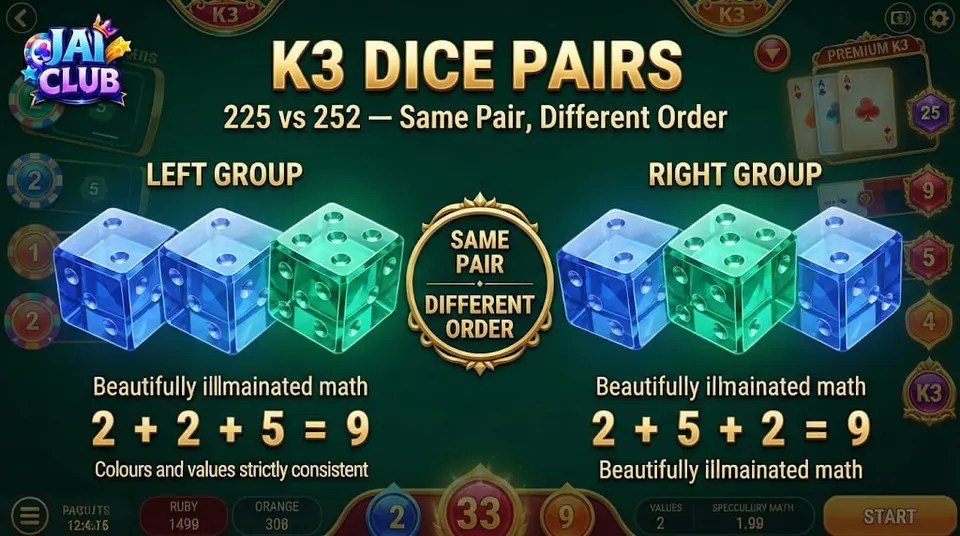
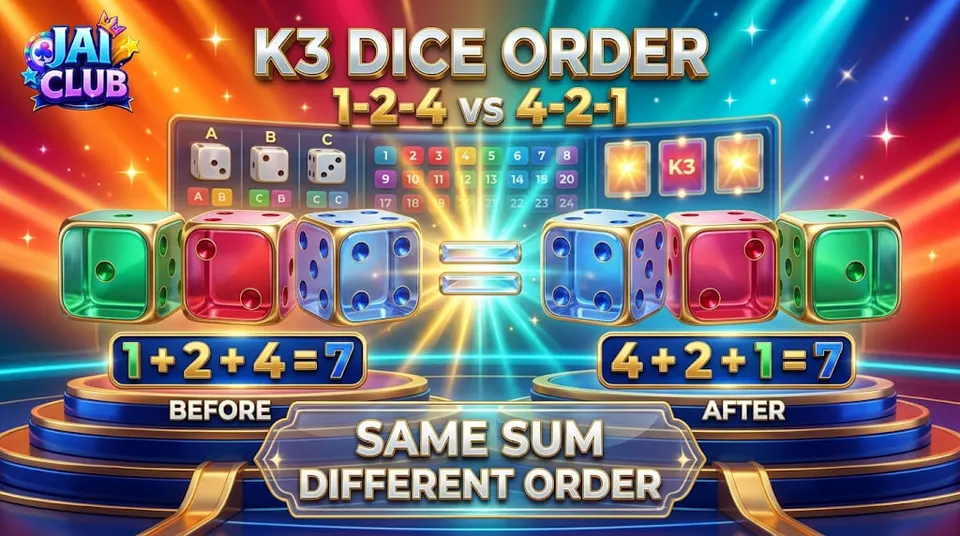
For example, the outcomes 1-2-4 and 4-2-1 both have a sum of 7.
They also contain the same three values. However, the first and third dice are different in the two sequences.
This raises an important question: does the order of the dice actually matter?
Quick answer: Dice order matters when an outcome is defined by specific positions. If only the total is relevant, 1-2-4 and 4-2-1 both produce the same sum of 7. If an event requires exact values in particular positions, they represent different ordered outcomes.
This guide explains the distinction using a standard three-dice mathematical model. It does not assume that every Jai Club K3 game uses position-specific selections or identical payout categories.
What Does Dice Order Mean?
Dice order refers to the arrangement of values across identifiable positions.
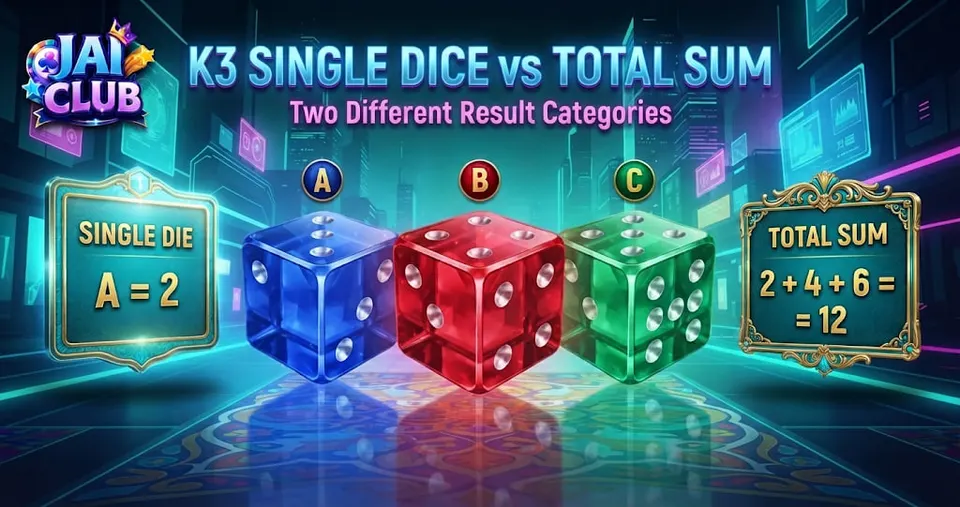
Imagine three dice labelled A, B and C.
The outcome 1-2-4 means A shows 1, B shows 2 and C shows 4.
The outcome 4-2-1 means A shows 4, B shows 2 and C shows 1.
Both contain the same numbers.
However, the first and third positions differ.
Therefore, they are not the same ordered outcome.
This distinction becomes important whenever a rule identifies a particular die position.
Comparing 1-2-4 and 4-2-1
| Property | 1-2-4 | 4-2-1 |
|---|---|---|
| Die A | 1 | 4 |
| Die B | 2 | 2 |
| Die C | 4 | 1 |
| Sum | 7 | 7 |
| Collection of values | 1, 2, 4 | 1, 2, 4 |
| Ordered outcome | Different | Different |
The table shows that the total remains unchanged when the same values are rearranged.
However, the identity of the value in each position can change.
A reader must therefore understand which property a particular calculation or rule uses.
Why the Sum Remains 7
Addition does not depend on the order of its terms.
For example:
1 + 2 + 4 = 7
Reversing the values gives:
4 + 2 + 1 = 7
Both calculations produce the same total.
This means that a sum-only classification would group the two outcomes together.
However, it does not mean the ordered sequences are identical.
The difference between ordered outcomes and shared totals is central to three-dice probability.
All Six Arrangements of 1, 2 and 4
Because the three values are different, they can appear in six distinct orders.
| Ordered outcome | Sum |
|---|---|
| 1-2-4 | 7 |
| 1-4-2 | 7 |
| 2-1-4 | 7 |
| 2-4-1 | 7 |
| 4-1-2 | 7 |
| 4-2-1 | 7 |
All six outcomes contain exactly the same collection of values.
Every arrangement has the same total.
However, each is a separate ordered result when the three dice are distinguishable.
This is why an exact sequence should not be confused with an unordered collection.
What Is a Permutation?
A permutation is an arrangement in which order matters.
For three different values, the number of permutations is:
3 × 2 × 1 = 6
This calculation is written as 3 factorial, or 3!.
The first position has three choices, the second has two remaining choices and the final position has one.
The result is six arrangements.
This explains why the collection 1, 2 and 4 can appear in six different orders.
The calculation assumes that all three values are distinct.
Why Repeated Values Change the Count
Consider the values 2, 2 and 4.
Because two values are identical, swapping those two 2s does not create a new visible sequence.
The distinct arrangements are:
2-2-4
2-4-2
4-2-2
There are three arrangements rather than six.
Mathematically:
[ \frac{3!}{2!}=3 ]
This distinction matters when counting different dice categories.
A result with one matching pair has fewer distinct arrangements than a result containing three different numbers.
What Happens With Three Identical Dice?
If all three dice show the same value, rearranging the values does not change the visible sequence.
For example, 5-5-5 remains 5-5-5 regardless of position.
Only one distinct arrangement exists.
However, it is still one of the possible ordered outcomes in a three-dice model.
The broader sample space contains many other outcomes, including doubles and all-different values.
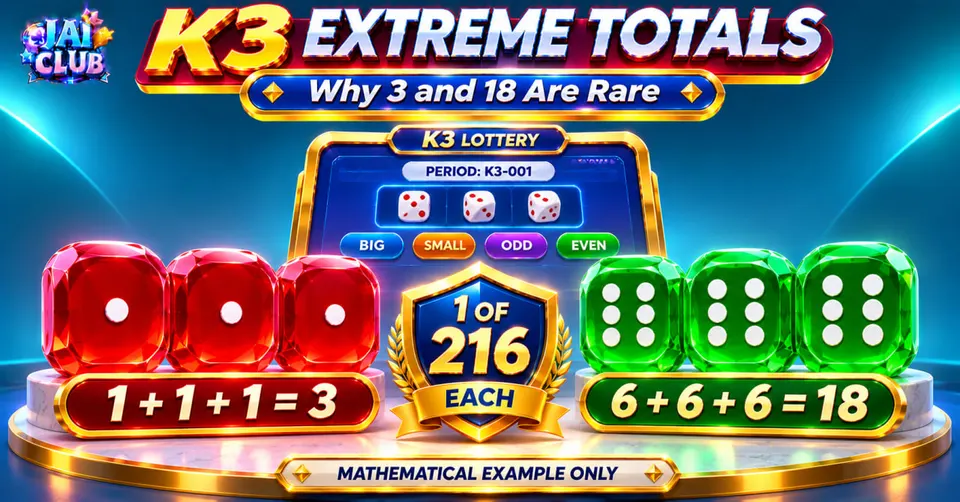
For a complete explanation of the 216 possible outcomes, read the K3 Lottery 216 Outcomes Guide.
Exact Order vs Any Order Probability
Under a fair model of three independent six-sided dice, there are 216 equally likely ordered outcomes.
The probability of the exact sequence 1-2-4 is:
[ P(1,2,4)=\frac{1}{216} ]
That is approximately 0.463%.
The probability of obtaining the values 1, 2 and 4 in any order is:
[ P({1,2,4})=\frac{6}{216} ]
That equals approximately 2.778%.
These probabilities differ because one event contains a single exact sequence, while the other includes six possible arrangements.
The calculations are mathematical examples rather than verified digital-game payout odds.
Is the Probability of Sum 7 the Same?
No.
The sum of 7 can be produced by more than just the six arrangements of 1, 2 and 4.
Other value groups also add to 7.
For example, 1-1-5, 1-3-3 and 2-2-3 all produce the same total.
The complete list of unordered value groups for sum 7 is:
| Value group | Ordered arrangements |
|---|---|
| 1-1-5 | 3 |
| 1-2-4 | 6 |
| 1-3-3 | 3 |
| 2-2-3 | 3 |
| Total | 15 |
Therefore, the probability of a sum of 7 is:
[ \frac{15}{216}\approx 6.944% ]
This is greater than the probability of obtaining only the values 1, 2 and 4 in any order.
Three Different Probability Questions
The following three events are not identical.
| Event | Ordered outcomes | Probability |
|---|---|---|
| Exactly 1-2-4 | 1 | 0.463% |
| Values 1, 2, 4 in any order | 6 | 2.778% |
| Any outcome with sum 7 | 15 | 6.944% |
These probabilities assume independent, fair six-sided dice.
The comparison demonstrates why a question must define whether it concerns exact position order, a collection of values or a total.
A correct calculation for one event should not be used as the probability of another.
Does Dice Order Affect Big or Small Categories?
A sum-based Big or Small classification, if defined by a particular game's rules, would depend on the total rather than the individual order.
In that situation, two arrangements with the same sum would fall into the same sum category.
However, the exact thresholds and any exceptions must be checked in the specific game's rules.
A guide should not invent universal K3 Big or Small boundaries.
The mathematical principle remains clear: rearranging values does not change their sum.
Does Dice Order Affect Odd or Even?
The parity of a sum depends on whether the total is odd or even.
Both 1-2-4 and 4-2-1 sum to 7.
Because 7 is odd, both have an odd total.
Similarly, any rearrangement of the same three values preserves the total and therefore preserves its parity.
This describes arithmetic.
It does not independently verify the names or settlement conditions of categories used by a particular gaming operator.
Does Dice Order Affect Double Classification?
A double contains exactly two matching values and one different value.
For example, 2-2-4 and 4-2-2 are both doubles.
Their positions differ, but each contains exactly one matching pair.
If a category considers only the existence of a pair, the order would not change that classification.
If a rule concerns the position of the matching dice, order could matter.
The relevant rule must be defined before calculating the outcome probability.
Does Dice Order Matter for Straight Combinations?
A mathematical straight contains consecutive values under a defined classification.
The collection 1, 2 and 3 is consecutive.
If the straight classification accepts any order, then 3-2-1 also qualifies.
If a definition requires strictly increasing order, only 1-2-3 satisfies that particular condition.
Neither definition should be assumed without clarification.
The number of qualifying outcomes changes according to the rule being used.
Why Result History Must Preserve Positions
A game-history record may show each die in a separate position.
If a spreadsheet automatically sorts the dice values, it destroys the original order.
For example, the recorded outcome 4-2-1 could become 1-2-4 after sorting.
The sum would remain 7, but the original position information would be lost.
That could affect any analysis involving exact sequences.
For accurate records, the original values should remain in their displayed positions.
Why Screenshots Can Be Misleading
A cropped screenshot may show only the total and hide the individual dice.
Two different outcomes can then look identical because their sums match.
Another screenshot may arrange the dice from right to left or omit the position labels.
This can create confusion when comparing results.
The full record should identify the values in their original positions.
A screenshot alone also does not independently establish that the result was generated fairly.
It documents what the interface displayed, subject to the authenticity of the image.
Can Dice Order Predict the Next Result?
No reliable prediction follows merely from understanding permutations.
Knowing that 1-2-4 has six arrangements does not reveal which three-dice outcome will occur next.
Similarly, a recently repeated sum does not force a different sum to appear.
Mathematical probabilities describe possible outcomes under stated assumptions.
They do not establish a forecasting advantage for future independent random events.
Historical records can be analysed, but past patterns should not be presented as guaranteed predictions.
Frequently Asked Questions
Is 1-2-4 the same as 4-2-1?
They contain the same values and sum, but they are different ordered outcomes.
What is the sum of both sequences?
Both have a total of 7.
How many ways can 1, 2 and 4 be arranged?
There are six distinct ordered arrangements.
What is the probability of exactly 1-2-4?
It is 1/216 under a fair independent three-dice model.
What is the probability of 1, 2 and 4 in any order?
It is 6/216, approximately 2.778%.
How many ordered outcomes have sum 7?
There are 15.
Does order affect a sum-based classification?
No. Rearranging the same values does not change the sum.
Why do doubles have fewer arrangements?
Because two identical values cannot create new visible sequences simply by being swapped.
Can sorting a history record create errors?
Yes. Sorting removes the original positions.
Are these official Jai Club K3 probabilities?
No. They describe a mathematical fair-dice model.
The Difference Worth Remembering
The important question is not simply whether the dice contain the same numbers.
It is which property is being compared.
For a sum, 1-2-4 and 4-2-1 are equivalent because both total 7.
For an exact ordered result, they are different.
For a collection of values where order is ignored, they belong to the same group.
Once these three ideas are separated, K3 combination tables and result histories become easier to interpret accurately.
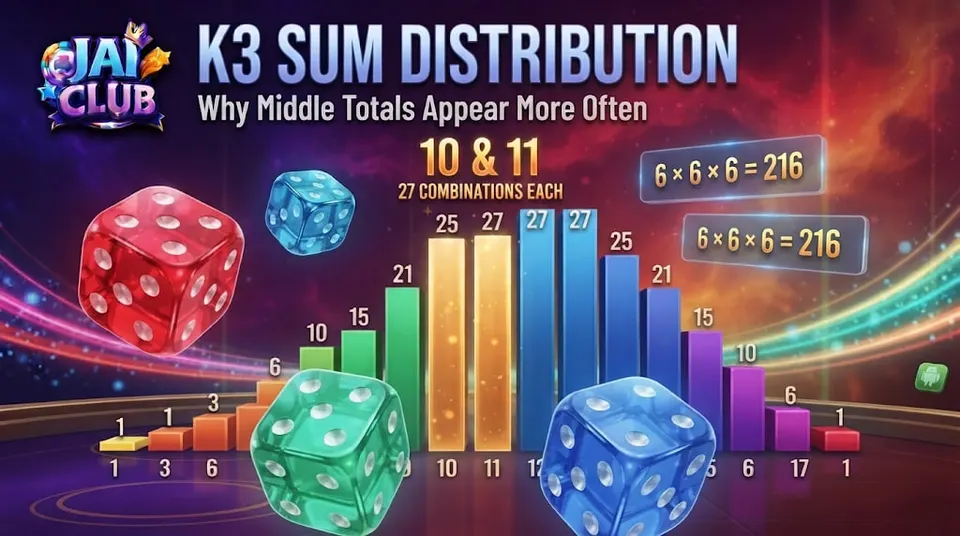
Readers interested in the wider sum distribution can continue with Why Middle K3 Totals Have More Combinations.
Editorial scope: All probabilities assume three independent fair six-sided dice. The article does not certify actual Jai Club K3 game rules, odds or payouts.