K3 Single Dice vs Total Sum: Two Different Result Categories
Understand why one die's value is different from the total of all three dice, how the values are counted and which probability calculations apply to each mathematical event.
In this article
- What Is a Single-Die Result?
- What Is the Total Sum?
- Single Die vs Total Sum
- EXAMPLE: Same First Die, Different Totals
- EXAMPLE: Same Total, Different First Die
- How Many Possible Three-Dice Outcomes Exist?
- Probability of a Specific Single-Die Value
- Probability of a Specific Total
- Why Three-Dice Sums Are Not Uniform
- Does the Order of Dice Matter?
- EXAMPLE: Exact Result vs Single Die vs Sum
- What Happens With Repeated Dice?
- Are Single-Die Categories Available in Every K3 Game?
- Why Result History Should Preserve All Three Values
- Can a Single-Die Pattern Predict the Sum?
- Does History Predict Future Dice Values?
- Frequently Asked Questions
- What is a single-die value in K3?
- What is the three-dice total?
- Can one die show 12?
- What is the sum of 2-4-6?
- What is the probability that a particular fair die shows 2?
- What is the probability of the exact outcome 2-4-6?
- What is the probability of a total of 12?
- Does the total identify the first die?
- Are single-die selections official in every K3 game?
- Can historical single-die results guarantee the next total?
- One Result, Several Different Questions
A K3-style game based on three dice can display several different numerical properties of one result.
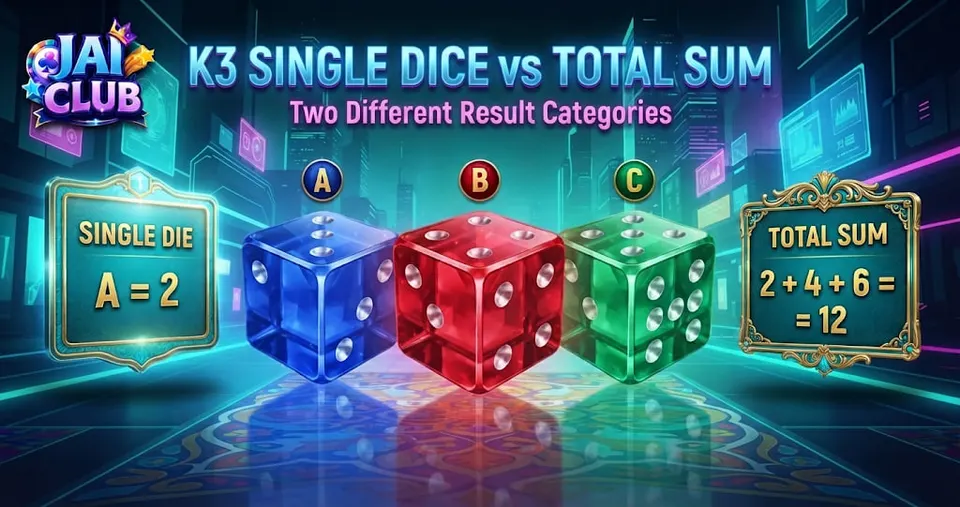
The first die may show 2, the second die may show 4 and the third die may show 6.
These three individual values are not the same thing as their combined sum.
Confusing a single-die value with the total can lead to incorrect comparisons, especially when a result-history table displays several numbers together.
Quick answer: A single die in a standard three-dice model has possible values from 1 to 6. The total sum of all three dice ranges from 3 to 18. They are different mathematical quantities and have different probability distributions.
This guide explains the distinction through position-based examples, accurate combinatorics and practical result-reading principles.
The calculations apply to fair, independent six-sided dice. They do not confirm the exact selection categories or settlement rules of any particular Jai Club K3 implementation.
What Is a Single-Die Result?
A single-die result is the value displayed by one specific die.
In a three-dice model, the dice can be labelled A, B and C.
For example:
A = 2
B = 4
C = 6
The value of Die A is 2.
The value of Die B is 4.
The value of Die C is 6.
Each individual value belongs to the range 1 through 6.
If a mathematical event refers only to Die A, the values on B and C do not change the value displayed by A.
What Is the Total Sum?
The total sum is calculated by adding the values on all three dice.
For the same example:
2 + 4 + 6 = 12
The result is a sum of 12.
The individual dice values remain 2, 4 and 6.
The number 12 is not a value displayed on one standard six-sided die.
It is the combined total.
This is why a single-die chart and a sum chart should not be treated as equivalent.
Single Die vs Total Sum
| Property | Single die | Three-dice total |
|---|---|---|
| Values used | One selected die | All three dice |
| Possible range | 1–6 | 3–18 |
| Number of possible values | 6 | 16 |
| Mathematical operation | Read one face | Add three faces |
| Distribution under fair dice | Uniform | Not uniform |
| Example from 2-4-6 | Die A = 2 | Sum = 12 |
The distinction is mathematical.
Whether a particular game offers selections corresponding to these properties depends on its actual rules.
EXAMPLE: Same First Die, Different Totals
Consider three fictional results.
| Ordered result | Die A | Sum |
|---|---|---|
| 2-1-1 | 2 | 4 |
| 2-3-5 | 2 | 10 |
| 2-6-6 | 2 | 14 |
All three outcomes show 2 on Die A.
However, their totals differ.
Therefore, knowing the first die does not determine the full sum.
The other two dice contribute additional values.
A single-die observation contains less information than the full three-dice result.
EXAMPLE: Same Total, Different First Die
Now consider three outcomes with the same sum.
| Ordered result | Die A | Sum |
|---|---|---|
| 1-3-6 | 1 | 10 |
| 2-3-5 | 2 | 10 |
| 4-4-2 | 4 | 10 |
All three produce a total of 10.
However, the first die shows a different value in each case.
This demonstrates that the sum does not determine the value of an individual die.
A history table displaying only the total cannot reconstruct all three original values.
How Many Possible Three-Dice Outcomes Exist?
Each standard die has six possible face values.
For three distinguishable dice, the number of ordered outcomes is:
6 × 6 × 6 = 216.
These outcomes include every combination of values and positions.
For example, 1-2-3 and 3-2-1 count separately as ordered outcomes.
The calculation describes the mathematical sample space.
A result's classification depends on which part of the outcome is being examined.
Probability of a Specific Single-Die Value
Suppose Die A is fair.
It has six equally likely faces.
Therefore, the probability that Die A shows 2 is:
1/6 = 16.67% approximately.
This probability does not require Die B or Die C to show particular values.
Across the 216 ordered outcomes, Die A equals 2 in 36 cases because B and C can each take six values.
Thus:
36/216 = 1/6.
The same result follows from either calculation.
Probability of a Specific Total
The probability of a total is calculated differently.
For example, a sum of 10 can be produced by 27 ordered three-dice outcomes.
Therefore:
P(sum 10) = 27/216 = 12.5%.
This is different from the 16.67% probability that a particular fair die shows 2.
The events concern different information.
It would be mathematically incorrect to apply the probability of one to the other.
Why Three-Dice Sums Are Not Uniform
A single fair die has six faces with equal probabilities.
However, different three-dice sums can be produced by different numbers of combinations.
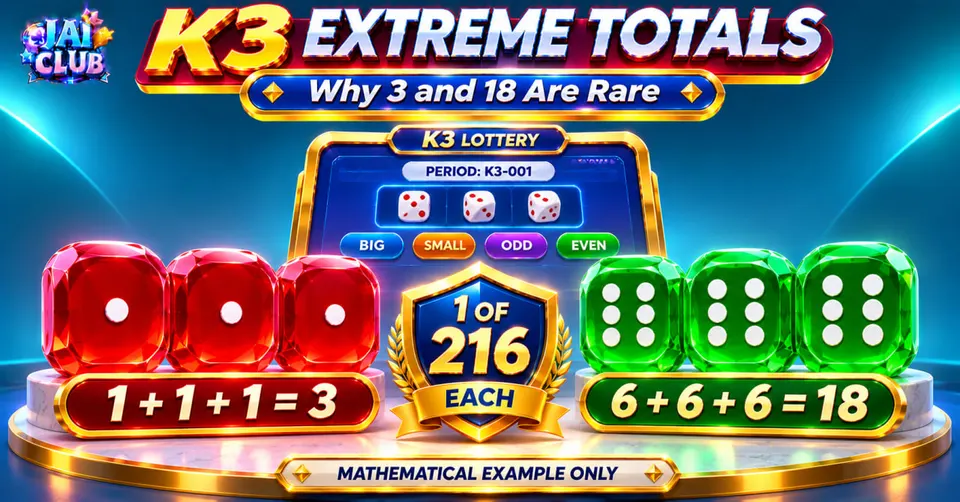
The total 3 occurs only through 1-1-1.
The total 18 occurs only through 6-6-6.
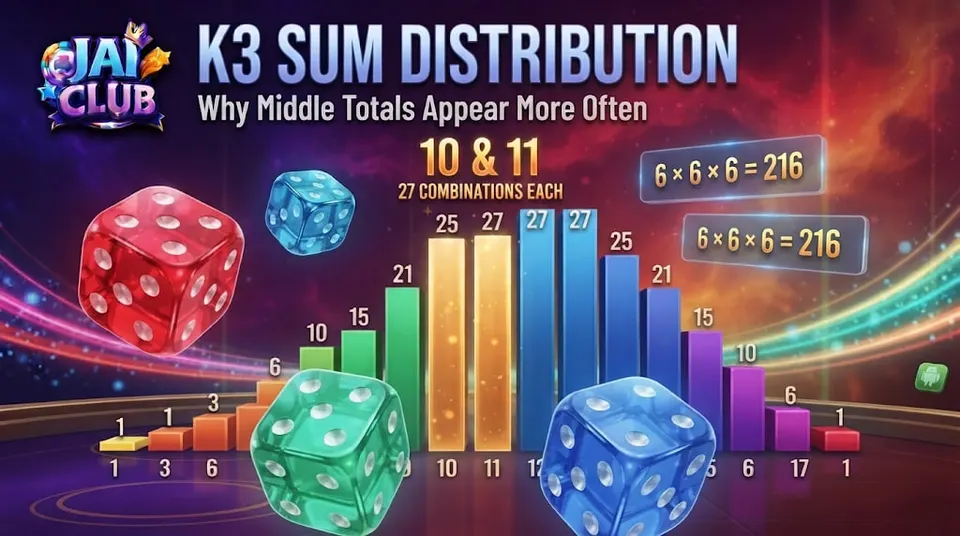
Middle totals such as 10 and 11 have many more possible arrangements.
Therefore, the theoretical sum distribution is not flat.
For the complete table, read K3 Sum Distribution.
Does the Order of Dice Matter?
Order matters for an exact position-specific event.
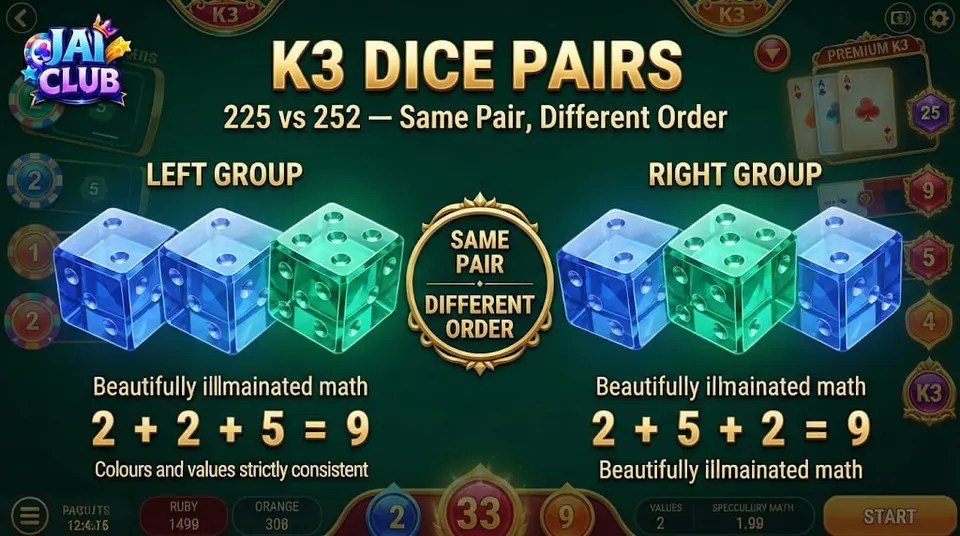
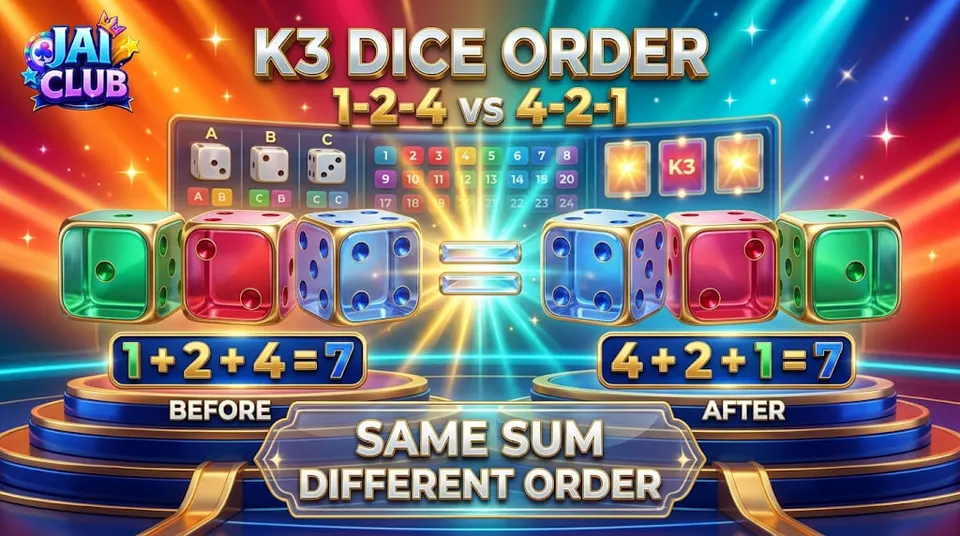
For example, 2-4-6 and 6-4-2 have the same sum of 12.
However, Die A shows 2 in the first outcome and 6 in the second.
Therefore, the two results differ when evaluating the value of Die A.
If only the sum matters, the results are equivalent for that property.
The wording of the event determines how the outcomes should be grouped.
EXAMPLE: Exact Result vs Single Die vs Sum
Consider the fictional result 2-4-6.
There are three different probability questions:
- What is the probability of exactly 2-4-6?
- What is the probability that Die A shows 2?
- What is the probability that the total equals 12?
Under fair independent dice:
The exact ordered result 2-4-6 has probability 1/216.
Die A showing 2 has probability 36/216, or 1/6.
A total of 12 has probability 25/216.
These events overlap, but they are not identical.
They must be counted separately.
What Happens With Repeated Dice?
The same mathematical distinction applies to doubles and triples.
For example, the outcome 3-3-5 contains two matching values.
Its total is 11.
Die A shows 3, while Die C shows 5.
The repeated values do not change the definition of the total.
Likewise, the triple 4-4-4 has individual dice values of 4 and a total of 12.
A triple is not a single-die value of 12.
The total remains a separate calculated quantity.
Are Single-Die Categories Available in Every K3 Game?
Not necessarily.
A three-dice result can always be analysed mathematically through individual positions and the total.
However, that does not establish that every operator provides position-specific selections.
The actual game rules determine which categories exist.
Similarly, a mathematical probability is not automatically the same as the payout odds offered by a service.
A responsible explanation separates the result structure from operator-specific financial conditions.
Why Result History Should Preserve All Three Values
A result-history panel may show the three individual dice and their total.
If the values are copied into a spreadsheet, preserving their original order makes position-specific analysis possible.
Storing only the total loses information about the individual dice.
For example, 1-3-6 and 4-4-2 both sum to 10.
A sum-only table cannot distinguish them.
Complete records support more accurate classification of doubles, triples, exact sequences and position values.
Can a Single-Die Pattern Predict the Sum?
Knowing one die's value restricts the possible total range but does not determine the sum.
For example, if Die A shows 2, the other two dice can each range from 1 to 6.
The minimum total is:
2 + 1 + 1 = 4.
The maximum is:
2 + 6 + 6 = 14.
There are many possible totals between those values.
Therefore, one known die does not establish the exact total.
If future dice remain unknown, a fixed sum cannot be predicted from one value alone.
Does History Predict Future Dice Values?
Historical results can be used to count previous outcomes.
However, a frequency chart does not automatically identify the next value.
Under a fair independent model, the next roll of a particular die has the same theoretical distribution regardless of previous rolls.
A series of repeated numbers does not force another value to appear.
The mathematics explains possible outcomes and their probabilities, not a guaranteed prediction strategy.
Frequently Asked Questions
What is a single-die value in K3?
It is the result of one specific die, usually between 1 and 6.
What is the three-dice total?
It is the sum of all three displayed values.
Can one die show 12?
Not on an ordinary six-sided die. Twelve can be a total but not an individual face value.
What is the sum of 2-4-6?
It is 12.
What is the probability that a particular fair die shows 2?
It is 1/6, approximately 16.67%.
What is the probability of the exact outcome 2-4-6?
It is 1/216 under fair independent dice.
What is the probability of a total of 12?
It is 25/216, approximately 11.57%.
Does the total identify the first die?
No. Different individual outcomes can share the same total.
Are single-die selections official in every K3 game?
No. The actual available categories depend on the operator's rules.
Can historical single-die results guarantee the next total?
No. They do not establish future unknown dice values.
One Result, Several Different Questions
A three-dice outcome contains several mathematical properties.
Each individual die has its own face value. The complete result has an order. The combined values also produce a total.
The mistake is treating those different properties as though they were interchangeable.
Reading them separately makes K3 results and probability tables easier to understand, without inventing operator-specific game rules.
For a broader mathematical overview, see K3 Lottery 216 Outcomes.
Editorial note: The examples assume fair independent six-sided dice. They do not verify the actual probability distribution or selection rules of any particular Jai Club K3 game.