The Wingo Colour Payout Mystery: Why One Result Can Show Two Colours
Why can one Wingo result display two colours? Understand special number mapping, dual-colour classifications, settlement rules and the difference between results and payouts.
In this article
- Why Can One Wingo Result Show Two Colours?
- Understanding Wingo Number-to-Colour Mapping
- Illustrative Dual-Colour Mapping
- Does Two Colours Mean Two Winning Results?
- Classification Is Not the Same as Payout
- Why Violet Is Often Treated Differently
- What Happens When the History Chart Shows Two Colour Dots?
- How Dual-Colour Results Affect Historical Statistics
- Why Two Colour Labels Can Lead to Prediction Errors
- Wingo Colour Payout vs Wingo Number Payout
- What if the Displayed Payout Looks Incorrect?
- Can Dual-Colour Results Predict the Next Colour?
- Frequently Asked Questions
- Why does Wingo sometimes show two colours?
- Does two colours mean two different numbers appeared?
- Can 0 show red and violet?
- Can 5 show green and violet?
- Does a dual-colour result guarantee two payouts?
- Why is the Wingo history chart showing two dots?
- Is a dual-colour result a technical error?
- Can special colours be predicted using historical charts?
- Are these the official Jai Club settlement rules?
- Conclusion
A Wingo result screen may look straightforward at first. A round finishes, a number appears and the interface displays a colour associated with that result. However, some Wingo-style interfaces use special number classifications that can produce more than one colour label for a single numerical outcome. For someone expecting every number to belong to exactly one colour, this can be confusing.
A result showing violet alongside red or green may appear to be a display error. Some readers interpret it as two separate winning numbers, while others assume that the colour result has changed after the round. In certain game variants, however, an outcome can be associated with multiple colour categories by design.
This guide examines how dual-colour classifications work, why one number may trigger two labels and how the recorded result differs from a payout calculation. The exact number mapping and settlement rules must always be checked against the particular game. The examples below are illustrative and should not be assumed to describe every Jai Club Wingo configuration.
Why Can One Wingo Result Show Two Colours?
The main reason is that a game may classify a numerical result using overlapping colour categories. Instead of dividing all possible numbers into three completely separate groups, the rules may assign certain special outcomes to violet as well as another colour.
This means the display is not necessarily reporting two different number results. It may be reporting one number that satisfies more than one classification condition.
The distinction matters because the number is the underlying result, while colours are categories applied to it. A game can calculate an outcome first and then display the relevant categories based on its rules.
Whether each category is eligible for a particular payout is a separate issue. Classification and settlement should not be treated as interchangeable.
Understanding Wingo Number-to-Colour Mapping
Many Wingo-style formats use digits from 0 to 9. Some familiar variants map ordinary numbers to red or green and apply special violet classifications to particular digits.
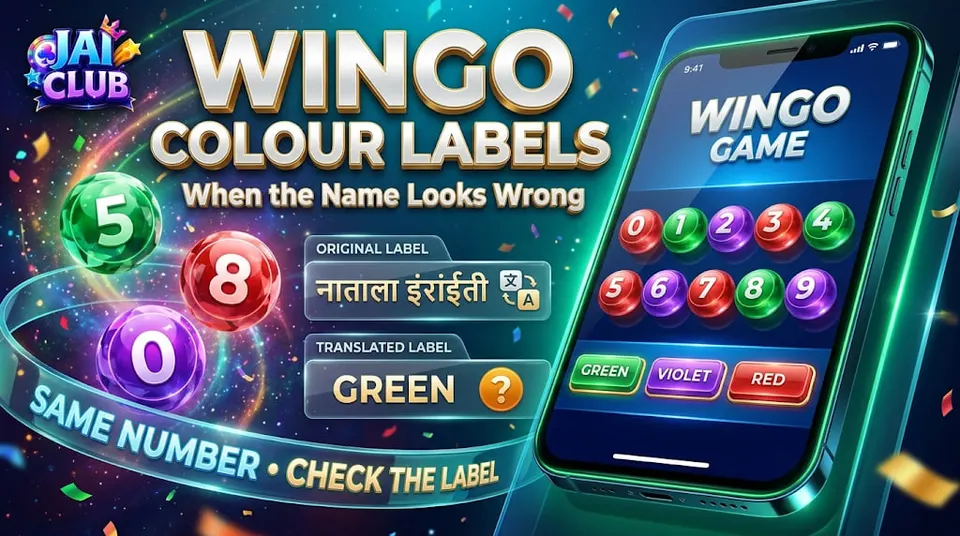
For example, one commonly described variant associates 0 with red and violet, and 5 with green and violet. Other versions may use different rules. This mapping must not be presented as a universal Jai Club specification unless confirmed in the actual game's rules.
The important principle is that a mapping table defines how numbers are labelled. When overlapping classifications exist, two displayed colours can arise from a single numerical outcome without requiring a second draw.
Illustrative Dual-Colour Mapping
| Example result | Possible displayed colours | Interpretation |
|---|---|---|
| 0 | Red and Violet | One special number with overlapping labels |
| 5 | Green and Violet | One special number with overlapping labels |
| 2 | Red | One ordinary colour classification |
| 7 | Green | One ordinary colour classification |
This table illustrates one commonly encountered mapping convention. It is not a verified paytable for every Wingo game or a guarantee about Jai Club's current rules.
Does Two Colours Mean Two Winning Results?
No. When a game assigns two colours to one number, that does not necessarily mean two separate outcomes have occurred. The round may still have only one numerical result and one unique period identifier.
Suppose an illustrative result is 0, and the interface displays red together with violet. Both labels can refer to the same underlying number. A history panel may therefore record one round while showing two coloured markers.
Some users mistake the second label for an additional result because the interface highlights each colour separately. Others may expect the result history to show only one colour for every period.
The correct interpretation depends on how the game's rules distinguish results, classifications and awards.
Classification Is Not the Same as Payout
One of the most important distinctions is between a result being associated with a colour and a particular selection qualifying for a payout.
A number might display two colour labels, but the game may apply separate settlement rules to the corresponding categories. The presence of both labels does not establish that every selection connected to either category receives an identical payout.
Some designs distinguish ordinary outcomes from special outcomes. The payout calculation may depend on the exact result, the chosen category, the applicable multiplier and any special conditions.
For this reason, a history screenshot alone is not enough to calculate what a particular wager should have returned. The relevant paytable and transaction record are also needed.
Why Violet Is Often Treated Differently
Violet may appear less frequently in a particular number-mapping scheme if only certain digits are associated with it. However, the actual frequency depends on the outcome probabilities and the verified mapping.
A category containing fewer possible digits is not automatically more valuable to a user. Its payout rate, probability, settlement restrictions and other rules must all be considered.
It would also be incorrect to assume that violet is due after a long absence. Historical frequency does not independently establish what the next result will be.
A special colour classification describes part of the game structure. It should not be interpreted as evidence of a predictable sequence.
What Happens When the History Chart Shows Two Colour Dots?
A result history may use two dots, a split-colour marker or another visual symbol to represent a special number. These are interface choices designed to communicate classification.
If the game uses overlapping colour categories, a dual-colour display may be a normal way of showing the completed result. However, if the number and colour labels do not match the published mapping, the discrepancy deserves closer examination.
The first step is to locate the correct round identifier and number result. Then compare the displayed labels with the current game's documented mapping.
Do not compare results from two different game variants unless their rules have been confirmed to match.
How Dual-Colour Results Affect Historical Statistics
A dual-colour outcome can make frequency charts difficult to interpret if the chart does not explain how it counts overlapping categories.
For example, a chart may count a special number under both its ordinary colour and violet. Another chart might classify it under a dedicated special-outcome group only.
Both approaches could produce different aggregate counts from the same sequence. Without a clear counting method, readers may misinterpret how often each category appeared.
This is why a statistical chart should define its classification method before using historical counts to make broader claims.
Why Two Colour Labels Can Lead to Prediction Errors
Prediction tools may be built around different assumptions. One might treat every digit as belonging to one exclusive colour, while another might count special digits under multiple labels.
If the underlying mapping is inconsistent, the analysis can be misleading even before the tool attempts to predict anything.
For example, a program trained on a single-colour history may not interpret a dual-colour outcome correctly. The error may produce inaccurate frequency charts, misleading accuracy claims or incorrect category totals.
A tool displaying confident colour predictions does not demonstrate that its underlying classification is correct.
Wingo Colour Payout vs Wingo Number Payout
A number-based result and a colour-based result may be connected, but they are not necessarily settled under the same rules.
A selection involving an exact number has a different classification structure from one involving a broader colour category. Different outcomes may qualify under different conditions, and their payout multipliers may vary accordingly.
The relevant distinction is between the category being displayed and the actual terms governing the specific selection.
Readers should not infer a payout from the colour alone or assume that two colour markers imply double payment.
What if the Displayed Payout Looks Incorrect?
An apparently incorrect payout may result from misunderstanding the mapping, a special-outcome rule or the difference between gross awards and net account changes.
Consider a fictional situation in which a completed round displays a dual-colour result. The user sees both colours and assumes that two independent awards are due. However, the game's rules may define the settlement in a more specific way.
A proper review requires the round ID, selection type, wager amount, recorded result and applicable settlement rule.
If the account information remains inconsistent with those records, the verified operator's support process is the appropriate place to raise a transaction enquiry.
Can Dual-Colour Results Predict the Next Colour?
No reliable forecasting method follows from the existence of dual-colour outcomes. The mapping tells us how to classify an outcome after it occurs; it does not establish which number will appear next.
A sequence containing multiple special-colour results can look unusual, particularly when the history chart uses bright overlapping markers. However, the visual appearance of a sequence is not evidence that its next result is predictable.
For an introduction to the broader game structure, see the Jai Club Wingo Guide.
Frequently Asked Questions
Why does Wingo sometimes show two colours?
Some variants classify special numerical outcomes under overlapping colour categories.
Does two colours mean two different numbers appeared?
Not necessarily. A single number may be displayed with two associated colour labels.
Can 0 show red and violet?
In some commonly described Wingo mappings, yes. The actual game's rules must be checked.
Can 5 show green and violet?
Some variants use that mapping, but it should not be assumed for every platform.
Does a dual-colour result guarantee two payouts?
No. Payout eligibility depends on the game's specific settlement rules.
Why is the Wingo history chart showing two dots?
The display may be representing overlapping colour classifications for one result.
Is a dual-colour result a technical error?
Not automatically. It may be part of the intended number mapping.
Can special colours be predicted using historical charts?
Historical classifications alone do not establish a reliable prediction method.
Are these the official Jai Club settlement rules?
No. This article explains general Wingo-style conventions and does not independently certify the current Jai Club paytable.
Conclusion
A Wingo result displaying two colours is not necessarily contradictory. In some game variants, special numbers belong to overlapping colour classifications, allowing a single completed outcome to appear under more than one label.
The key is to distinguish the underlying number from its colour classifications and the separate rules used to calculate awards. A dual-colour display does not automatically mean two winning numbers or two payouts.
Understanding this distinction helps readers interpret result histories accurately without confusing unusual screen presentations with prediction opportunities.
For related explanations, explore the Jai Club Wingo Guide.
Editorial disclaimer: Number mappings and settlement rules may vary by operator and game version. This article is educational and does not provide betting recommendations or verified payout instructions.