Inside Wingo Prediction Bots: Telegram Signals, Accuracy & Risks
Investigate how Wingo prediction bots distribute Telegram signals, what accuracy claims mean, how to evaluate prediction histories and why paid signals may be unreliable.
In this article
- What Is a Wingo Prediction Bot?
- How Telegram Prediction Signals Work
- Free Wingo Bots vs Paid Signal Groups
- What Does Bot Accuracy Actually Mean?
- Example of a Transparent Bot Evaluation
- Why Different Prediction Categories Need Different Baselines
- How Selective Screenshots Create Misleading Claims
- Why Long Winning Streaks Do Not Prove a Reliable Bot
- AI Prediction Bots vs Fixed-Rule Bots
- Can Bots Access Future Wingo Results?
- Common Warning Signs in Prediction Groups
- Why Referral Links Can Create Conflicts of Interest
- Telegram Channel Size Is Not Proof of Accuracy
- Financial and Privacy Risks
- How to Assess a Wingo Bot Claim
- Frequently Asked Questions
- What is a Wingo prediction bot?
- Are Telegram Wingo prediction bots accurate?
- Can a bot guarantee Wingo results?
- Do paid bots perform better than free bots?
- Are AI prediction bots different?
- Why do some bots publish only winning signals?
- Should a prediction bot ask for my OTP?
- Can Telegram subscriber numbers prove reliability?
- Does this article recommend a Wingo bot?
- Conclusion
Wingo prediction bots are frequently promoted through messaging applications, especially in discussions about colour and number-based games. Some claim to produce automatic numbers for upcoming rounds, while others advertise private signals, artificial intelligence or access to supposedly exclusive prediction methods.
These services can appear convincing because messages arrive at precise intervals, predictions are formatted professionally and successful results may be shared immediately after a round. However, an automated message is not evidence that the sender can determine a future game outcome. A bot can generate suggestions, post historical data and calculate basic statistics without possessing any privileged information.
For readers researching Jai Club Wingo prediction bots, this article explains how signal services generally operate, how advertised accuracy should be assessed and which warning signs deserve attention. It does not recommend joining a paid group or relying on prediction signals.
What Is a Wingo Prediction Bot?
A Wingo prediction bot is generally a program that sends number, colour or result-category suggestions automatically. It may operate through Telegram or another messaging platform and deliver messages according to a configured schedule.
Some bots generate predictions from previous results. Others use random-number selection, fixed formulas or undisclosed methods. A bot can also repeat information copied from another source.
The automated nature of the service does not establish that the predictions are correct. Software automation means that messages can be prepared or delivered without manual intervention; it does not demonstrate forecasting ability.
A provider claiming that its bot uses a secret game algorithm should be expected to support that statement with verifiable evidence rather than screenshots alone.
How Telegram Prediction Signals Work
A Telegram prediction service may publish messages containing a round identifier, suggested number and associated colour category. Some also display confidence percentages, past performance summaries or subscription information.
The messages may be sent to a public channel, a private group or an individual user. A bot can publish them at regular intervals using ordinary scheduling features.
This creates the appearance of a real-time prediction feed. However, a message sent shortly before a round does not automatically contain information about the outcome-generation process.
A bot that announces a prediction on a countdown schedule may simply be synchronised with publicly visible round times.
Free Wingo Bots vs Paid Signal Groups
Some services advertise free prediction messages, while others charge for access to private groups or premium features. A paid subscription may include more frequent messages, charts or technical-looking dashboards.
Payment does not make a forecast more accurate. A service can charge for a prediction without demonstrating any improvement over random guessing or a basic statistical baseline.
Paid communities may also use selective reporting to create the impression that subscribers receive more reliable information than public users.
An independent evaluation should consider the complete performance record rather than the cost of membership or the size of the community.
What Does Bot Accuracy Actually Mean?
Prediction accuracy generally measures how often a forecast matches the recorded outcome under a clearly defined scoring rule. The definition matters because predicting an exact number is different from predicting a colour or Big/Small category.
Suppose a fictional bot publishes 100 number predictions, of which 12 match the eventual results. Its observed exact-number accuracy would be 12% over that sample.
This figure alone would not establish whether the tool has a genuine forecasting advantage. The probability distribution, independence assumptions, sample size and appropriate baseline all matter.
A service should also publish every prediction rather than only the successful ones.
Example of a Transparent Bot Evaluation
| Metric | Fictional result |
|---|---|
| Predictions issued | 100 |
| Correct predictions | 12 |
| Incorrect predictions | 88 |
| Observed accuracy | 12% |
| Predictions recorded before results | Required |
| Complete history available | Needed for verification |
The example is fictional and does not describe the performance of any real Wingo bot.
Why Different Prediction Categories Need Different Baselines
A number predictor choosing among ten possible digits is performing a different task from a colour predictor choosing among three displayed categories.
The probability of each category depends on the actual game's mapping rules and outcome distribution. A prediction tool may therefore achieve different raw accuracy figures depending on what it attempts to forecast.
For example, a bot claiming 60% colour accuracy cannot be evaluated properly without knowing the expected frequency of the relevant categories and the testing method.
A high percentage may appear impressive while offering no meaningful improvement over a simple baseline.
How Selective Screenshots Create Misleading Claims
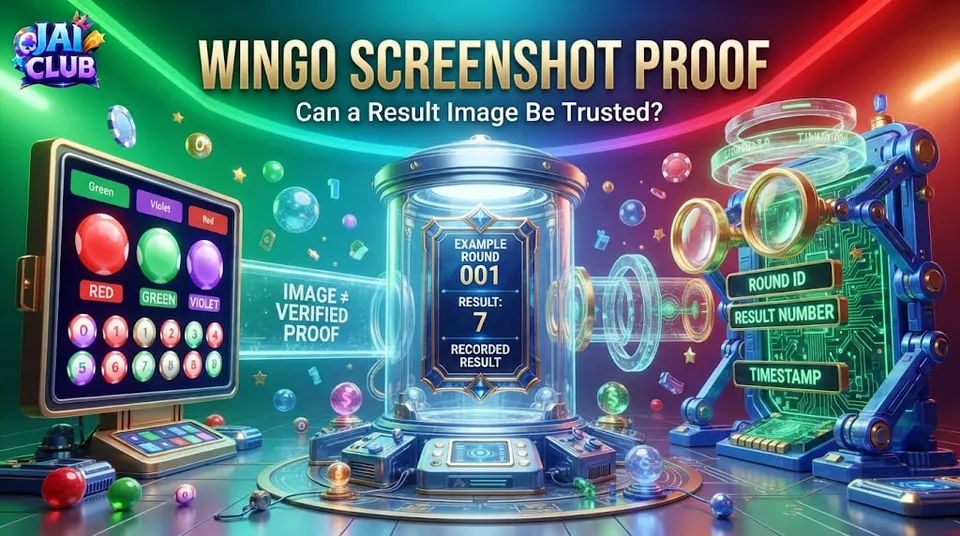
A signal provider may post successful predictions with celebratory graphics while failing to display incorrect calls. A history containing only wins can create the illusion of near-perfect accuracy.
Other misleading practices include editing prediction messages after an outcome, deleting incorrect posts or showing selected periods while excluding unsuccessful sessions.
A credible performance record should make it possible to establish when each prediction was issued, what result followed and whether any earlier messages were modified or removed.
A screenshot alone rarely supplies enough information for that assessment.
Why Long Winning Streaks Do Not Prove a Reliable Bot
A series of successful predictions can occur by chance, especially when many people or bots are making forecasts simultaneously. The more prediction sequences that are published, the more likely it becomes that some will look unusually successful.
Imagine hundreds of independent services each making guesses. Even without genuine predictive ability, a few may produce impressive short runs.
If only those unusually successful services receive attention, the overall picture becomes distorted.
Sustained, independently recorded performance matters more than one exceptional-looking sequence.
AI Prediction Bots vs Fixed-Rule Bots
A bot marketed as AI-powered may use machine learning, but the label does not prove that it does. A fixed-rule program can send signals automatically, calculate frequencies and display confidence values without using a trained AI model.
A genuine model should be evaluated using appropriate testing data and a clearly defined performance measure.
For readers interested in the technical differences, the broader Jai Club Wingo Guide explains the game terminology that such tools attempt to analyse.
The key distinction is between software sophistication and verified predictive accuracy.
Can Bots Access Future Wingo Results?
Some services claim to have access to a private server, secret database or unpublished result feed. These are serious technical claims that require credible evidence.
A website or bot displaying previous results does not demonstrate access to future outcomes. Similarly, correctly showing the current period number does not prove that the next result is known.
An independent observer should not accept privileged-access claims merely because the service uses technical language or publishes a few successful examples.
Claims of guaranteed access may also be used to justify expensive subscriptions or requests for account information.
Common Warning Signs in Prediction Groups
Several patterns deserve caution when evaluating prediction services. One is a promise of guaranteed winnings or permanently accurate signals. Another is pressure to pay immediately for a limited subscription.
Requests for passwords, OTPs or account access are especially concerning. A prediction bot does not need confidential authentication credentials to perform basic analysis of public result data.
Users should also be wary of instructions to install unverified APK files or disable device security protections.
A group claiming that failed predictions can always be recovered through larger future wagers is presenting a potentially harmful financial claim rather than demonstrating reliable forecasting.
Why Referral Links Can Create Conflicts of Interest
Some signal services also promote gaming platforms through referral links. This arrangement can create incentives that are separate from the quality of the predictions being offered.
For example, a provider might benefit when users register or engage in money-related activity through a particular link. Such an incentive does not prove that the prediction service is fraudulent, but it should be clearly disclosed.
Readers should distinguish the promotion of a gaming service from evidence supporting a prediction method.
A referral arrangement does not make a prediction more accurate or remove financial risk.
Telegram Channel Size Is Not Proof of Accuracy
A channel with many subscribers can appear trustworthy, but audience size is not a statistical measure of predictive performance.
Subscriber counts may reflect advertising, curiosity, older content or activity unrelated to forecasting. Some communities may also use automated accounts or promotional campaigns.
The number of members says little about whether predictions were made before the results or how often they were correct.
A useful assessment focuses on transparent data and meaningful testing rather than follower counts.
Financial and Privacy Risks
Prediction services can create two different types of exposure: financial risk from acting on unreliable signals and privacy risk from sharing information with unverified software or contacts.
A paid bot may charge a subscription even if its forecasts have no demonstrated advantage. Additional financial losses can occur when users treat its output as a reliable reason to place wagers.
Requests for account access, payment credentials or remote-control permissions can create separate security concerns.
The safest interpretation of an unverified bot is that it provides suggestions whose reliability has not been established.
How to Assess a Wingo Bot Claim
A credible evaluation begins with a complete, timestamped record of predictions issued before their corresponding results. The scoring method should define whether success means matching an exact number, a colour or another category.
The observed accuracy should then be compared with a justified baseline, taking into account the relevant rules and the size of the test sample.
Finally, the service should explain how predictions are generated without making unsupported claims of guaranteed access to unpublished outcomes.
Where this evidence is absent, the accuracy of the service remains unverified.
Frequently Asked Questions
What is a Wingo prediction bot?
It is software that automatically sends number, colour or result-category suggestions associated with Wingo-style games.
Are Telegram Wingo prediction bots accurate?
Accuracy must be established through complete, independently verifiable testing. Promotional screenshots are insufficient.
Can a bot guarantee Wingo results?
No such guarantee should be accepted without credible evidence.
Do paid bots perform better than free bots?
A subscription fee does not establish higher predictive accuracy.
Are AI prediction bots different?
Some may use machine learning, but the AI label alone does not prove that the implementation or forecasts are reliable.
Why do some bots publish only winning signals?
Selective reporting may create a misleading impression of performance. A complete record is needed.
Should a prediction bot ask for my OTP?
No. Sharing authentication codes with an unverified service creates account security risks.
Can Telegram subscriber numbers prove reliability?
No. Subscriber counts are not evidence of forecasting accuracy.
Does this article recommend a Wingo bot?
No. It explains how such services operate and how their claims should be evaluated.
Conclusion
Wingo prediction bots combine automated messaging with claims about future number and colour outcomes. They may produce professional-looking signals, performance summaries and countdown-based messages, but those features do not establish access to future results.
Reliable evaluation requires complete historical records, predictions timestamped before outcomes and meaningful comparison with statistical baselines.
Readers should remain cautious about paid accuracy claims, sensitive-data requests and promises that a sequence of predictions can guarantee financial returns.
Editorial disclaimer: This article provides independent information about prediction bot claims and security risks. It does not endorse any Telegram service or provide betting signals.