TRX Wingo Timestamp Mismatch: Block Time vs Game Round Time
Understand why a TRON blockchain timestamp and a Wingo game-period time may differ, how UTC and IST conversions work and why two clocks can refer to different events.
In this article
- What Is a TRON Block Timestamp?
- What Is a Wingo Round Time?
- Why Two Different Times Can Represent the Same Moment
- EXAMPLE: UTC 13:00 and IST 18:30
- The Date Must Also Match
- Block Production Time vs Result Publication
- EXAMPLE: Separate Events in One Timeline
- What Is Timestamp Precision?
- Local Device Time vs Server Time
- Why Round IDs Matter
- Can a Block Appear After the Round Closes?
- Why Selection Timing Affects Verification
- A Timestamp Is Not a Result Formula
- Why Screenshots Can Show Incorrect Time Context
- EXAMPLE: Missing Time-Zone Label
- Can Timing Differences Prove Manipulation?
- Why Blockchain Explorer Records Matter
- What a Strong Timing Comparison Requires
- Frequently Asked Questions
- Why does TRX Wingo time differ from a block timestamp?
- What is the difference between UTC and IST?
- Is 13:00 UTC the same as 18:30 IST?
- Can converting the time change the date?
- Is block time the same as game result time?
- Does a matching timestamp prove the block generated the result?
- Why is the period ID important?
- Can a phone clock be different from server time?
- Does a timestamp mismatch prove fraud?
- Can a blockchain explorer verify the game algorithm?
- The Same Clock Value Is Not the Whole Story
A TRX Wingo discussion may show a game round time beside a blockchain block timestamp.
Sometimes the clock values do not match.
For example, a game screen may show an evening time in India while a blockchain record displays an earlier time in UTC.
This difference does not automatically mean the records refer to different moments.
However, matching time zones does not automatically establish that a particular blockchain event was used to calculate a game result.
Quick answer: A TRON block timestamp and a Wingo round timestamp may describe different events or use different time zones. UTC and Indian Standard Time differ by five hours and thirty minutes. A valid comparison must identify the event represented by each timestamp and convert both to a common time reference.
This guide explains time zones, blockchain event timing, game-round stages and the limits of timestamp-based verification.
What Is a TRON Block Timestamp?
A blockchain block can contain a timestamp associated with the block.
For TRON, the timestamp is part of the block's recorded metadata.
It helps identify when the block was produced according to the network's relevant conventions.
However, it is not automatically the timestamp of a particular gaming result.
A game may refer to a blockchain event, but its connection to that event must be documented.
The block timestamp provides information about the network record, not the complete external game process.
What Is a Wingo Round Time?
A timed Wingo-style game may have several meaningful timestamps.
These could include the beginning of a period, its submission deadline, the time a result becomes available and the time a history record is displayed.
These are not necessarily the same moment.
For example, a round might close before the relevant result appears on a mobile screen.
A screenshot showing the countdown time therefore does not automatically identify the official result-publication time.
The meaning of the field matters more than the clock alone.
Why Two Different Times Can Represent the Same Moment
Time zones provide different local representations of the same instant.
Coordinated Universal Time, or UTC, is commonly used in technical systems.
Indian Standard Time, or IST, is UTC+05:30.
Therefore, a timestamp displayed in UTC can be converted to IST by adding five hours and thirty minutes.
This conversion changes the clock representation, not the underlying moment.
A mismatch between displayed clock values may disappear once both are expressed in the same time zone.
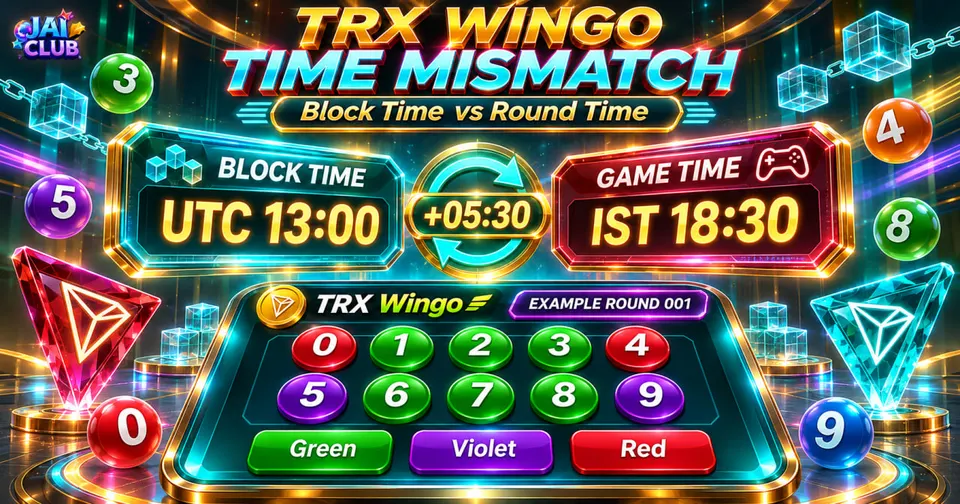
EXAMPLE: UTC 13:00 and IST 18:30
Consider the following fictional timestamp comparison.
| Source | Displayed time | Time zone |
|---|---|---|
| Blockchain event | 13:00 | UTC |
| Game interface | 18:30 | IST |
The conversion is:
13:00 + 05:30 = 18:30.
The two times represent the same moment if the date and timestamp meaning are also consistent.
This is a time-zone example, not a verified TRX Wingo block-to-round mapping.
The fact that two clocks align does not prove that the operator used that block as the source.
The Date Must Also Match
A common mistake is converting the clock time while ignoring the date.
For example, a UTC timestamp late in the evening may correspond to the next calendar day in India.
If a blockchain record shows 22:00 UTC on one date, the corresponding IST time is 03:30 on the following date.
Therefore, the full timestamp must include both date and time.
Comparing only hours and minutes can produce misleading conclusions.
A correct verification should use complete date-time values with explicit time-zone information.
Block Production Time vs Result Publication
Even after time-zone conversion, two timestamps may differ because they describe different events.
A block could be produced before a result is published.
A gaming service might process data, calculate an outcome and then display it.
A device may receive that result after another network delay.
These steps are technically distinct.
However, the exact process and timing of a particular Jai Club TRX Wingo implementation are not independently established here.
The difference between timestamps should be analysed rather than automatically labelled suspicious.
EXAMPLE: Separate Events in One Timeline
Imagine a fictional system with the following events.
| Event | Example UTC |
|---|---|
| Round closes | 13:00:00 |
| Selected source block appears | 13:00:06 |
| Result is processed | 13:00:08 |
| Phone displays result | 13:00:10 |
The sequence is illustrative.
It shows that a block timestamp and visible result time could differ even when both are expressed in UTC.
The example does not establish that TRX Wingo uses this architecture or these time intervals.
The actual source-selection and publication rules would need documentation.
What Is Timestamp Precision?
A timestamp can record time at different levels of precision.
Some screens show only hours and minutes.
Others include seconds or milliseconds.
For example, 13:00 may represent the minute beginning at 13:00:00 rather than one exact instant.
Two events displayed as 13:00 could actually be several seconds apart.
A meaningful comparison should therefore consider the precision of each field.
A screenshot with minute-only timing cannot establish exact second-level ordering.
Local Device Time vs Server Time
A mobile phone has its own clock.
An online gaming service may use a server-based time reference.
The two clocks may not be perfectly aligned.
Device configuration and synchronisation can affect the local display.
A user may also see a timer based on locally rendered information.
Therefore, a phone screenshot alone cannot establish the precise authoritative server time.
The source of the timestamp should be identified before it is compared with blockchain data.
Why Round IDs Matter
A game period ID identifies a particular round.
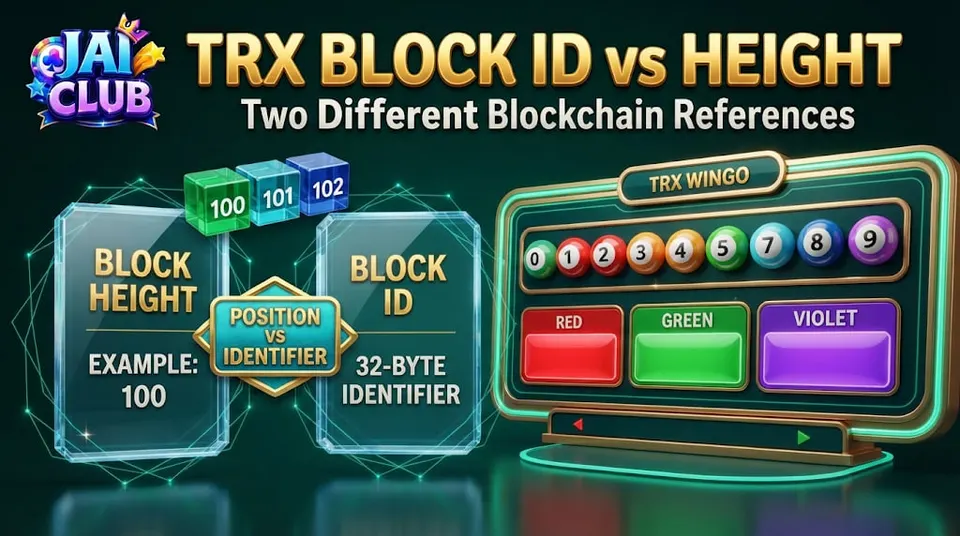
A blockchain block height identifies a position in the network.
A timestamp describes an associated moment.
These values are not interchangeable.
A valid block-to-round claim needs a documented relationship between the specific game period and the source blockchain record.
Two records having similar times does not automatically establish that relationship.
The period ID and block reference must be connected through the relevant selection rule.
For related identifier concepts, read TRX Wingo Block ID vs Block Height.
Can a Block Appear After the Round Closes?
A hypothetical design could select a future blockchain event after the relevant round closes.
That arrangement might be intended to use source data not yet known at the time of the deadline.
However, the design must define how the source event is selected.
Another system could use a different timing relationship.
Without published technical rules, there is no basis for asserting that a particular block must always appear before or after a game round.
The explanation must distinguish a possible architecture from a verified implementation.
Why Selection Timing Affects Verification
Suppose a hypothetical service claims a particular future block determines a result.
For a strong verification claim, the source-selection method should be fixed before the block's contents become known.
Otherwise, an operator with discretion to choose among already available blocks could potentially influence which data is used.
This concern is about the integrity of the method.
It is not evidence that a specific operator has manipulated results.
The actual fairness claim depends on documented rules and how they are implemented.
A Timestamp Is Not a Result Formula
A timestamp identifies time.
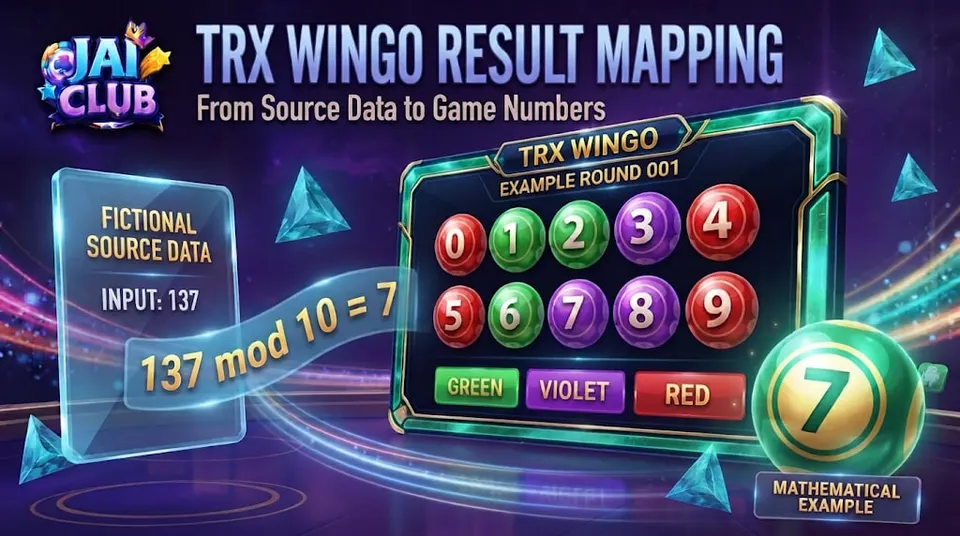
It does not explain how a number from 0 through 9 is generated.
For example, a block at 13:00 UTC does not automatically imply a particular Wingo number.
The operator would also need to explain the source field and mathematical conversion.
A verified timestamp and genuine block record are therefore only parts of the evidence.
They do not independently establish the game result.
For calculation concepts, see TRX Wingo Result Mapping.
Why Screenshots Can Show Incorrect Time Context
A screenshot may omit the date or time-zone label.
It may also show the phone's local clock alongside a game field using another time reference.
These values can look contradictory without actually describing the same event.
Another image might show a blockchain explorer after its display has converted a timestamp into the viewer's local time zone.
Consequently, readers should not assume every visible time is UTC.
The source and display settings matter.
EXAMPLE: Missing Time-Zone Label
Imagine a screenshot showing the time 18:30 without any time-zone information.
The value might represent IST, UTC or another local time.
A second image shows a blockchain event at 13:00 UTC.
Without knowing the first time zone, the viewer cannot confidently conclude that the timestamps match.
If 18:30 is confirmed to be IST on the same date, the values represent the same moment.
If it is 18:30 UTC, they are five and a half hours apart.
The missing label changes the interpretation.
Can Timing Differences Prove Manipulation?
No single timing difference proves manipulation.
There may be legitimate explanations involving time zones, event stages, processing delays or display precision.
However, a genuine conflict with a published source-selection rule could warrant investigation.
The correct evaluation requires the full rule, relevant records and accurate timestamps.
A careful explanation should avoid both unsupported accusations and unsupported assurances.
The evidence should determine the conclusion.
Why Blockchain Explorer Records Matter
A trustworthy explorer can provide information about recorded blocks and transactions.
That may help verify the existence and timestamp of a particular network event.
However, the explorer does not automatically verify an external gaming system's period mapping.
The gaming operator's method is still necessary.
A valid blockchain record can coexist with an unverified or incorrectly explained gaming claim.
The two types of evidence should be evaluated separately.
What a Strong Timing Comparison Requires
A meaningful comparison should identify the complete game period.
It should also identify the exact blockchain source record and timestamp.
Both times should be expressed using a common time-zone reference.
The type of event represented by each timestamp must be clear.
Finally, the comparison should follow the published source-selection method rather than an assumption based on similar clock values.
These conditions create a more reliable analysis than two cropped screenshots placed side by side.
Frequently Asked Questions
Why does TRX Wingo time differ from a block timestamp?
Possible explanations include time-zone differences, distinct event stages and display or processing delays.
What is the difference between UTC and IST?
Indian Standard Time is five hours and thirty minutes ahead of UTC.
Is 13:00 UTC the same as 18:30 IST?
Yes, on the corresponding date.
Can converting the time change the date?
Yes. A late UTC time may correspond to the next calendar day in India.
Is block time the same as game result time?
Not necessarily. They may describe different events.
Does a matching timestamp prove the block generated the result?
No. The source-selection and calculation rules still need verification.
Why is the period ID important?
It identifies the game round being compared with a blockchain event.
Can a phone clock be different from server time?
Yes. Local clocks and server references may differ.
Does a timestamp mismatch prove fraud?
No. The meaning and reliability of the complete records must be examined.
Can a blockchain explorer verify the game algorithm?
It can provide network evidence, but it does not independently certify an external game's calculation method.
The Same Clock Value Is Not the Whole Story
A useful timing comparison asks three questions: which event occurred, when it occurred and which time zone was used.
Two apparently different clock values can represent the same instant. Two identical clock values can also describe different events.
That distinction matters when a blockchain reference is presented as proof of a game result.
The strongest claim connects the correct period, source record, timestamp and reproducible calculation without relying on guesses.
Editorial note: All example times, periods and event sequences are illustrative. This article does not independently verify the timing or result-generation rules of a particular Jai Club TRX Wingo implementation.