TRX Wingo Block ID vs Block Height: What the Records Actually Mean
Understand how TRON block heights and block IDs differ, why block references should not be confused with Wingo period identifiers, and what blockchain data can actually verify.
In this article
- What Is a Block Height?
- What Is a TRON Block ID?
- Block Number and Block Height
- Comparison of Three Important Identifiers
- Why TRON's Block ID Structure Matters
- What Is Big-Endian Encoding?
- EXAMPLE: A Fictional Block Reference
- Block ID vs Transaction ID
- What Does a Block Header Contain?
- Block Timestamp vs Wingo Result Time
- How a Game Could Reference a Future Block
- Why a Block Height Does Not Reveal the Next Number
- Does a Real Block ID Prove the Game Result?
- Why Copying Only Part of a Hash Can Mislead
- Block Verification vs Game Fairness
- The Limits of Promotional Screenshots
- Frequently Asked Questions
- What is a TRON block height?
- Is block number the same as block height?
- Is a TRON block ID just a SHA-256 hash?
- Is block ID the same as transaction ID?
- Can one block contain several transactions?
- Is a Wingo period number a blockchain block height?
- Can a block height predict a future Wingo number?
- Does a genuine block ID prove game fairness?
- Why might a block timestamp differ from game time?
- What an Authentic Block Reference Actually Establishes
Blockchain discussions often use several technical labels that appear to describe the same record. In TRX Wingo-related content, readers may encounter terms such as block number, block height, block ID, transaction hash and game period number.
However, these identifiers do not have the same meaning.
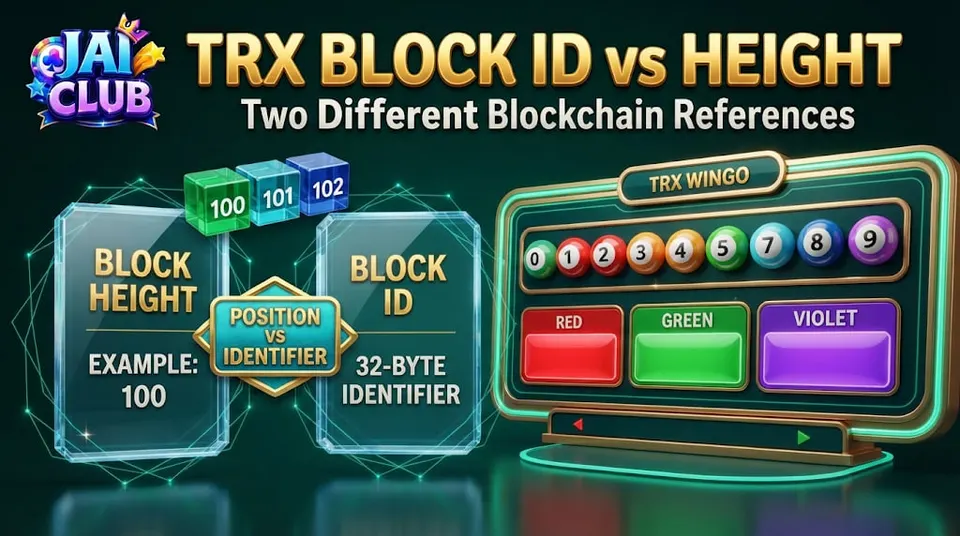
A block height identifies a position in a blockchain sequence. A block ID identifies a particular block. A game period number identifies an event in the relevant gaming system.
Confusing these values can lead to incorrect claims about how a completed game outcome was generated.
Quick answer: On the TRON blockchain, block height is the sequential number of a block, while the block ID is a separate 32-byte identifier containing information derived from the block height and header. Neither value is automatically the same as a TRX Wingo game period or result number.
This guide explains the technical distinction and the additional evidence needed to evaluate blockchain-related game claims.
What Is a Block Height?
A blockchain is organised as a sequence of blocks.
Each block occupies a particular position in that sequence.
The block height is the numerical position of the block.
For example, in a fictional illustration, a chain might include blocks at heights 100, 101 and 102.
The height identifies where a block appears relative to the beginning of the chain.
However, it does not describe the full contents of the block.
A reader cannot determine every transaction or data field simply by knowing the height.
What Is a TRON Block ID?
A TRON block ID is an identifier associated with a particular block.
According to TRON's developer documentation, its block ID uses a 32-byte structure containing an eight-byte block-number prefix followed by 24 bytes derived from the SHA-256 digest of the block header's raw data.
This is an important technical detail.
TRON's block ID is not simply the full SHA-256 hash of a block.
Its construction includes the block number as part of a composite identifier.
Therefore, block height and block ID are related but not interchangeable.
Block Number and Block Height
The phrases block number and block height are commonly used to refer to the same sequential integer.
For example, if a record displays block height 100, its block number refers to that same position.
However, the block ID is a separate field.
A block explorer may show both values.
Readers should distinguish the ordinary numerical height from the longer block identifier.
If a result-verification method requires a block ID, supplying only the height may not provide enough information.
The exact source field must be defined.
Comparison of Three Important Identifiers
| Identifier | What it represents | Main limitation |
|---|---|---|
| Block height | Position of a block in the chain | Does not contain all block data |
| Block ID | Identifier associated with a particular block | Does not explain a game result by itself |
| Game period ID | Identifier for a game round | Does not automatically map to a blockchain block |
These values can appear together, but their relationship depends on the relevant system.
A blockchain protocol defines its own identifiers.
A gaming service can separately define the identifiers used for its rounds.
A connection between them must be documented rather than assumed.
Why TRON's Block ID Structure Matters
It is easy to describe every long blockchain identifier as a hash.
However, TRON's composite block ID has a more specific structure.
The first eight bytes encode the block number in big-endian form.
The remaining 24 bytes come from part of the SHA-256 digest of the block header's raw data.
This means that the block's numerical position is directly represented within the block ID.
A correct technical explanation should preserve that distinction.
Using the word hash informally may be convenient, but it can hide important differences when a game claims to derive results from particular bytes.
What Is Big-Endian Encoding?
Big-endian is a way of arranging bytes so that the most significant byte comes first.
A blockchain identifier can contain numerical information encoded as bytes rather than ordinary decimal text.
This is different from simply writing a block height as a familiar number.
For example, the decimal integer 256 can be represented in hexadecimal as 0x100.
The exact number of bytes and their order matter when interpreting technical data.
A game-verification method that uses part of a block ID must specify which bytes or characters are selected.
Otherwise, the calculation may be ambiguous.
EXAMPLE: A Fictional Block Reference
Imagine a demonstration game that displays:
Game period: EXAMPLE-501
Block height: 100
Block ID: EXAMPLE-BLOCK-ID
The period identifies a gaming event.
The height identifies the position of a blockchain block.
The placeholder block ID represents a separate network identifier.
These values are deliberately fictional.
The example does not demonstrate how the game result was produced because no source-selection or calculation method has been specified.
Showing the three labels together is not equivalent to proving their relationship.
Block ID vs Transaction ID
A block ID identifies a block.
A transaction ID identifies an individual transaction.
One block can contain multiple transactions.
This means a single block may be associated with several different transaction IDs.
A result-mapping claim that requires an individual transaction must identify the relevant transaction and explain why it was selected.
A block height alone does not identify one specific transaction when several are present.
For further background, see TRX Wingo Transaction Hash Proof.
What Does a Block Header Contain?
A block header contains metadata associated with the block.
TRON's documented structure includes fields such as the block number, timestamp, previous-block reference and other information used by the network.
These fields have different technical purposes.
For example, the block number identifies sequence position.
The timestamp relates to the block's production time.
The previous-block reference links the block with earlier chain history.
A game claiming to use block-header data should identify the exact field involved.
A vague reference to “blockchain data” is not enough for reproduction.
Block Timestamp vs Wingo Result Time
A blockchain block has a timestamp associated with its production.
A timed game may separately display round start, close or result-publication times.
Those events are not necessarily identical.
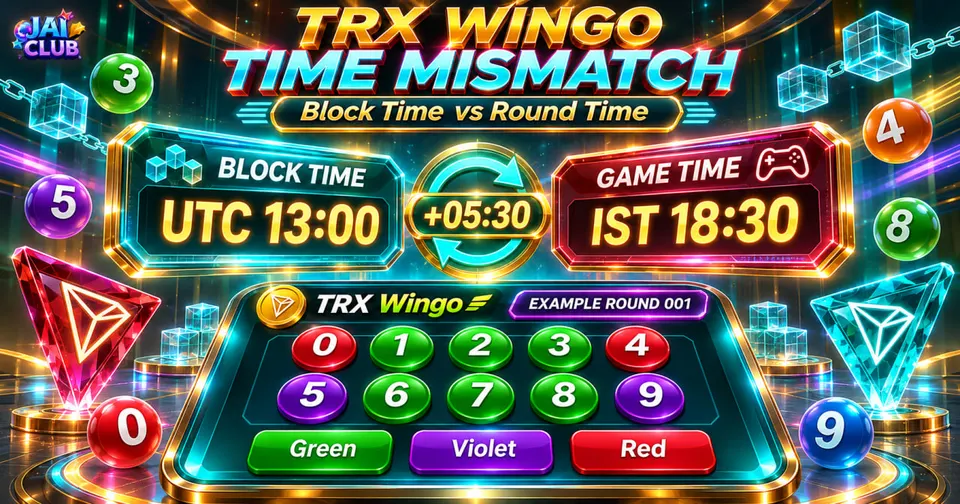
An apparent mismatch could also involve different time zones.
India Standard Time is UTC+05:30.
Therefore, 13:00 UTC and 18:30 IST refer to the same moment.
A proper comparison must identify which event each timestamp describes.
Without that context, a visible clock difference does not establish manipulation or a technical failure.
How a Game Could Reference a Future Block
A hypothetical game might identify a future blockchain block before its contents are known.
Once that block exists, the game could apply a documented transformation to selected data.
However, the method must define the input-selection rule in advance.
If the operator can choose among already known blocks after seeing their contents, the selection process could influence the available outcome.
This is a general design consideration.
It is not a claim that any particular Jai Club TRX Wingo implementation uses such a method.
The fairness of a real system depends on the full documented process.
Why a Block Height Does Not Reveal the Next Number
A block height identifies a numerical position.
It does not automatically reveal the future contents of the corresponding block.
A claim that the next Wingo number can be obtained simply from the future block height requires a verified formula and evidence that the formula is actually used.
Even then, whether the relevant input data is known in advance would need separate examination.
A numerical identifier is not inherently a prediction tool.
The existence of a public blockchain does not guarantee future game outcomes.
Does a Real Block ID Prove the Game Result?
No.
A genuine TRON block ID can help identify a real block.
However, that establishes information about the blockchain, not automatically the game.
The gaming service would still need to explain how it selected the block and converted its data into the displayed outcome.
For example, it might claim that a particular portion of the ID is used.
That claim should be checked against a published method.
A real block reference accompanied by an unexplained game number is incomplete verification.
Why Copying Only Part of a Hash Can Mislead
Some screenshots show only the beginning or end of a long identifier.
Truncation can make technical data easier to display, but it also removes information.
Two different full identifiers may share a similar visible prefix or suffix.
A partial string may therefore be insufficient for identifying the original network record.
A proper technical comparison should use the full relevant identifier from a trustworthy source.
The exact calculation rule must also specify whether it uses the full identifier or a defined portion.
Block Verification vs Game Fairness
The ability to locate a block on a public network is useful.
It may provide evidence that the block exists and contains particular data.
However, game fairness involves additional processes.
These include source selection, result calculation and the rules used to evaluate the completed outcome.
A public network cannot independently certify an external game's full implementation merely because the game displays a valid block reference.
Transparency about one component should not be confused with a complete audit.
The Limits of Promotional Screenshots
A promotional image may display a block height, long identifier and colour result together.
That presentation can look convincing.
However, screenshots may omit the source-selection rules, complete data fields and actual calculation formula.
The result could also belong to a different game period.
Readers should not accept the association merely because the numbers appear side by side.
A reproducible demonstration requires complete source information and a consistent method.
Frequently Asked Questions
What is a TRON block height?
It is the sequential numerical position of a block in the blockchain.
Is block number the same as block height?
These terms generally refer to the same sequential integer.
Is a TRON block ID just a SHA-256 hash?
No. TRON uses a composite 32-byte block ID containing a block-number prefix and data derived from a SHA-256 digest.
Is block ID the same as transaction ID?
No. A block ID identifies a block, while a transaction ID identifies one transaction.
Can one block contain several transactions?
Yes. A block may contain multiple transactions.
Is a Wingo period number a blockchain block height?
Not automatically. They belong to separate systems unless a documented rule connects them.
Can a block height predict a future Wingo number?
Not without a verified method, and a height alone does not reveal unknown future block contents.
Does a genuine block ID prove game fairness?
No. Game-specific source selection and calculations also require verification.
Why might a block timestamp differ from game time?
They may describe different events or use different time zones.
What an Authentic Block Reference Actually Establishes
A valid block height helps locate a position on TRON. A valid block ID identifies the corresponding block.
Those facts are useful, but their meaning should not be extended beyond the blockchain record itself.
The important unanswered question in a gaming claim is how a particular source block was selected and transformed into the displayed result.
For readers examining that calculation layer, TRX Wingo Result Mapping provides the next step.
Editorial note: Fictional examples do not represent actual Jai Club game rounds. Technical descriptions of TRON block identifiers follow public protocol documentation and do not certify any gaming operator's implementation.