TRX Wingo Result Mapping: From Transaction Data to Displayed Numbers
Learn what a TRX Wingo blockchain-to-result mapping claim means, how source records and conversion rules differ, and what evidence is needed to verify a displayed number independently.
In this article
- What Is TRX Wingo Result Mapping?
- What Is the Difference Between Source Data and Result Data?
- TRON Blockchain vs TRX Wingo Interface
- Transaction Hash vs Block Hash
- What Is a Deterministic Mapping Rule?
- Fictional Example: Mapping an Integer to a Digit
- Why the Exact Input Format Matters
- Why a Simple Modulo Formula Is Not Automatically Fair
- Fictional Modulo Bias Example
- What Does a Reproducible Result Require?
- Why Source-Selection Timing Matters
- Round ID vs Blockchain Reference
- Can Any Valid TRON Transaction Be Used?
- Blockchain Timestamp vs Game Result Time
- Why a Screenshot Cannot Verify the Mapping
- Mapping a Digit to a Colour
- Does Result Mapping Predict Future Numbers?
- What Would a Strong Verification Record Look Like?
- Common TRX Wingo Mapping Mistakes
- Frequently Asked Questions
- What is TRX Wingo result mapping?
- Does a transaction hash directly reveal the result?
- Is a block hash the same as a transaction hash?
- What does deterministic mean?
- Is modulo 10 an official TRX Wingo formula?
- Can modulo calculations introduce bias?
- Why does source-selection timing matter?
- Can a real blockchain hash prove game fairness?
- Can a public mapping rule predict future results?
- Does this article verify Jai Club's actual TRX Wingo algorithm?
- Conclusion
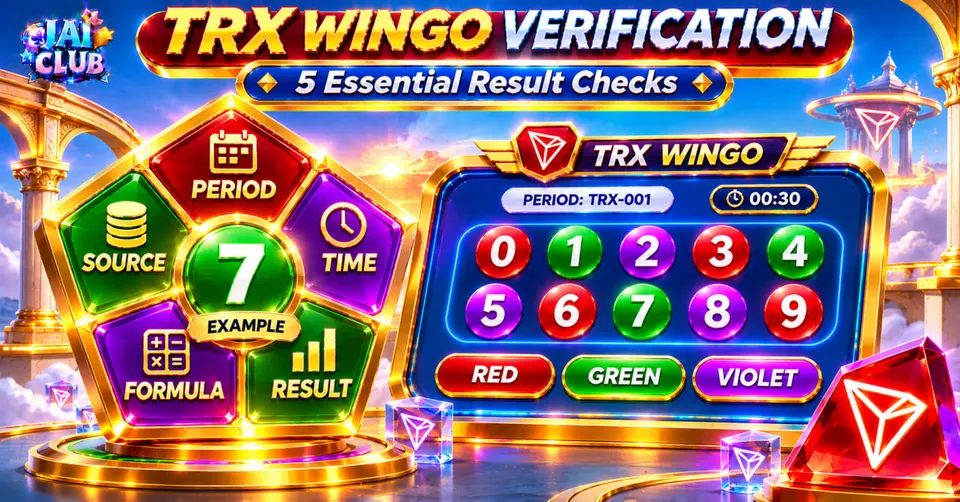
TRX Wingo is frequently discussed alongside blockchain terminology, including transaction hashes, block references and numerical results from 0 to 9.
Some descriptions suggest that the displayed result is derived from blockchain data. However, the statement that a game uses blockchain data does not explain how the final number is produced.
A complete explanation requires a mapping rule.
Quick answer: Result mapping is the process of converting a defined source value into a game outcome. A blockchain-based mapping claim should identify the source record, the exact data field, the calculation method and the time when the source was selected. Without those details, a displayed transaction hash does not prove how the game result was generated.
This article explains result mapping using fictional mathematical examples. It does not present an unverified formula as the actual Jai Club TRX Wingo algorithm.
What Is TRX Wingo Result Mapping?
A mapping rule connects an input value with an output.
In a number-based game, the output might be a digit from 0 to 9.
The input could be some value selected by the game's software.
If the operator claims the input comes from a public blockchain, a reader needs to know which blockchain value is used.
The mapping method must explain how that source value becomes the displayed result.
Without a published rule, an observer cannot reliably reproduce the calculation.
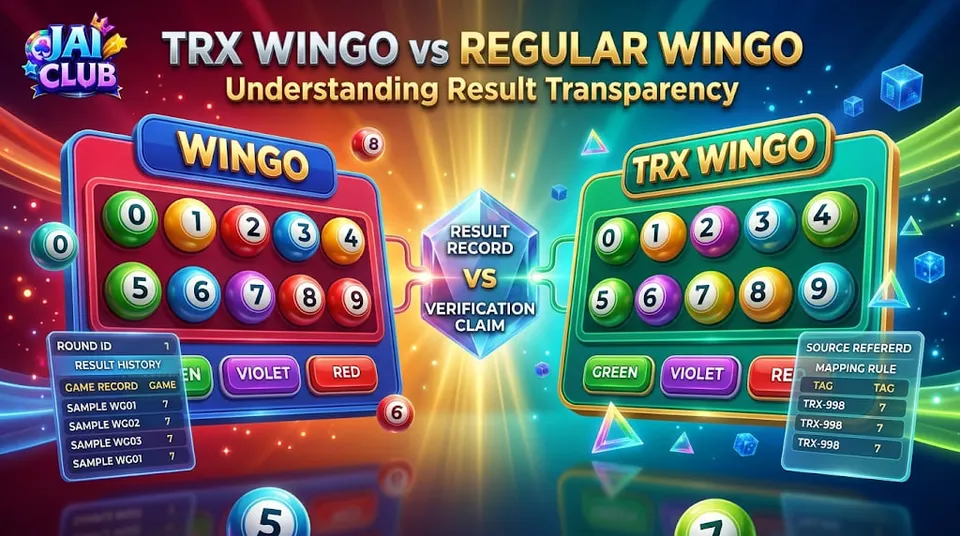
A result number and a blockchain identifier shown together do not establish the relationship by themselves.
What Is the Difference Between Source Data and Result Data?
Source data is the information used as input to a calculation.
Result data is the output produced by applying the relevant rule.
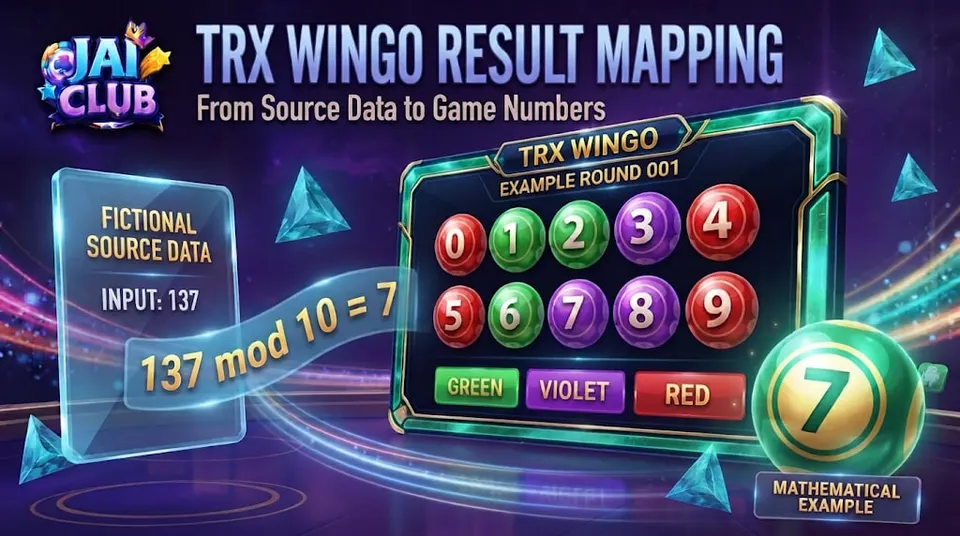
For example, in a fictional mathematical demonstration, the input may be an integer such as 137.
A rule might convert that integer into a single digit.
The important point is that the conversion rule must be known.
Different rules can produce different outputs from the same input.
Therefore, the input alone does not fully determine the meaning of the result unless the method is specified.
TRON Blockchain vs TRX Wingo Interface
TRON is a blockchain network, while TRX is its native cryptocurrency.
The network can contain blocks and transaction records.
A TRX Wingo-style interface may display game periods, numbers and colour categories.
These are different systems.
A public blockchain record can exist independently of a game.
The presence of a blockchain reference within a game interface does not automatically establish that the game used that specific record to generate its outcome.
The relationship must be documented and reproducible.
Transaction Hash vs Block Hash
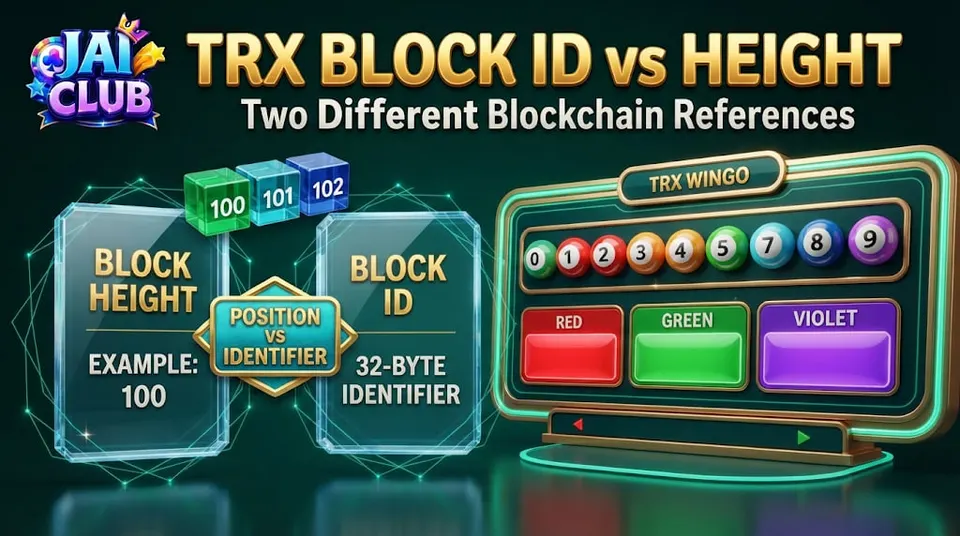
A transaction hash identifies a particular blockchain transaction.
A block hash identifies a block.
The distinction matters because a mapping rule may use one type of data rather than another.
A method requiring the last bytes of a block hash cannot be reproduced using an unrelated transaction identifier.
Similarly, a rule requiring a transaction field cannot necessarily use the block height instead.
The exact data source is therefore a central part of verification.
For further explanation of blockchain identifiers, see the TRX Wingo Blockchain Proof Guide.
What Is a Deterministic Mapping Rule?
A deterministic mapping rule gives the same output whenever it receives the same input under the same conditions.
For example, adding 2 and 3 always produces 5.
A result-mapping function should also behave consistently if it is presented as reproducible.
If a published method says a particular input produces the digit 7, independent observers applying the same method should obtain 7.
That repeatability is useful.
However, a deterministic formula is not automatically fair.
The input-selection process and the operator's control over that input also matter.
Fictional Example: Mapping an Integer to a Digit
Consider a completely fictional system using the formula:
Result = input mod 10
The modulo operation returns the remainder after division by 10.
For an input of 137:
137 mod 10 = 7
The result would be 7.
For an input of 244:
244 mod 10 = 4
The result would be 4.
This is a simple mathematical example. It is not a verified TRX Wingo mapping formula.
In particular, a real blockchain hash is not ordinarily just an integer written in familiar decimal digits. Its encoding and interpretation would need to be specified.
Why the Exact Input Format Matters
Blockchain hashes are commonly displayed as encoded strings.
A mathematical calculation may require those strings to be interpreted in a defined way.
For example, a method might use a particular byte, a portion of a hash or some other documented transformation.
Different representations of the same underlying data can be confusing when the format is not specified.
A hexadecimal-looking value should not simply be treated as an ordinary decimal integer.
A credible mapping method must define how the source data is read before applying any arithmetic.
Otherwise, two people may obtain different outputs while believing they followed the same rule.
Why a Simple Modulo Formula Is Not Automatically Fair
A modulo operation can produce a number within a desired range.
However, that does not establish an unbiased result distribution in every situation.
Suppose a hypothetical source produces integers uniformly from 0 through 255.
There are 256 possible input values.
When each value is reduced modulo 10, six result digits receive 26 possible inputs each, while four digits receive 25 each.
The output probabilities would therefore not be perfectly equal.
This is an example of modulo bias.
A game claiming equally likely outcomes must justify its entire data-selection and conversion process, not merely display a mathematical formula.
Fictional Modulo Bias Example
| Output digits | Possible inputs each | Probability each |
|---|---|---|
| 0–5 | 26 | 26/256 ≈ 10.16% |
| 6–9 | 25 | 25/256 ≈ 9.77% |
The example assumes that each integer from 0 through 255 is equally likely.
It does not describe the result distribution of any actual TRX Wingo game.
The purpose is to show why an apparently simple conversion can require careful mathematical analysis.
Even a reproducible formula may need additional design choices to produce an intended distribution.
What Does a Reproducible Result Require?
A reproducible result needs enough information for an independent observer to perform the same calculation.
At minimum, the method should specify the relevant network, the source event, the exact input field and the transformation.
It should also explain how the source event is selected for each game period.
For example, a method that chooses a future block should define the selection before the block becomes known.
Otherwise, the operator could potentially choose among several already available records.
Such discretionary selection would weaken the credibility of a fairness claim.
This is a general technical consideration rather than an allegation against a specific service.
Why Source-Selection Timing Matters
Imagine a hypothetical game where the operator can select any one of ten previously published blockchain records.
Even if the calculation formula is public, the operator's freedom to choose the input after observing the outcomes could influence which result is displayed.
A stronger design would define the source-selection procedure in advance.
This illustrates the difference between a transparent calculation and a transparent system.
Both the formula and the input-selection rules matter.
A real blockchain reference does not by itself establish that the source was selected fairly.
Round ID vs Blockchain Reference
A game period ID identifies the round within the operator's system.
A transaction hash or block identifier refers to an event on the blockchain.
These values may appear on the same screen, but they have different purposes.
A reliable mapping explanation should connect a specific period to a specific source record through an explicit rule.
For example, it should clarify whether the source is selected by timestamp, block height or another condition.
Without that mapping, a period number cannot be assumed to correspond to a particular blockchain event.
Can Any Valid TRON Transaction Be Used?
A genuine blockchain transaction is a real network record.
However, that does not mean it is suitable for any particular game calculation.
The method must explain why a particular transaction was selected.
If the operator can choose an unrelated transaction after the result is known, the presence of a valid hash does not strengthen the claim very much.
A verifiable system needs predictable selection rules.
The correct network record must be linked to the correct game period.
Simply showing a real transaction identifier is insufficient.
Blockchain Timestamp vs Game Result Time
Timing information can be important when comparing a claimed source record with a game round.
A blockchain record may have a timestamp associated with its block.
A game interface may display a period start, close or publication time.
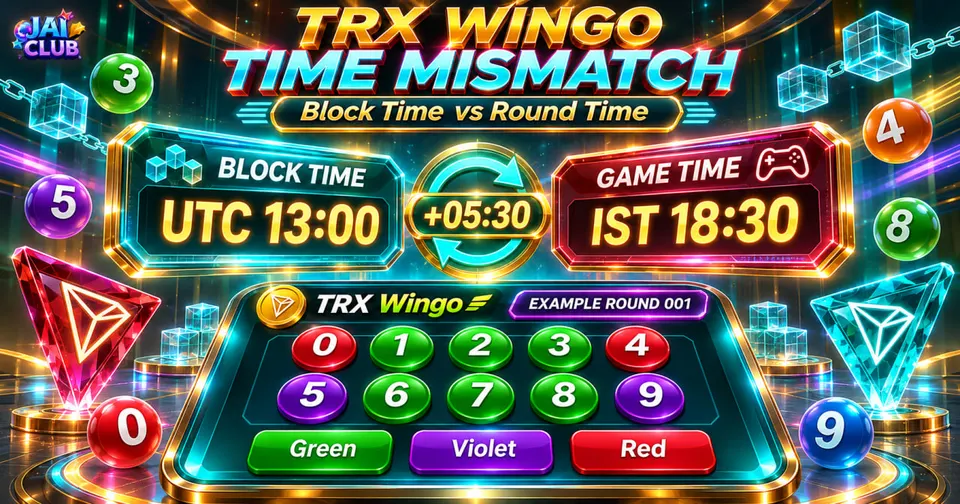
These times refer to different events and may use different time zones.
For Indian readers, IST is five hours and thirty minutes ahead of UTC.
A clock difference should therefore not automatically be treated as suspicious.
The meaning and time zone of each timestamp must be established before making comparisons.
Why a Screenshot Cannot Verify the Mapping
A screenshot may show a hash and a result number side by side.
However, it may omit the formula, source-selection conditions or relevant technical data.
Screenshots can also be cropped or edited.
Even if the hash is genuine, the screenshot does not establish that the displayed outcome was produced by the claimed method.
Independent reproduction would be more meaningful.
A reader should be able to identify the genuine source record and apply the documented calculation to obtain the same result.
Mapping a Digit to a Colour
A Wingo-style game may classify result digits into colour categories.
This adds another layer beyond the original numerical outcome.
For example, a hypothetical system might produce the digit 7 and then classify it according to a published colour table.
The colour mapping must also be documented.
Different Wingo variants may use different classifications, particularly for special digits.
Therefore, a complete result explanation needs both the source-to-number rule and the number-to-category rule when colours are part of the displayed result.
One cannot be safely inferred from the other.
Does Result Mapping Predict Future Numbers?
Not necessarily.
A method for verifying a completed outcome does not automatically reveal an unknown future input.
If the source data becomes available only after a particular blockchain event occurs, knowing the formula may not reveal the future result.
A prediction service claiming guaranteed future numbers would need independent evidence supporting that ability.
The presence of blockchain technology does not, by itself, establish advance knowledge of future events.
Historical mapping examples are not proof of reliable forecasting.
What Would a Strong Verification Record Look Like?
A useful verification record would identify the completed game period and the exact blockchain source event.
It would include the relevant input field and the published mapping formula.
An independent observer should be able to reproduce the displayed number using those details.
The source-selection timing should also be clear.
Additional information about the version of the calculation method would help identify whether rules changed over time.
These elements provide a stronger basis for evaluation than promotional screenshots or unexplained identifiers.
Common TRX Wingo Mapping Mistakes
One mistake is assuming that the last visible digit of any hash must be the game result.
Another is confusing a transaction hash with a block hash.
Some readers apply decimal arithmetic directly to encoded blockchain strings without defining how they are converted.
Others ignore the timing of source selection.
A further mistake is believing that a formula must be fair simply because it is deterministic.
Accurate verification requires examining the entire process rather than one calculation.
Frequently Asked Questions
What is TRX Wingo result mapping?
It is a method that would convert defined source information into a displayed game outcome.
Does a transaction hash directly reveal the result?
Not without a documented conversion rule.
Is a block hash the same as a transaction hash?
No. They identify different types of blockchain records.
What does deterministic mean?
It means the same input produces the same output under the same rule.
Is modulo 10 an official TRX Wingo formula?
No. It is used here only as a fictional mathematical example.
Can modulo calculations introduce bias?
Yes, depending on the input range and its probability distribution.
Why does source-selection timing matter?
It helps establish whether the input was chosen according to a rule set before its contents were known.
Can a real blockchain hash prove game fairness?
Not by itself. Source selection, mapping and implementation also require verification.
Can a public mapping rule predict future results?
Not necessarily. Future source data may remain unknown.
Does this article verify Jai Club's actual TRX Wingo algorithm?
No. It explains technical concepts without asserting an unverified operator formula.
Conclusion
TRX Wingo result mapping is about the relationship between source data and a displayed game outcome.
A meaningful verification process needs more than a blockchain identifier. It requires a defined input, reproducible calculation, clear source-selection rules and accurate timing information.
A genuine network event can support some technical claims without proving the fairness of an entire gaming service.
Readers should therefore distinguish mathematical examples from verified operator rules and treat guaranteed prediction claims cautiously.
For related game terminology, visit the Jai Club Games Guide.
Editorial note: Every conversion formula and numerical input in this article is hypothetical. No actual Jai Club TRX Wingo result-generation algorithm is claimed or certified.