TRX Wingo vs Regular Wingo: How Their Transparency Claims Differ
Compare regular Wingo result records with the blockchain-related transparency claims sometimes associated with TRX Wingo, including period IDs, source data, public hashes and result verification.
In this article
- What Is Regular Wingo?
- What Is TRX Wingo?
- The Main Difference Is the Verification Claim
- Regular Wingo vs TRX Wingo Comparison
- What Does Transparency Mean?
- A Result History Is Not the Same as Independent Verification
- What Can a Genuine TRON Transaction Prove?
- Block Hash vs Transaction Hash
- EXAMPLE: Two Claims About the Same Number
- What Is a Reproducible Result?
- Why Source-Selection Timing Matters
- Is Blockchain Transparency the Same as Fairness?
- Do TRX Wingo and Regular Wingo Have the Same Numbers?
- Can TRX Wingo Results Be Predicted From Blockchain Data?
- Common Comparison Mistakes
- Frequently Asked Questions
- Is TRX Wingo the same as regular Wingo?
- Does TRX Wingo automatically use the TRON blockchain?
- What is the purpose of a transaction hash?
- Does a genuine blockchain hash prove a game result?
- Can regular Wingo have transparent results?
- Is TRX Wingo necessarily fairer?
- Can blockchain data guarantee the next winning number?
- Is a screenshot of a blockchain explorer sufficient?
- What Makes the Comparison Useful?
Wingo and TRX Wingo are often mentioned together because both names are associated with number-based gaming interfaces. Readers may see familiar number buttons, colour selections, round identifiers and previous results.
However, discussions about TRX Wingo frequently introduce another subject: blockchain transparency.
Some descriptions suggest that blockchain records can provide additional evidence about how an outcome was generated. That can sound more convincing than an ordinary game-history table, but the important question is what those records actually establish.
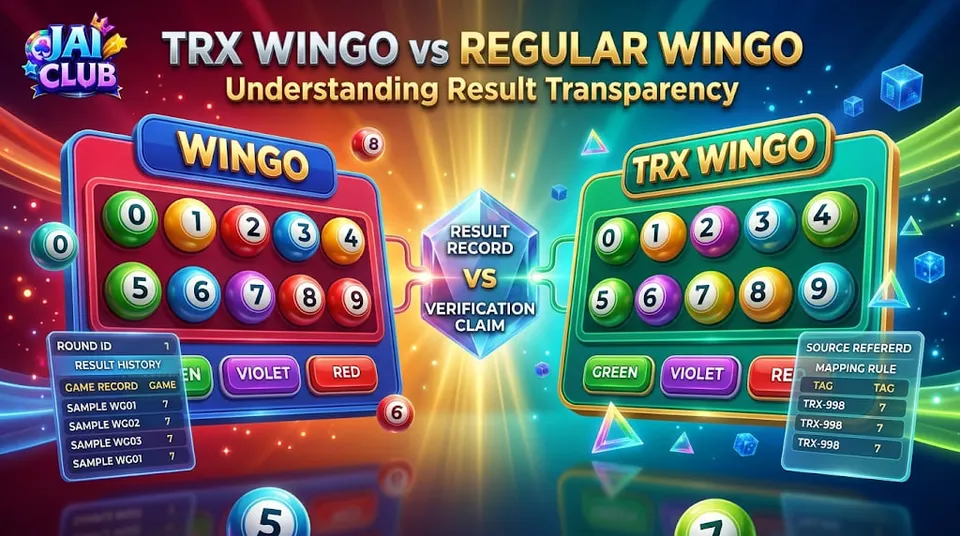
Quick answer: Regular Wingo and TRX Wingo should not be compared only by their names or visual designs. A regular game-result record may show what the service reported, while a blockchain-related claim may point to public network data. Neither automatically establishes independent fairness without a verifiable result-generation process.
This guide compares the types of information involved, what a transaction hash can prove and how readers can distinguish transparency from promotional claims.
What Is Regular Wingo?
Wingo is commonly used as a name for timed number-based games that may display results from 0 to 9, along with additional categories.
A typical interface can include a countdown, period identifier, number-selection area and completed-result history.
The exact rules differ between implementations.
Some interfaces may classify outcomes using colour names, while others present additional categories or different timing arrangements.
The presence of similar visual controls does not prove that two services operate under identical rules.
For general number and interface terminology, the Jai Club Wingo Guide provides a useful starting point.
What Is TRX Wingo?
TRX Wingo is a term associated with Wingo-style gaming discussions that also mention TRX or blockchain data.
TRX is the native cryptocurrency of the TRON blockchain.
However, the letters TRX in a game name do not, by themselves, establish that the game generates outcomes directly from public TRON data.
That relationship requires documentation.
A particular service would need to explain which network records it uses, how they are selected and how they become game numbers.
Without those details, the name alone cannot verify the underlying system.
The Main Difference Is the Verification Claim
A regular Wingo result history may identify a completed round and the numerical outcome published by the service.
A TRX Wingo interface or promotion may additionally claim a connection to a blockchain event.
The difference is therefore not necessarily the visible number grid.
It is the proposed source of evidence behind the published outcome.
A blockchain record can potentially be examined outside the gaming service.
However, independent access to a network record does not automatically verify the separate calculation that a game claims to have performed.
Regular Wingo vs TRX Wingo Comparison
| Area | Regular Wingo-style record | TRX Wingo-related claim |
|---|---|---|
| Game period | May have a round ID | May also have a round ID |
| Result number | Displayed by the game | Displayed by the game |
| Colour category | Depends on rules | Depends on rules |
| Blockchain reference | Not established by the name | May be claimed |
| Public network evidence | Not necessarily involved | Requires genuine source data |
| Independent verification | Needs documented rules and evidence | Needs documented source selection and calculation |
| Guaranteed fairness | No | No |
This table compares general concepts rather than asserting verified features of a particular operator.
What Does Transparency Mean?
Transparency means relevant information can be examined.
For a regular game, the operator may publish completed results and related rules.
For a blockchain-derived result claim, transparency could additionally involve a public source record and a reproducible calculation.
However, transparency is not simply the presence of more information on a screen.
The details must be meaningful.
For example, showing a long transaction identifier without explaining its connection to a game period does not provide a complete verification method.
The reader needs to understand what the reference identifies and why it was selected.
A Result History Is Not the Same as Independent Verification
A game-history table records outcomes reported by the relevant system.
It may help readers compare periods and detect visible inconsistencies.
However, a history table is not automatically evidence of how the outcome was generated.
If the operator publishes the result and controls the history, both may come from the same underlying system.
This does not mean the records are necessarily inaccurate.
It means that a record of the outcome and independent evidence of the generation method are different things.
That distinction applies to both regular and TRX Wingo discussions.
What Can a Genuine TRON Transaction Prove?
A genuine transaction identifier can be used to locate an on-chain transaction if it belongs to the relevant network.
A blockchain explorer may display details such as associated addresses, transaction status and block information.
This can help establish that a particular network event exists.
However, the transaction's existence does not automatically demonstrate that a gaming operator used it to calculate a result.
A genuine transaction could be unrelated to the claimed game round.
The relationship must be supported by an explicit and verifiable method.
Block Hash vs Transaction Hash
Blockchain discussions often use the word hash without specifying the type.
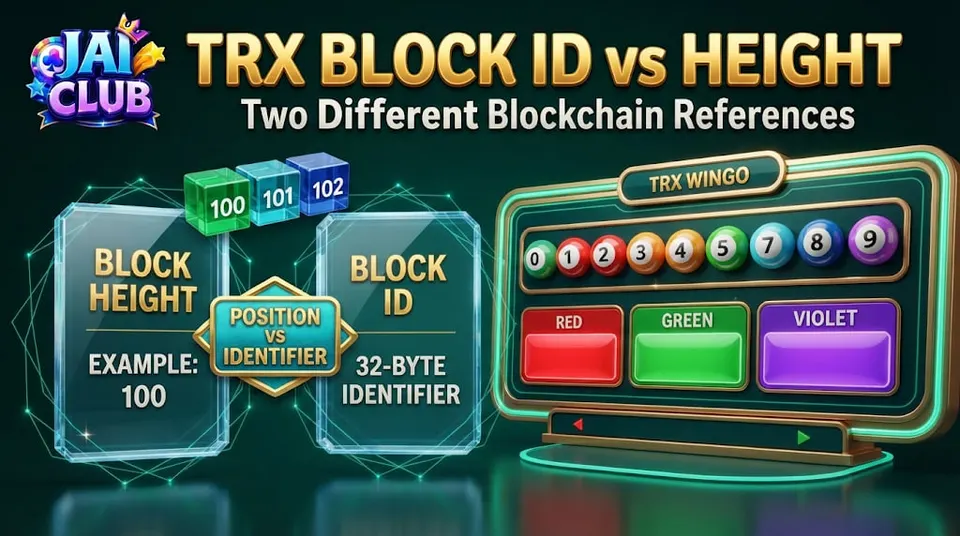
A transaction hash identifies a transaction.
A block hash identifies a block.
The two should not be used interchangeably.
A game that claims to use a block hash should explain which block was selected and which part of the block data is used.
A game that claims to use transaction data must explain why that particular transaction is relevant.
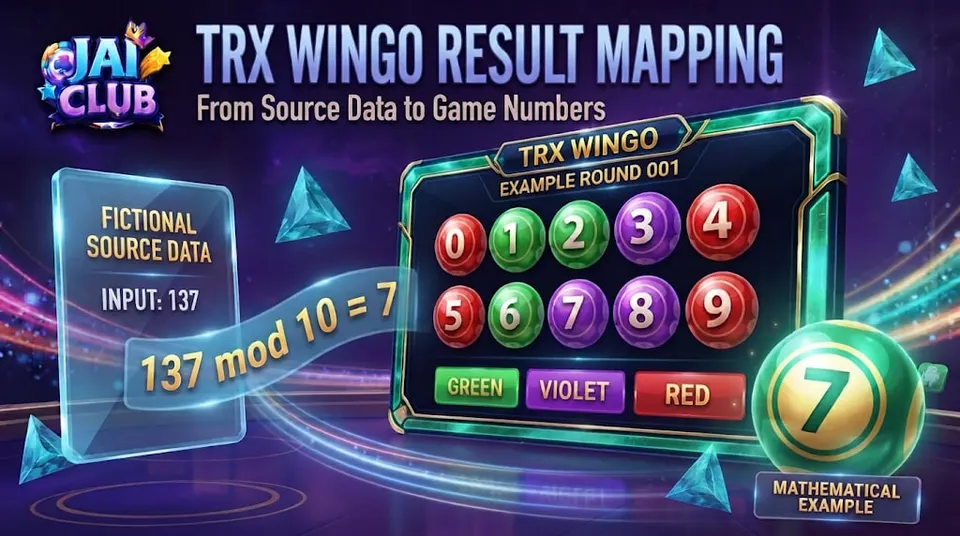
For more detail, read TRX Wingo Result Mapping.
EXAMPLE: Two Claims About the Same Number
Imagine two fictional games that both display the result 7.
Game A publishes a round number and the completed result.
Game B publishes the same type of information but also shows a blockchain reference.
Game B may appear more transparent.
However, the extra reference only becomes meaningful when the operator explains how that source was selected and converted into 7.
If no conversion rule is available, an observer cannot reproduce the result.
The example illustrates why the number of technical-looking fields on a screen is not a measure of fairness.
What Is a Reproducible Result?
A reproducible calculation produces the same output when the same method is applied to the same input.
For a blockchain-related game claim, a reader would need the exact source record and calculation rule.
The method should specify whether the input is a transaction field, block hash or another value.
It should also define how encoded data is interpreted.
Without those details, different people may reach different results using guesses about the formula.
A credible explanation should not rely on reverse-engineering one successful example after the outcome is known.
Why Source-Selection Timing Matters
A published formula can be reproducible and still leave an important question unanswered: who chooses the source data?
Consider a hypothetical system that permits an operator to select any one of several already published blockchain records.
Even if the formula is public, choosing the input after seeing the possible outputs could influence the result.
A stronger method defines the source-selection process in advance.
This reduces uncertainty about whether the input was selected according to a consistent rule.
The same principle is relevant when evaluating any claim that public data provides independent randomness.
Is Blockchain Transparency the Same as Fairness?
No.
A blockchain may make certain records publicly inspectable.
Game fairness concerns the full process used to generate outcomes and apply the relevant rules.
A service could provide a real blockchain reference while leaving important parts of the game logic undocumented.
Likewise, a game without blockchain integration might use a separately documented and independently assessed result-generation system.
Therefore, the word blockchain should not automatically be treated as proof that one game is fairer than another.
The scope of verification matters more than the marketing terminology.
Do TRX Wingo and Regular Wingo Have the Same Numbers?
Similar Wingo-style interfaces may use numbers from 0 through 9.
However, that does not establish identical classification rules, settlement conditions or outcome-generation methods.
Two games can display the same digits while applying different documented rules.
The colour categories and special-number treatment may also vary.
Readers should avoid transferring a mapping chart from one game to another without verifying compatibility.
Visual similarity is not enough to establish technical equivalence.
Can TRX Wingo Results Be Predicted From Blockchain Data?
A method for verifying a completed result does not necessarily predict a future result.
If the input depends on an event that has not yet occurred, the future source data may remain unknown.
Knowing how a formula works would not automatically reveal the missing input.
A prediction tool claiming guaranteed outcomes through blockchain hashes needs evidence supporting that claim.
Selected successful screenshots or past examples cannot establish reliable future forecasting.
The presence of public blockchain technology does not eliminate uncertainty.
Common Comparison Mistakes
One mistake is assuming that TRX Wingo must be blockchain-based solely because of its name.
Another is treating a transaction hash as proof of a completed game calculation.
Some readers compare result histories without ensuring that the games use compatible rules.
Others believe that a longer identifier or more complicated screen establishes stronger fairness.
A final mistake is confusing public data availability with independently audited implementation.
These claims should be evaluated separately.
Frequently Asked Questions
Is TRX Wingo the same as regular Wingo?
They may share visual or number-based concepts, but their actual rules and implementations must be verified separately.
Does TRX Wingo automatically use the TRON blockchain?
The name alone does not prove that a particular game uses TRON data to generate its results.
What is the purpose of a transaction hash?
It can identify a blockchain transaction and help locate the relevant network record.
Does a genuine blockchain hash prove a game result?
No. The source-selection and result-mapping rules also need verification.
Can regular Wingo have transparent results?
A regular game can publish records and documented methods, but the strength of any transparency claim depends on its evidence.
Is TRX Wingo necessarily fairer?
No reliable universal comparison can be made from the game names alone.
Can blockchain data guarantee the next winning number?
No. A completed-result verification method does not automatically reveal unknown future inputs.
Is a screenshot of a blockchain explorer sufficient?
No. It can document visible information but does not establish the full connection to the game outcome.
What Makes the Comparison Useful?
The most meaningful comparison between TRX Wingo and regular Wingo is not which interface looks more advanced.
It is which claims can actually be checked.
A result history can describe a completed round. A public blockchain record can establish facts about a network event. A reproducible method can show how a defined input produces an outcome.
Only when those pieces are connected by documented rules does a blockchain-based verification claim become technically meaningful.
For readers investigating the underlying evidence, the next useful article is TRX Wingo Blockchain Proof.
Editorial scope: This article compares general gaming and blockchain-verification concepts. It does not independently certify the result-generation method, fairness or blockchain integration of any particular Jai Club service.