TRX Wingo Verification Checklist: Five Details Every Result Record Needs
Learn the five essential elements of a TRX Wingo blockchain-verification claim: period identification, source record, selection timing, conversion formula and reproducible outcome.
In this article
- What Does Verification Mean?
- The Five Essential Details
- Check 1: Identify the Correct Game Period
- Why the Period Must Be Complete
- Check 2: Identify the Authentic Blockchain Source
- What Can a Blockchain Explorer Establish?
- Check 3: Examine Source-Selection Timing
- Block Time vs Game Time
- EXAMPLE: A Fictional Timing Record
- Check 4: Find the Result-Mapping Rule
- EXAMPLE: A Simple Fictional Formula
- Reproducible Does Not Automatically Mean Unbiased
- Check 5: Reproduce the Displayed Outcome
- EXAMPLE: An Incomplete Verification Screenshot
- EXAMPLE: A More Complete Verification Record
- Why Fake Hash Screenshots Are Misleading
- Can a Prediction Tool Pass These Checks?
- What Verification Cannot Establish Alone
- Frequently Asked Questions
- What is the first step in TRX Wingo verification?
- Does a valid transaction hash prove a game outcome?
- Why is source-selection timing important?
- Is a public mapping formula enough?
- Can a blockchain result be reproduced?
- Does reproduction prove game fairness?
- Does blockchain verification predict the next number?
- Can screenshots be misleading?
- Are these official Jai Club verification requirements?
- A Useful Verification Claim Must Be Reproducible
A TRX Wingo result screen may display a period number, outcome digit and blockchain-related information. Some claims also include transaction hashes, block identifiers or statements about public verification.
However, showing technical information is not the same as providing a complete verification method.
A meaningful claim must explain where the source data came from, how it was selected and why the specified calculation produces the displayed outcome.
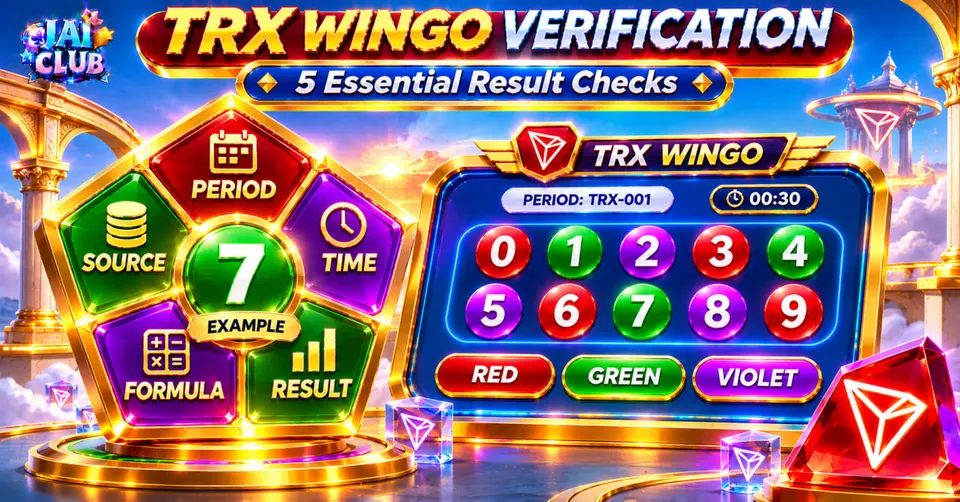
Quick answer: A TRX Wingo verification claim should identify five essential elements: the correct game period, the authentic source record, the source-selection timing, the published result-mapping rule and a reproducible final outcome.
These checks help readers distinguish a technically meaningful claim from a screenshot that simply looks convincing.
This article does not independently certify a particular Jai Club TRX Wingo implementation.
What Does Verification Mean?
Verification is the process of checking a claim against relevant evidence.
In a blockchain-related game, several different things may need verification.
A transaction identifier can be checked against a public network record.
A period identifier can be checked against the relevant game-history information.
A result-mapping formula can be tested using the specified source data.
However, none of these checks should automatically be treated as a complete assessment of game fairness.
The entire method and its implementation matter.
The Five Essential Details
The following table summarises the information required for a meaningful technical claim.
| Check | Required information | Main question |
|---|---|---|
| 1 | Game period | Which exact round? |
| 2 | Blockchain source | Which real network record? |
| 3 | Selection timing | Why was this source chosen? |
| 4 | Mapping formula | How was the number calculated? |
| 5 | Reproduction | Can the same outcome be obtained independently? |
These five checks are an educational verification framework.
They are not an official Jai Club certification checklist.
Check 1: Identify the Correct Game Period
A game period identifies the round associated with the result.
Without the exact period, it can be difficult to determine which event is being verified.
For example, two screenshots may show different result digits but belong to different rounds.
That would not establish a conflict.
A useful record should identify the complete game mode and period rather than only a partial number.
This is particularly important when similar-looking game variants have separate round sequences.
The period forms the starting point for the rest of the verification process.
Why the Period Must Be Complete
Some interfaces shorten long identifiers to fit within a small mobile screen.
A cropped screenshot may also hide the beginning or end of the period.
This can make two different records appear similar.
A complete identifier is more useful than a partial one.
If the period is unknown, the outcome should not be attributed to a guessed event.
Likewise, a screenshot should not be treated as a verified record merely because it contains a recognisable colour or number.
The correct event must be established first.
Check 2: Identify the Authentic Blockchain Source
A blockchain-related claim should identify the exact network record used as the input.
This could involve a block or transaction, depending on the documented system.
The identifier type matters.
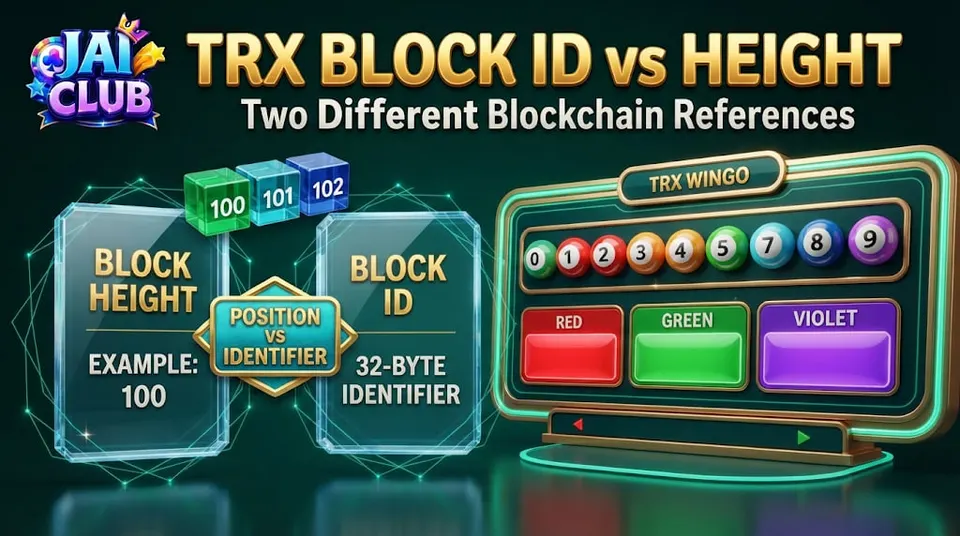
A transaction hash refers to an individual transaction.
A block ID refers to a block.
A block height identifies the position of a block.
These are different concepts, and one should not be substituted for another without justification.
What Can a Blockchain Explorer Establish?
A reliable blockchain explorer can help locate public network information.
For example, it may show whether a transaction exists and which block contains it.
This can establish facts about the network event.
However, the explorer does not automatically establish that an external gaming service used the same record.
That relationship belongs to the game's result-generation claim.
A genuine blockchain transaction may exist independently of the game.
Therefore, checking the source is necessary but not sufficient.
Check 3: Examine Source-Selection Timing
A public calculation can still leave a question about how the input was selected.
Suppose a hypothetical game claims to use a future blockchain block.
A meaningful method should explain which block will be selected before its contents become known.
If a service can choose from several already published records after viewing their values, the selection process may introduce bias.
This does not establish that any specific operator has manipulated results.
It explains why the timing and rules of source selection are important.
A transparent formula without transparent input selection is incomplete.
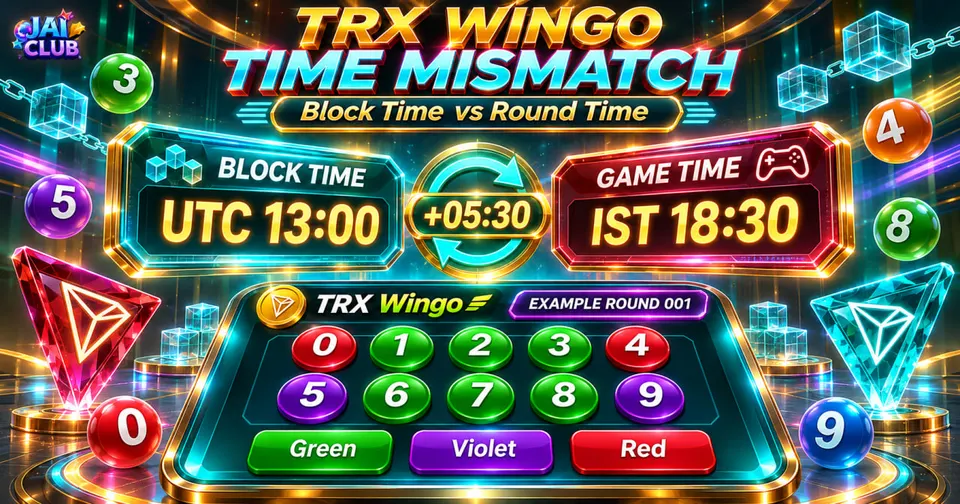
Block Time vs Game Time
Blockchain timestamps and game timestamps may describe different events.
One may represent the time a block was produced.
Another may represent the start, close or publication time of a gaming round.
The time zones may also differ.
Indian Standard Time is UTC+05:30.
Therefore, 13:00 UTC and 18:30 IST can describe the same instant.
However, time-zone agreement does not prove that a particular blockchain block was correctly selected.
The event meaning must also match.
EXAMPLE: A Fictional Timing Record
Consider a hypothetical game period labelled EXAMPLE-501.
The method states that a particular future network event will supply its source data.
The relevant block is later recorded at 13:00 UTC.
The game displays a corresponding local timestamp of 18:30 IST.
The times are mathematically consistent.
However, a complete verification still requires the exact selected block and the published conversion formula.
Matching clocks are only one part of the evidence.
Check 4: Find the Result-Mapping Rule
A result-mapping rule explains how a source value becomes the displayed outcome.
For example, a hypothetical system could convert an input integer into a digit from 0 to 9.
The exact calculation must be documented.
The method should specify which source field is used and how any encoded data is interpreted.
If the input is a hexadecimal string, the rules must explain how it is processed.
A vague statement that the result comes from a hash is not sufficient.
The mapping should be precise enough for independent reproduction.
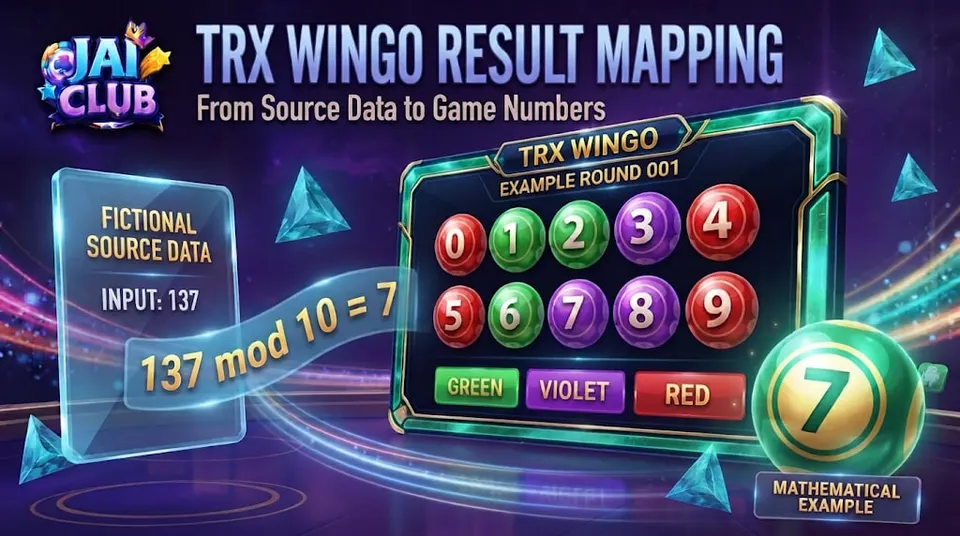
EXAMPLE: A Simple Fictional Formula
Consider the hypothetical rule:
Result = input mod 10.
For an input of 137:
137 mod 10 = 7.
For an input of 244:
244 mod 10 = 4.
These calculations are deterministic.
However, they do not describe a verified TRX Wingo formula.
The examples use ordinary decimal integers to demonstrate the concept.
A real blockchain-based method would need to specify the exact source representation.
Reproducible Does Not Automatically Mean Unbiased
A calculation can consistently reproduce the same result while still having a biased output distribution.
For example, reducing uniformly selected integers from 0 to 255 modulo 10 does not produce exactly equal numbers of inputs for all ten output digits.
Some results have more corresponding inputs than others.
Therefore, repeatability is only one requirement.
Fairness also depends on the source distribution, selection method and mathematical mapping.
A valid formula should not automatically be described as a fair formula without further evidence.
Check 5: Reproduce the Displayed Outcome
A complete verification claim should allow an independent observer to obtain the same number from the defined source.
The process should begin with the exact game period and corresponding blockchain record.
The observer should then apply the documented calculation.
If the result matches, this supports the claim that the published method produces that number from that input.
However, the comparison does not automatically prove that the live game always used the published method.
Implementation and consistency may require additional evidence.
A single reproducible example does not certify an entire system.
EXAMPLE: An Incomplete Verification Screenshot
Imagine a fictional screenshot displaying:
Period: EXAMPLE-601
Result: 7
Blockchain hash: a long unidentified string.
The screenshot appears technical.
However, it does not specify whether the identifier belongs to a transaction or block.
It also does not explain the source-selection timing or mapping rule.
An independent observer therefore cannot reproduce the result from the information shown.
The image may document a claim, but it does not provide complete technical proof.
EXAMPLE: A More Complete Verification Record
A stronger hypothetical record would identify the following information:
- The complete game mode and period.
- The specific blockchain network and record.
- The rule used to select the input.
- The exact data field and calculation formula.
- The resulting number and any additional category mapping.
These details allow the explanation to be examined step by step.
However, even such documentation needs trustworthy source data and evidence that the live implementation follows the stated rules.
Why Fake Hash Screenshots Are Misleading
A screenshot can be edited or presented without sufficient context.
A genuine blockchain record can also be placed beside an unrelated game result.
Both situations can create a misleading impression.
A copied logo or green confirmation symbol does not establish authenticity.
The important question is whether the source record and game result are linked through a verifiable method.
For related concepts, read the TRX Wingo blockchain proof guide: https://jaiclubgame.com/jai-club-trx-wingo-transaction-hash-proof
Can a Prediction Tool Pass These Checks?
A tool may correctly reproduce completed outcomes while having no ability to predict future ones.
If future source data is not yet available, the public formula alone may not reveal the next result.
Some promotional services confuse retrospective verification with advance forecasting.
These are different capabilities.
A claim of prediction accuracy requires forecasts recorded before the outcomes and a complete performance history.
Successful retrospective calculations are not evidence of guaranteed future results.
What Verification Cannot Establish Alone
Even a genuine source record and reproducible calculation do not automatically establish every financial or technical property of a game.
They do not independently verify the operator's settlement rules.
They do not prove that the implementation always follows the published method.
They do not demonstrate that a player can profit from the system.
They also do not establish that every public screenshot is authentic.
A useful verification process should state its scope rather than claim more than the evidence supports.
Frequently Asked Questions
What is the first step in TRX Wingo verification?
Identify the exact game mode and completed period.
Does a valid transaction hash prove a game outcome?
No. The relationship between the source record and result must also be documented.
Why is source-selection timing important?
It helps establish whether the input was selected according to a rule defined before its contents became known.
Is a public mapping formula enough?
No. Its input, implementation and mathematical properties also matter.
Can a blockchain result be reproduced?
It can be reproduced when the required source information and deterministic calculation are available.
Does reproduction prove game fairness?
Not automatically. It supports a specific calculation claim but may not verify the entire system.
Does blockchain verification predict the next number?
Not necessarily. The relevant future source data may remain unknown.
Can screenshots be misleading?
Yes. They may be incomplete, altered or taken from unrelated records.
Are these official Jai Club verification requirements?
No. They form a general educational framework.
A Useful Verification Claim Must Be Reproducible
A blockchain-related result claim is strongest when it connects five elements: the correct period, authentic source, predefined selection timing, documented formula and reproducible outcome.
A long hash or convincing screenshot is not a substitute for those details.
The goal is to distinguish what can actually be checked from what remains an unsupported assertion.
Editorial note: This article describes general blockchain-verification principles. It does not certify Jai Club's actual TRX Wingo result-generation method.