5D Lottery Digit Sum vs Full Result: Why Totals Hide Information
Learn the difference between a five-digit lottery result and the sum of its digits, why different sequences can share the same total, and how position information is lost when only the sum is recorded.
In this article
- What Is a Full 5D Result?
- What Is a Digit Sum?
- EXAMPLE: Three Different Results With Sum 15
- Why the Order Disappears During Addition
- The Difference Between an Integer and a Digit Sum
- Why ABCDE Positions Matter
- Leading Zeros and Sum Calculations
- Repeated Digits and Digit Sums
- What Is the Smallest Possible Digit Sum?
- What Is the Largest Possible Digit Sum?
- Do All Sums Have the Same Number of Results?
- Why Sum Frequency and Digit Frequency Differ
- Can You Reconstruct a Result From Its Sum?
- Why a Sum-Only Screenshot Is Incomplete
- Does the Digit Sum Predict Future Results?
- Frequent Errors in 5D Sum Charts
- Frequently Asked Questions
- Is the digit sum the same as the full 5D result?
- What is the sum of 12345?
- Can different results have the same digit sum?
- Does changing the digit order change the sum?
- Does changing the order change the full result?
- What is the sum of 00457?
- Why are leading zeros important?
- What is the maximum possible five-digit sum?
- Can a sum identify the original sequence?
- Do historical digit sums guarantee future outcomes?
- A Total Is a Summary, Not the Full Record
A five-digit lottery result contains five numerical positions. Each position can be examined individually, and the five values can also be added together.
This creates two different kinds of information: the complete five-digit result and its digit sum.
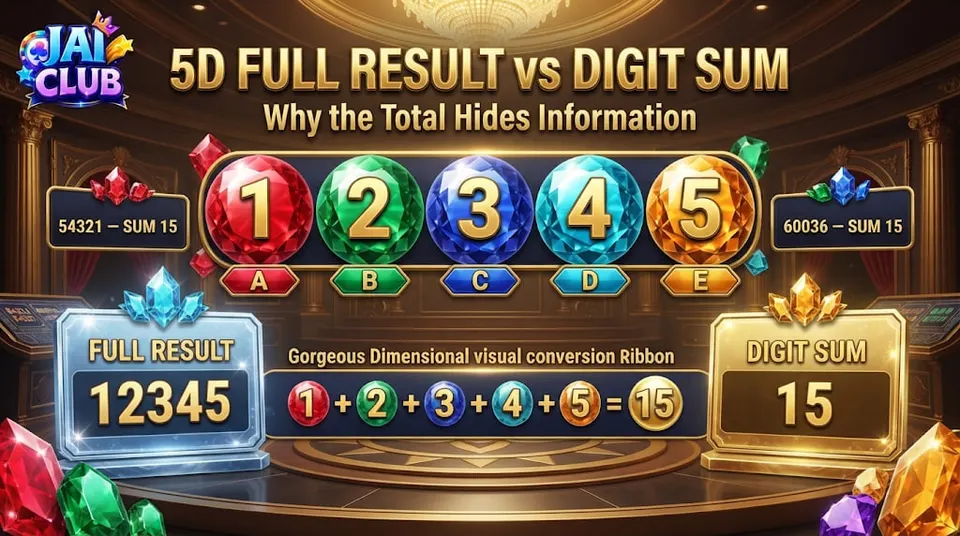
For example, the fictional sequence 12345 has a digit sum of 15.
However, many other sequences can also produce a total of 15.
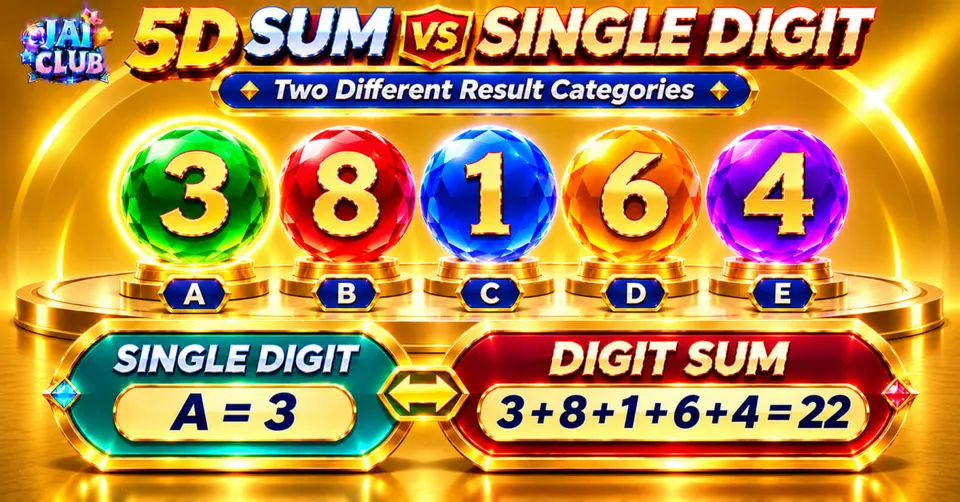
Quick answer: The full 5D result preserves five individual digits and their order. The digit sum combines those values into one total, losing information about their original positions. Equal sums do not mean that two results are identical.
This guide explains the distinction using clear examples and shows why a sum-only history cannot reconstruct the original five-digit sequence.
What Is a Full 5D Result?
A full five-position result contains five ordered digits.
These positions may be labelled A, B, C, D and E from left to right.
For example, 12345 can be described as:
A = 1, B = 2, C = 3, D = 4 and E = 5.
This representation preserves both the values and their positions.
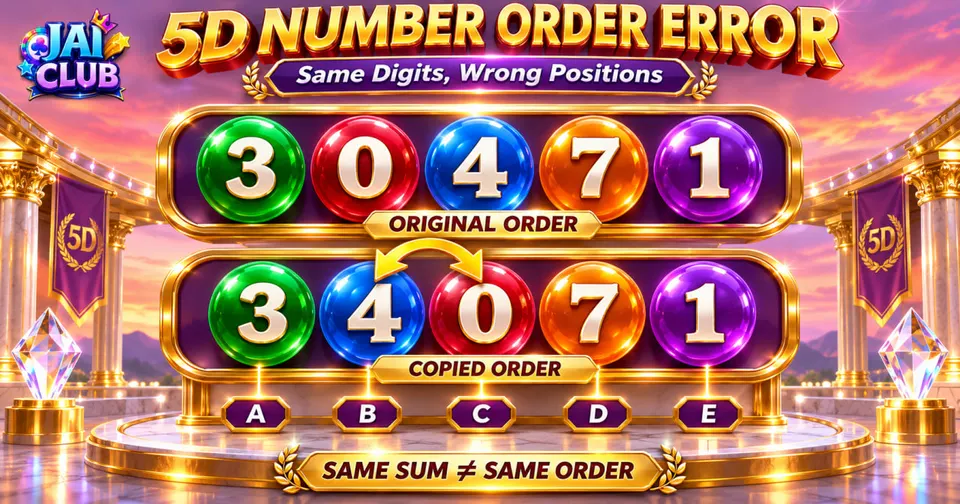
The complete sequence can distinguish 12345 from 54321.
Although the digits are the same, their order is different.
For position terminology, read the 5D Lottery ABCDE Guide.
What Is a Digit Sum?
A digit sum is the total obtained by adding the individual digits.
For the sequence 12345:
1 + 2 + 3 + 4 + 5 = 15
The digit sum is therefore 15.
This calculation describes one mathematical property of the sequence.
However, it does not preserve the order of the digits.
The sum also does not identify whether a digit appeared once or several times unless additional information is available.
Many different full results can have the same sum.
EXAMPLE: Three Different Results With Sum 15
| Full result | Digit addition | Sum |
|---|---|---|
| 12345 | 1 + 2 + 3 + 4 + 5 | 15 |
| 54321 | 5 + 4 + 3 + 2 + 1 | 15 |
| 60036 | 6 + 0 + 0 + 3 + 6 | 15 |
The first two results contain the same digits in different positions.
The third contains a different collection of digits.
Yet all three produce the same sum.
This is why a sum value cannot uniquely identify a full five-digit outcome.
The examples are fictional and do not represent live Jai Club results.
Why the Order Disappears During Addition
Addition is commutative, meaning the order of the values does not change their total.
For example:
1 + 2 + 3 + 4 + 5 = 15
Reversing the terms gives:
5 + 4 + 3 + 2 + 1 = 15
The result remains 15.
Therefore, calculating a digit sum discards the original sequence order.
This is useful when studying totals, but it limits what can be reconstructed from the result.
The sum preserves less information than the complete five-position sequence.
The Difference Between an Integer and a Digit Sum
The ordinary integer 12345 represents twelve thousand three hundred and forty-five.
Its digit sum is 15.
These are completely different numerical quantities.
The integer uses decimal place values.
The digit sum treats each of the five characters as a separate number and adds them.
A five-position gaming result may be displayed as a fixed sequence rather than interpreted as a quantity intended for normal integer arithmetic.
Readers should identify which meaning is relevant to the context.
Why ABCDE Positions Matter
A, B, C, D and E identify the location of each digit.
Consider the results 12345 and 21345.
Both have a digit sum of 15.
However, position A differs.
In the first sequence, A is 1.
In the second sequence, A is 2.
If a game or analysis uses individual position values, the two sequences cannot be treated as equivalent.
A sum-only table would not show this distinction.
Leading Zeros and Sum Calculations
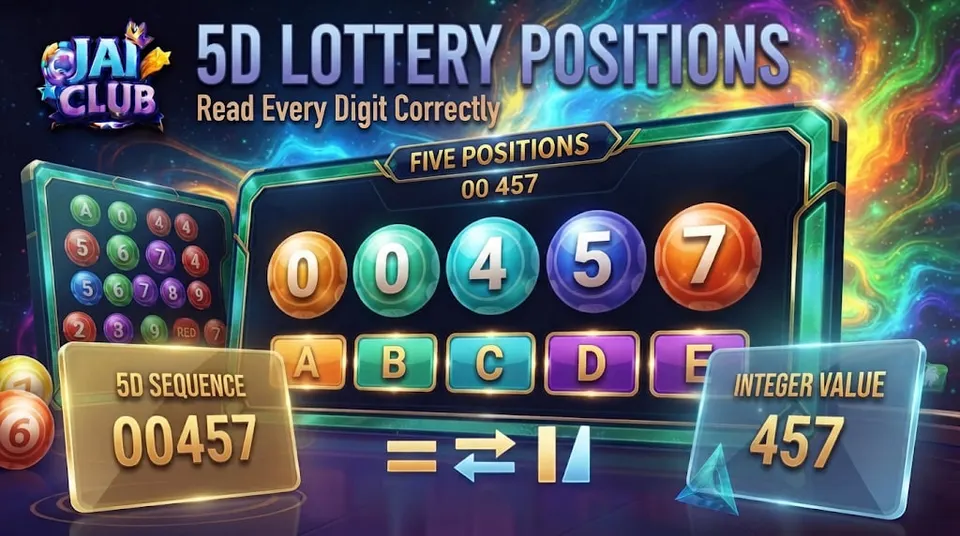
The fictional result 00457 contains five positions.
Its digit sum is:
0 + 0 + 4 + 5 + 7 = 16
The ordinary integer representation is 457, but the fixed-width sequence remains 00457.
Removing the leading zeros does not change the digit sum.
However, it removes information about the values in the first two positions.
That distinction is important when storing or comparing full results.
A zero can be mathematically neutral in addition while still being meaningful as a position value.
Repeated Digits and Digit Sums
Repeated digits must be counted each time they appear.
Consider 11223.
Its sum is:
1 + 1 + 2 + 2 + 3 = 9
The repeated 1 and repeated 2 each contribute more than once.
A common mistake is to add only the distinct digits and incorrectly calculate 1 + 2 + 3 = 6.
That would not be the digit sum of the five-position result.
Every position must be included.
The same principle applies when zero or another value appears repeatedly.
What Is the Smallest Possible Digit Sum?
Assume a five-position format in which each position can contain a digit from 0 to 9, including leading zeros.
The smallest possible result is 00000.
Its digit sum is:
0 + 0 + 0 + 0 + 0 = 0
Therefore, the minimum possible digit sum is 0.
This is a mathematical property of the assumed format.
Whether a particular game uses 00000 as an eligible result or provides a sum-based category is a separate question requiring verification.
What Is the Largest Possible Digit Sum?
Under the same five-position decimal model, the largest digit in each position is 9.
The sequence 99999 has a digit sum of:
9 + 9 + 9 + 9 + 9 = 45
Therefore, the maximum possible digit sum is 45.
All integer totals from 0 through 45 can be produced by at least one five-digit sequence under this model.
However, these totals do not all contain the same number of underlying sequences.
A theoretical sum distribution would need to count how many ordered five-digit results produce each total.
Do All Sums Have the Same Number of Results?
No.
The extreme sum 0 is produced only by 00000.
The extreme sum 45 is produced only by 99999.
A middle sum can be produced in many more ways.
For example, the total 15 can arise from several distinct collections of digits and many different arrangements.
Therefore, it would be incorrect to assume that the 46 possible digit sums from 0 through 45 are all equally likely under an independent uniform digit model.
The distribution depends on how many underlying sequences contribute to each total.
Why Sum Frequency and Digit Frequency Differ
Digit frequency counts how often an individual value appears in a particular position or dataset.
Sum frequency counts how often a total appears.
These are different analyses.
For example, a history might contain many results with the digit 7 in position A.
That does not automatically determine how often the digit sum equals 7.
The remaining four digits also contribute to the sum.
A useful historical chart should specify whether it concerns individual positions, complete sequences or totals.
Otherwise, the figures can be misleading.
Can You Reconstruct a Result From Its Sum?
Usually not.
If a digit sum of 15 is known, many full sequences remain possible.
The sum alone does not reveal which digit occupied position A or E.
It also does not reveal whether digits were repeated.
Additional information would be required to narrow the possibilities.
Even knowing the collection of digits may not establish the original order.
A complete five-position result contains more information than its arithmetic total.
Why a Sum-Only Screenshot Is Incomplete
A screenshot showing only a digit sum may be accurate as far as that calculation is concerned.
However, it does not provide enough information to establish the underlying full result.
For example, a displayed sum of 15 could correspond to 12345, 54321 or 60036.
If a comparison concerns exact position values, a sum-only screenshot is insufficient.
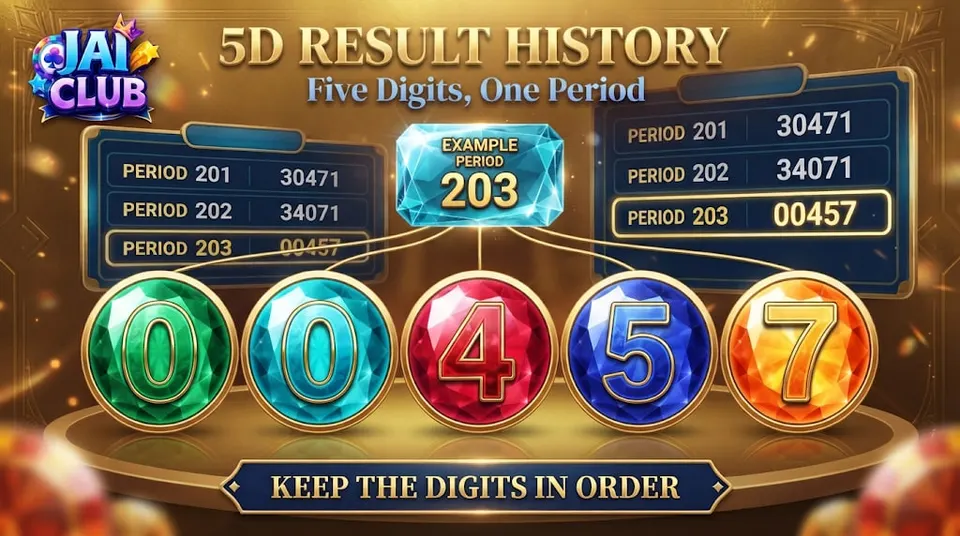
The relevant completed period and full sequence are required.
Readers should avoid treating derived numerical summaries as substitutes for source records.
Does the Digit Sum Predict Future Results?
Knowing a previous digit sum does not establish the next sequence.
A historical chart can describe which totals appeared in a selected dataset.
However, that information does not automatically determine future outcomes.
If the game uses an independent random model, past totals do not force the next result to include or exclude particular digits.
A mathematical formula can calculate a sum correctly without providing any forecasting ability.
The distinction between description and prediction is essential.
Frequent Errors in 5D Sum Charts
One mistake is treating equal sums as identical full results.
Another is ignoring the position order when comparing sequences.
Some readers also remove leading zeros and lose information about fixed-width results.
Others count repeated digits only once.
A more subtle error is assuming that every possible sum has the same theoretical probability.
These mistakes can produce inaccurate summaries even when the source data is otherwise correct.
Frequently Asked Questions
Is the digit sum the same as the full 5D result?
No. The full result contains five ordered digits, while the sum is one calculated total.
What is the sum of 12345?
It is 15.
Can different results have the same digit sum?
Yes. Many different sequences can produce the same total.
Does changing the digit order change the sum?
No. Rearranging the same digits preserves their sum.
Does changing the order change the full result?
Yes. Different positions create different ordered sequences.
What is the sum of 00457?
It is 16.
Why are leading zeros important?
They preserve the original five-position structure even though they add zero to the sum.
What is the maximum possible five-digit sum?
It is 45 under a five-position 0–9 model.
Can a sum identify the original sequence?
Not uniquely. Additional position information is required.
Do historical digit sums guarantee future outcomes?
No. A correctly calculated historical sum does not predict an unknown future result.
A Total Is a Summary, Not the Full Record
A digit sum is useful because it condenses five values into one number.
That simplicity is also its limitation.
Once the original positions have been removed, the total cannot reliably reconstruct the complete sequence.
For accurate recordkeeping, the full five-character result should remain attached to its period, with any digit sum stored as a separate derived field.
For related historical-record principles, see 5D Result History.
Editorial note: All sequences are fictional mathematical examples. The article does not verify operator-specific 5D payout categories or outcome probabilities.