5D Lottery Place-Value Confusion: Reading Each Digit Separately
Learn why a five-digit lottery result should be read as five ordered positions, how ordinary decimal place value differs from position labels and why leading zeros matter.
In this article
- What Is Place Value in Mathematics?
- What Are Five-Digit Position Labels?
- Decimal Place Value vs Position Labels
- Why the Full Number and Individual Digits Differ
- Why Leading Zeros Cause Confusion
- Example: 00457 vs 457
- Digit Sum vs Place-Value Total
- Why ABCDE Is Not an Addition Formula
- Example: Two Different 5D Sequences
- Does Reversing the Sequence Change the Integer?
- Place Value With Repeated Digits
- Five-Character Strings vs Ordinary Numbers
- Why Spreadsheet Formatting Matters
- Full Result vs Round Identifier
- Do All 5D Games Use the Same Position Rules?
- Place Value and Prediction Claims
- Common Place-Value Mistakes
- Frequently Asked Questions
- What is place value in 5D Lottery?
- What do A, B, C, D and E mean?
- Is 00457 the same as 457?
- What is the digit sum of 38164?
- Is the digit sum the same as the integer value?
- Does reversing digits change the result?
- Does reversing digits change their sum?
- Can leading zeros disappear in spreadsheets?
- Does knowing place value help predict future 5D results?
- Are the ABCDE labels official for every 5D game?
- Conclusion
A five-digit result can be read in more than one way depending on its purpose.
In ordinary mathematics, a number such as 38164 represents thirty-eight thousand one hundred and sixty-four. Each digit contributes a value based on its place.
In a five-position lottery format, the same characters may instead be treated as an ordered sequence of five separate digits.
These two interpretations are related but not identical.
Quick answer: A 5D Lottery result should be understood according to its defined five-position format. The labels A, B, C, D and E identify positions, while ordinary decimal place values represent powers of ten. Confusing those concepts can lead to mistakes when comparing result sequences, digit sums and leading zeros.
This article explains the difference through clear examples. It does not claim that any particular Jai Club 5D game uses a specific position-based payout rule.
What Is Place Value in Mathematics?
Place value describes how much a digit contributes to an ordinary number based on its position.
In the decimal system, positions from right to left represent units, tens, hundreds, thousands and ten-thousands.
For example, the number 38164 can be expanded as:
3 × 10,000 + 8 × 1,000 + 1 × 100 + 6 × 10 + 4 × 1
The result is 38,164.
The digit 3 contributes 30,000 because it occupies the ten-thousands position.
This is ordinary decimal place-value mathematics.
It is different from simply identifying the digit stored in each position of a game result.
What Are Five-Digit Position Labels?
A five-position result may use labels A, B, C, D and E.
These labels identify the individual digit positions from left to right.
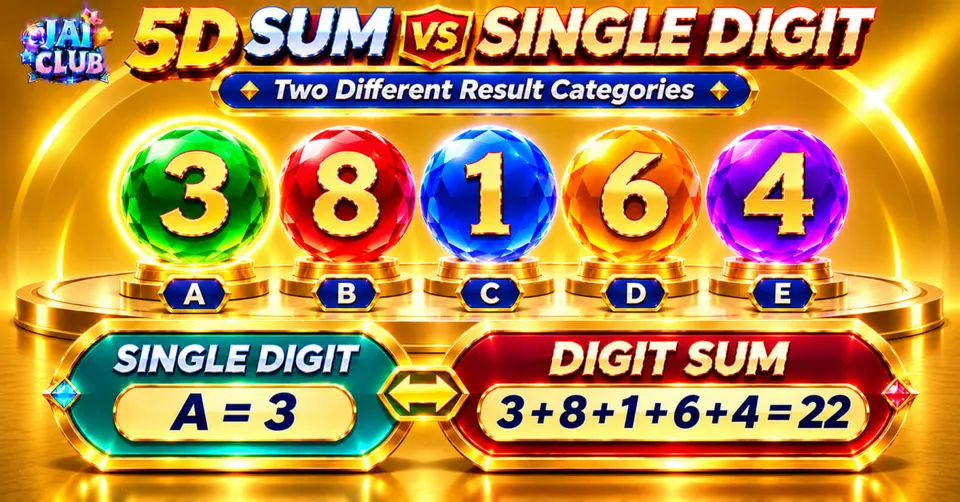
For example, the fictional sequence 38164 can be separated into:
| Position | Digit |
|---|---|
| A | 3 |
| B | 8 |
| C | 1 |
| D | 6 |
| E | 4 |
The table identifies each value separately.
It does not multiply the digits by their decimal place values.
This distinction is especially important if a game describes a result using individual position labels.
For further background, read the 5D Lottery ABCDE Guide.
Decimal Place Value vs Position Labels
The same sequence can be described using both systems.
| 5D position | Digit | Ordinary decimal contribution |
|---|---|---|
| A | 3 | 30,000 |
| B | 8 | 8,000 |
| C | 1 | 100 |
| D | 6 | 60 |
| E | 4 | 4 |
| Total integer value | 38,164 |
The ordinary integer value is 38,164.
However, a game category referring to position A would ordinarily concern the digit stored at A, not the decimal contribution of 30,000.
Similarly, a category referring to E would concern the final digit rather than the full integer.
Actual selection rules must still be verified for the specific game.
Why the Full Number and Individual Digits Differ
A complete five-digit sequence contains more information than any one digit.
For example, the result 38164 contains the digit 3 in its first position.
However, the digit 3 does not identify the remaining four digits.
Many different sequences can begin with 3.
Similarly, knowing that position E contains 4 does not reveal the complete result.
This is why a five-position history should preserve all five digits in their original order.
A single position value is not a substitute for the full sequence.
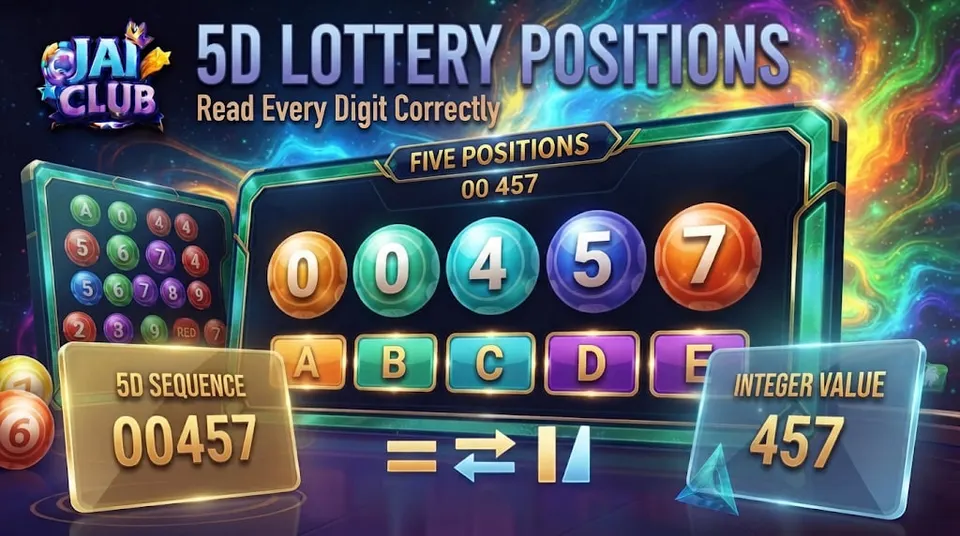
Why Leading Zeros Cause Confusion
Leading zeros are zeros placed at the beginning of a sequence.
Consider the fictional result:
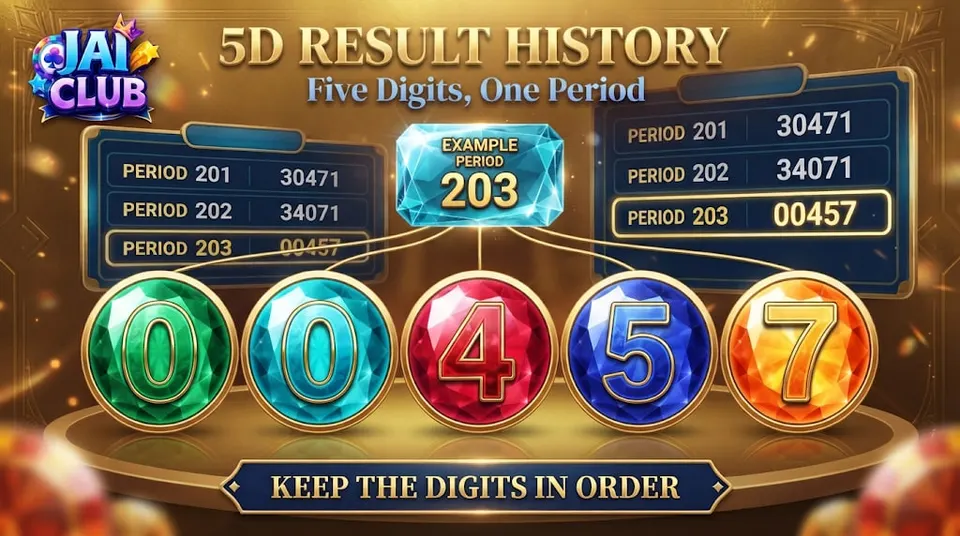
00457
In an ordinary integer representation, leading zeros do not change the numerical value.
The integer 00457 equals 457.
However, in a fixed five-character sequence, the two leading zeros occupy positions A and B.
If they are removed, the original position structure is lost.
Therefore, the five-position representation 00457 should not be replaced with the three-character representation 457 when the position labels matter.
Example: 00457 vs 457
| Feature | 00457 |
457 |
|---|---|---|
| Number of visible characters | 5 | 3 |
| Ordinary integer value | 457 | 457 |
| Fixed five-position representation | Yes | Not without padding |
| Position A explicitly shown | 0 | No |
| Position B explicitly shown | 0 | No |
The mathematical integer values are equal.
The fixed-width representations are not equivalent as displayed strings.
This distinction matters in spreadsheets, databases and copied result histories.
For more detail, see the 5D Leading Zero Guide.
Digit Sum vs Place-Value Total
A digit sum is obtained by adding the individual digits.
For the fictional sequence 38164:
3 + 8 + 1 + 6 + 4 = 22
The result 22 is the digit sum.
The ordinary integer value remains 38,164.
These values answer different questions.
The integer reflects positional powers of ten, while the digit sum treats each digit as an individual numerical value.
A result-history table may display one, both or neither, depending on its design.
Readers should not assume they are interchangeable.
Why ABCDE Is Not an Addition Formula
The labels A, B, C, D and E identify positions.
They do not automatically mean that a game uses the sum A + B + C + D + E as a selectable category.
The arithmetic can always be performed if the five digits are known.
However, whether the game uses that total for a particular purpose is an operator-specific question.
A general educational explanation can show how the sum is calculated without claiming that it determines a payout.
The same caution applies to other possible groupings or classification rules.
Example: Two Different 5D Sequences
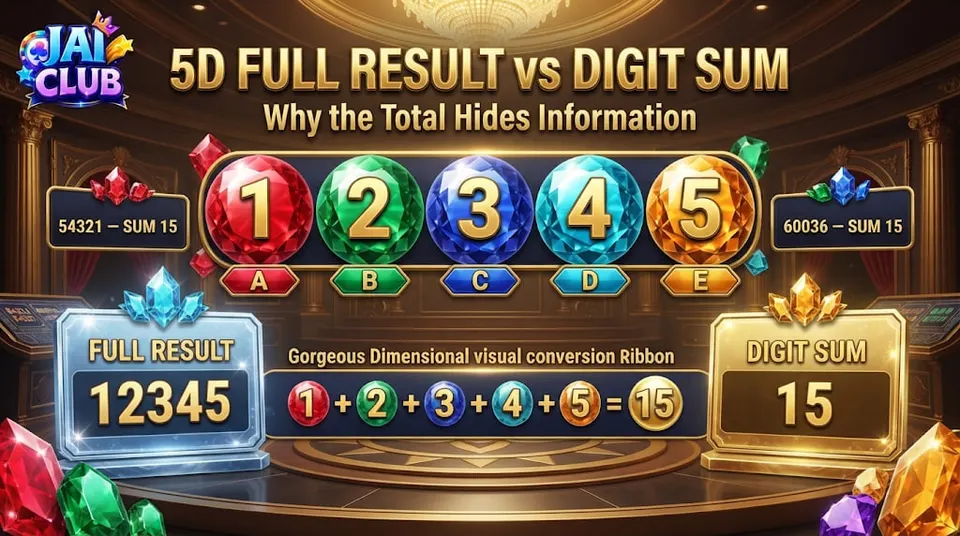
Consider two fictional results:
12345
54321
The first has A = 1 and E = 5.
The second has A = 5 and E = 1.
Their ordinary integer values differ significantly.
However, their digit sums are both 15.
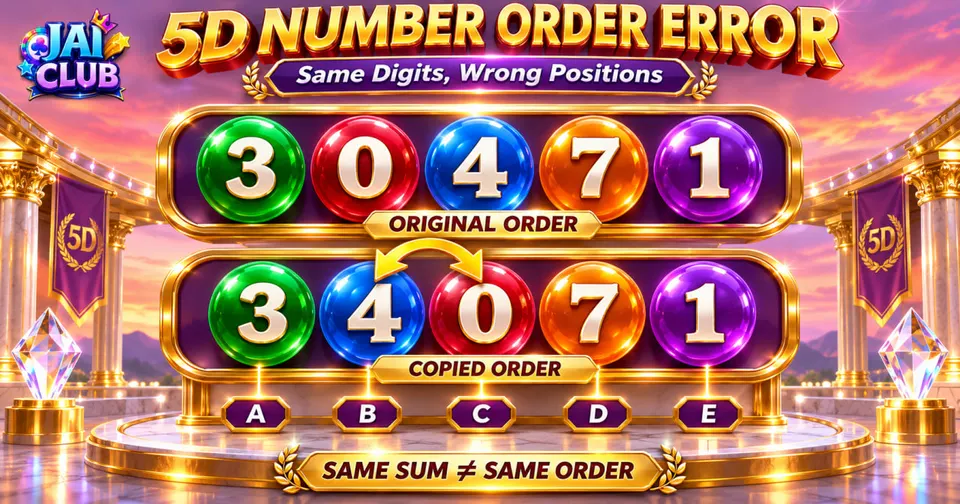
This example shows how full sequence value, individual positions and digit sum are separate properties.
A reader must identify which property is relevant before comparing records.
Does Reversing the Sequence Change the Integer?
Yes.
The integer 12345 is different from 54321 because the digit contributions change.
In the first number, the digit 1 occupies the ten-thousands place.
In the second, the digit 5 occupies that place.
Therefore, their decimal integer values differ.
However, reversing the same digits does not change their digit sum.
This is another reason why the full number, position labels and sum should not be treated as one value.
Place Value With Repeated Digits
Repeated digits also occupy different positions.
Consider the fictional sequence 11234.
The first digit 1 contributes 10,000 to the ordinary integer value.
The second digit 1 contributes 1,000.
Although the visible digits are identical, their decimal place-value contributions differ.
In a five-position game record, those digits are still identified separately as A and B.
Repetition does not remove the importance of order.
Five-Character Strings vs Ordinary Numbers
Software can store five-digit results as text or as numerical values.
If a result is stored as a number, leading zeros may be removed automatically.
For example, a spreadsheet may convert 00457 into 457.
If the original record represents a fixed five-position sequence, that conversion can destroy information needed to interpret A and B.
Storing the sequence as text can preserve all characters.
The appropriate storage method depends on whether the data is intended for arithmetic or exact position-based identification.
Why Spreadsheet Formatting Matters
A spreadsheet might use a column labelled Result to store completed five-position sequences.
If the values are entered as numbers, leading zeros may not remain visible.
This can create confusion when two records are compared later.
For example, the string 00019 contains five characters, while the integer 19 contains no explicit information about the leading positions.
The digit sum is still 10 in both ordinary interpretations, but the original five-position display is no longer preserved.
A reliable data record should maintain the intended format.
Full Result vs Round Identifier
A five-digit result should not be confused with the period or round identifier.
Some period numbers can contain many digits and resemble ordinary numerical sequences.
However, their purpose is to identify events.
The result is the outcome associated with the event.
A copied screenshot that hides labels may make the distinction unclear.
Readers should identify which number represents the round and which represents the actual five-position result.
The two values should not be mixed during arithmetic or historical analysis.
Do All 5D Games Use the Same Position Rules?
Not necessarily.
Different digital games may present five-digit values and categories in different ways.
A format could use individual positions, combinations or other defined classification rules.
A five-character display alone does not establish every rule.
Therefore, a guide should explain the general mathematics while avoiding unsupported claims about operator-specific settlement conditions.
The actual game's documentation remains important.
Place Value and Prediction Claims
Knowing how place value works does not reveal the next game outcome.
A historical chart might show repeated first-position digits or frequent final digits.
These observations describe previous results.
They do not automatically establish future probabilities or a reliable forecasting system.
Similarly, a digit sum or integer conversion formula cannot predict unknown future digits merely because it is mathematically correct.
Understanding result formatting is useful for accurate reading, not guaranteed prediction.
Common Place-Value Mistakes
One common mistake is treating a position label as an ordinary decimal contribution.
Another is removing leading zeros from a fixed-width result.
Some readers confuse the complete integer with the sum of its digits.
Others reverse the result when copying it or mix a round identifier with the five-digit outcome.
A further mistake is assuming that mathematically valid calculations must correspond to actual game selection categories.
These errors can be avoided by preserving the complete sequence and identifying the meaning of every field.
Frequently Asked Questions
What is place value in 5D Lottery?
It is the ordinary decimal interpretation of digit positions, which should be distinguished from the game's five-position labels.
What do A, B, C, D and E mean?
They identify the first through fifth digit positions in a result sequence.
Is 00457 the same as 457?
They have the same ordinary integer value, but they are different displayed representations of a fixed-width sequence.
What is the digit sum of 38164?
It is 22.
Is the digit sum the same as the integer value?
No. The integer value of 38164 is 38,164, while its digit sum is 22.
Does reversing digits change the result?
Yes. It changes the ordered sequence and usually changes the ordinary integer value.
Does reversing digits change their sum?
No. The same digits produce the same sum regardless of order.
Can leading zeros disappear in spreadsheets?
Yes. Software may remove them when treating the value as an ordinary number.
Does knowing place value help predict future 5D results?
No. It helps interpret numerical information, not forecast unknown outcomes.
Are the ABCDE labels official for every 5D game?
Not necessarily. Position terminology and settlement conditions depend on the specific format.
Conclusion
5D Lottery place-value confusion usually comes from treating a five-position sequence as though it were only an ordinary decimal integer.
The same characters can be described through their full integer value, their individual ABCDE positions or their digit sum.
These interpretations serve different purposes.
Preserving the original five-character sequence, including leading zeros, helps readers compare result records accurately and avoid calculation mistakes.
For related gaming topics, visit the Jai Club Games Guide.
Editorial note: All sequences are fictional mathematical examples. This guide does not claim that any particular Jai Club 5D selection or payout formula has been independently verified.