5D Sum vs Individual Digit: Two Different Ways to Read a Result
Understand how a five-digit result differs when examined through one selected position or its combined digit sum, including ranges, mathematical examples and probability assumptions.

In this article
- What Is an Individual Digit?
- What Is the Digit Sum?
- Individual Digit vs Total Sum
- EXAMPLE: The Same First Digit, Different Sums
- EXAMPLE: The Same Sum, Different First Digits
- Why the Individual-Digit Range Is 0–9
- Why the Sum Range Is 0–45
- Theoretical Probability of One Individual Digit
- Theoretical Probability of One Exact Full Result
- Why Sum Probabilities Are Different
- One Digit Does Not Determine the Other Four
- EXAMPLE: What Can Be Known From Position A?
- Why Position Order Still Matters
- Mathematical Categories vs Official Game Selections
- Why Comparing Payouts Requires More Information
- Can Historical Digits Predict the Next Sum?
- Common Errors When Comparing Categories
- Frequently Asked Questions
- What is an individual 5D digit?
- What is the digit sum?
- What is the possible range for one digit?
- What is the possible range for the sum?
- Can two results have the same sum but different digits?
- Can the first digit determine the total?
- Is the probability of one specific digit always 10%?
- Is the probability of each sum equal?
- Are individual-digit and sum categories available in every Jai Club 5D game?
- Does the previous digit sum predict the next result?
- Choose the Property Before Reading the Number
A five-position lottery result can be examined in several different ways.
A reader may focus on one particular digit, such as the first or final position.
Another reader may calculate the sum of all five digits.
Both approaches use information from the same result, but they answer different questions.
Quick answer: An individual digit is the value in one specified position, normally from 0 to 9. The digit sum is the total obtained by adding all five values, ranging from 0 to 45 under a five-position decimal model. These are different mathematical properties and should not be treated as interchangeable game categories.
This guide explains the ranges, calculations and theoretical probabilities involved.
The examples are mathematical illustrations, not independently verified Jai Club 5D selection or payout rules.
What Is an Individual Digit?
An individual digit is one value from a five-position sequence.
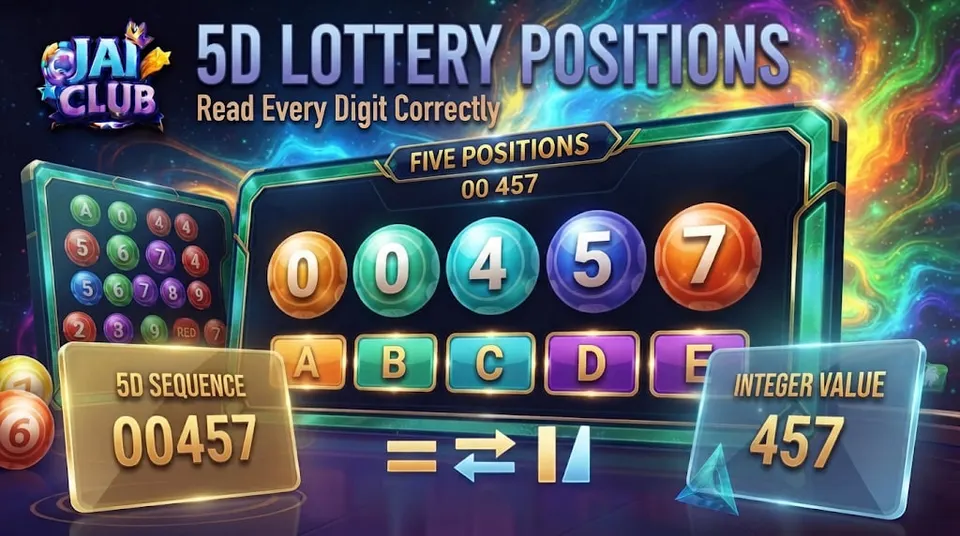
The positions can be labelled A, B, C, D and E from left to right.
For example, consider the fictional result:
38164
The individual digits are:
A = 3
B = 8
C = 1
D = 6
E = 4
Each value belongs to the range 0 through 9.
A position-based comparison examines one of these values without replacing it with the total of the entire sequence.
What Is the Digit Sum?
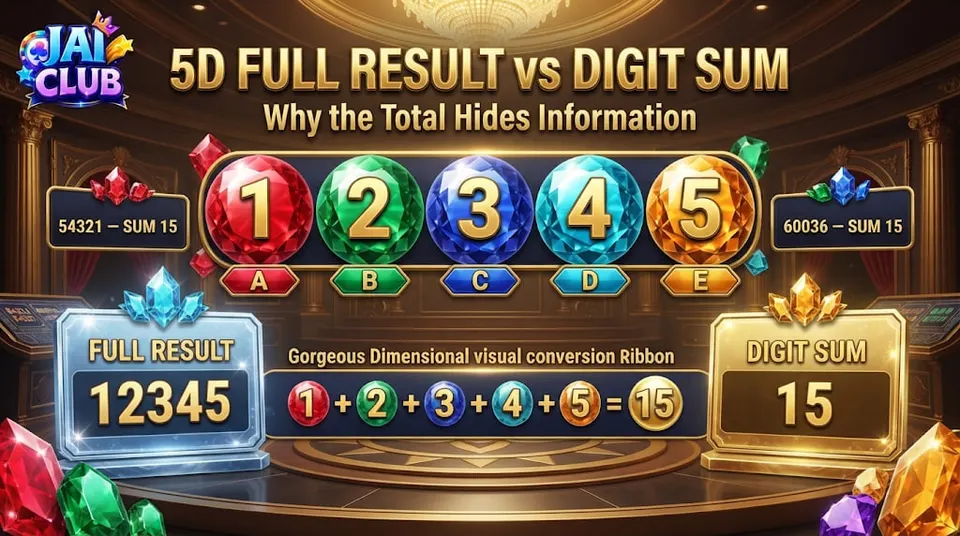
The digit sum is calculated by adding all five digits.
For the same example:
3 + 8 + 1 + 6 + 4 = 22.
Therefore, the complete result is 38164 and its digit sum is 22.
The number 22 is not the value of any single position.
It represents a derived mathematical property of the whole result.
This distinction matters when interpreting a chart or comparing numerical categories.
Individual Digit vs Total Sum
| Property | Individual digit | Digit sum |
|---|---|---|
| Values involved | One position | All five positions |
| Possible range | 0–9 | 0–45 |
| Number of possible values | 10 | 46 |
| Example from 38164 | A = 3 | Sum = 22 |
| Information represented | One digit | Combined total |
| Distribution under independent uniform digits | Uniform | Not uniform |
The final row describes a mathematical model.
It does not establish the outcome distribution of any specific digital game.
EXAMPLE: The Same First Digit, Different Sums
Consider three fictional results.
| Result | Position A | Digit sum |
|---|---|---|
| 30000 | 3 | 3 |
| 38164 | 3 | 22 |
| 39999 | 3 | 39 |
Every sequence begins with 3.
However, the other positions differ.
This creates very different totals.
Knowing position A alone does not determine the final digit sum.
The remaining four digits must also be considered.
EXAMPLE: The Same Sum, Different First Digits
Now examine three results with the same total.
| Result | Position A | Digit sum |
|---|---|---|
| 38164 | 3 | 22 |
| 47263 | 4 | 22 |
| 56263 | 5 | 22 |
All three sequences have a sum of 22.
However, position A differs in every row.
Therefore, a sum-only result does not reveal which value appeared in the first position.
This illustrates why individual-digit and sum-based analyses are different.
Why the Individual-Digit Range Is 0–9
A decimal digit can take one of ten possible values.
These are 0, 1, 2, 3, 4, 5, 6, 7, 8 and 9.
If a five-position sequence uses decimal digits, each position can contain one of these values.
The actual format must permit the corresponding digits and leading zeros.
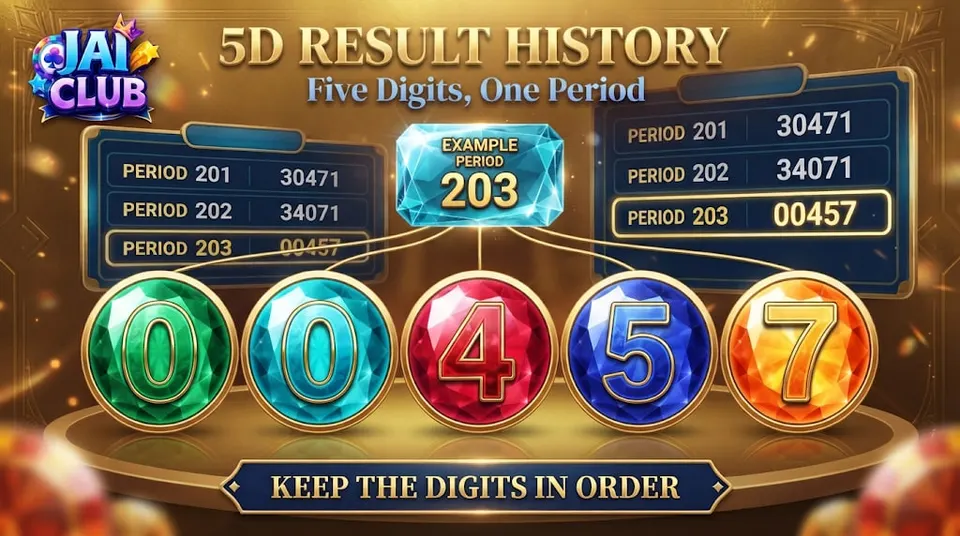
A result such as 00457 contains zero in positions A and B.
Those zeros remain meaningful position values even though they contribute nothing to the digit sum.
Why the Sum Range Is 0–45
The smallest possible digit sum occurs when all five positions contain zero.
0 + 0 + 0 + 0 + 0 = 0.
The largest possible digit sum occurs when all five positions contain nine.
9 + 9 + 9 + 9 + 9 = 45.
Therefore, the possible totals range from 0 to 45.
There are 46 distinct integer sums in that inclusive range.
However, these totals do not have equal theoretical probabilities under a uniform independent digit model.
Theoretical Probability of One Individual Digit
Assume that each position is independently and uniformly generated from 0 through 9.
Under this model, the probability of a specific value in a specified position is:
1/10 = 10%.
For example, the probability that position A equals 3 is 10%.
This event includes every possible combination of the remaining four digits.
It does not require the full result to equal a particular five-character sequence.
The probability belongs to one position-specific event.
Theoretical Probability of One Exact Full Result
Under the same independent uniform model, there are:
10 × 10 × 10 × 10 × 10 = 100,000
possible ordered five-position sequences.
The probability of one exact sequence, such as 38164, is:
1/100,000 = 0.001%.
This is much smaller than the 10% probability that position A equals 3.
The two events are different.
The first requires all five positions to match.
The second places a condition on only one position.
Why Sum Probabilities Are Different
The digit sum can be formed by many different combinations.
For example, a sum of 0 requires the exact sequence 00000.
A sum of 45 requires the exact sequence 99999.
However, the middle totals can be formed in far more ways.
As a result, the theoretical distribution of five-digit sums is not uniform.
Assigning the same 1/46 probability to every possible total would therefore be incorrect under the independent uniform model.
The number of underlying sequences associated with each sum matters.
One Digit Does Not Determine the Other Four
Suppose position C contains the digit 7.
This does not establish the values in A, B, D or E.
Under the independent uniform model, those positions remain unconstrained by the observed value of C.
Even if a particular digit appeared frequently in historical results, that would not automatically determine future values in other positions.
An individual-digit record contains less information than the complete five-position result.
The same principle applies to every position from A through E.
EXAMPLE: What Can Be Known From Position A?
Suppose the first digit is confirmed as 3 while the other four values remain unknown.
The minimum possible sum is:
3 + 0 + 0 + 0 + 0 = 3.
The maximum possible sum is:
3 + 9 + 9 + 9 + 9 = 39.
Therefore, the sum can range from 3 to 39.
Knowing A = 3 restricts the total range, but it does not identify the exact sum.
Additional position values are needed.
Why Position Order Still Matters
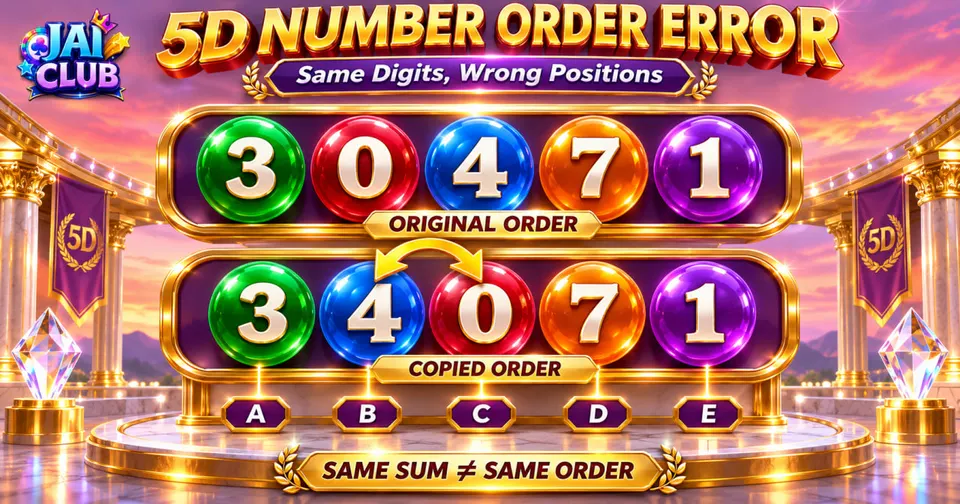
Consider the results 38164 and 83164.
They contain the same collection of digits.
Their digit sums are identical.
However, the first two positions have been exchanged.
In the first result, A = 3 and B = 8.
In the second, A = 8 and B = 3.
A sum-based comparison would treat their totals as equal.
An individual-position comparison would not.
This is why the original order must be preserved in historical records.
Mathematical Categories vs Official Game Selections
A five-digit result can always be analysed mathematically through individual positions and its total.
However, that does not establish which categories a particular gaming operator offers.
A service might use some numerical properties while ignoring others.
It may also apply additional classifications defined in its actual rules.
Therefore, a guide should not present every mathematical event as an available Jai Club selection.
The existence and terms of any game-specific category require verification.
Why Comparing Payouts Requires More Information
A mathematical probability does not by itself establish the financial value of a selection.
A payout comparison would require the actual accepted entry, payment terms, costs and relevant conditions.
For example, an individual-digit event may have a different mathematical probability from a particular sum.
But that does not automatically mean either is more favourable financially.
The operator's payout schedule would be required for a meaningful comparison.
No such payout schedule is certified in this guide.
Can Historical Digits Predict the Next Sum?
A history table can show previous individual-digit values and calculated sums.
It can also support descriptive frequency analysis.
However, an observed pattern does not automatically identify the next outcome.
Under an independent uniform model, future digits do not become due because they were absent from earlier results.
Similarly, a previously common sum is not guaranteed to repeat.
Historical statistics and reliable future prediction are different concepts.
Common Errors When Comparing Categories
One error is treating the digit sum as though it were the value of an individual position.
Another is comparing the probability of an exact full sequence with the probability of one specified digit.
Some readers also assume all 46 possible sums are equally likely.
Others discard leading zeros and lose the original position structure.
A further mistake is assuming that every mathematical category corresponds to a verified betting option.
These errors can be avoided by defining the event before calculating its probability.
Frequently Asked Questions
What is an individual 5D digit?
It is the value in one specified position of the five-digit result.
What is the digit sum?
It is the total obtained by adding all five values.
What is the possible range for one digit?
From 0 to 9.
What is the possible range for the sum?
From 0 to 45 under a five-position decimal model.
Can two results have the same sum but different digits?
Yes. Many different sequences share the same total.
Can the first digit determine the total?
No. The remaining four digits also contribute.
Is the probability of one specific digit always 10%?
Only under a uniform model for that position.
Is the probability of each sum equal?
No. Different sums have different numbers of possible underlying sequences.
Are individual-digit and sum categories available in every Jai Club 5D game?
That has not been independently established.
Does the previous digit sum predict the next result?
No reliable prediction follows from historical sums alone.
Choose the Property Before Reading the Number
The same five-digit result supports several mathematical descriptions.
An individual position provides one value. The digit sum combines all five values.
The two should never be confused because they answer different questions and have different theoretical probability structures.
Understanding which property is being examined makes result tables easier to interpret without inventing game-specific rules.
For the underlying five-position format, read: https://jaiclubgame.com/jai-club-5d-lottery-abcde-digit-positions
Editorial note: Calculations assume independent uniform decimal digits where stated. They do not independently verify Jai Club 5D selection rules, outcome probabilities or payouts.