5D Lottery Repeated Numbers: Reading 11111 and Mixed-Digit Results
Understand repeated digits in five-position lottery results, including 11111, 11223 and 77777, and learn how repetition affects number arrangements, digit sums and result interpretation.
In this article
- What Are Repeated Digits in 5D Lottery?
- Understanding 11111
- What Does 77777 Mean?
- Mixed-Digit Repetition
- Examples of Repeated-Digit Results
- Same Digits vs Same Positions
- Repetition and ABCDE Positions
- How Many All-Identical Results Exist?
- Probability of Five Identical Digits
- Probability of One Specific Result Like 11111
- Why 11223 Has Fewer Unique Arrangements
- Repeated Digits and Digit Sums
- Can Different Repetition Patterns Have the Same Sum?
- Repeated Results vs Repeated Digits
- Why Repeated-Digit Patterns Attract Attention
- Are Repeated Numbers Good Prediction Signals?
- Leading Zeros and Repeated Digits
- Common Mistakes With Repeated Numbers
- Frequently Asked Questions
- What are repeated digits in 5D Lottery?
- What does 11111 mean?
- Is 77777 automatically a jackpot?
- What is the sum of 11223?
- Is 11223 the same result as 22113?
- How many five-identical-digit sequences are possible?
- What is the theoretical probability of any five-identical result?
- What is the probability of exactly 11111?
- Can a five-digit sequence begin with repeated zeros?
- Can repeated-digit history predict the next result?
- Conclusion
Five-digit lottery results can contain repeated numbers. A sequence may show the same digit twice, three times or even in all five positions.
Examples such as 11111, 77777 and 11223 often attract attention because their patterns are easy to recognise.
However, a repeated-digit sequence is not automatically a special result category, nor does its appearance establish a reliable prediction for future rounds.
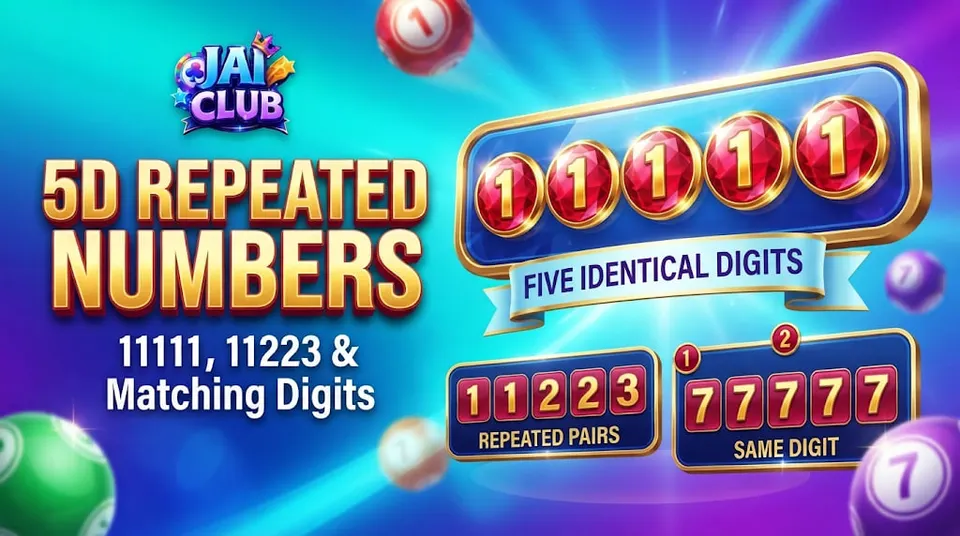
Quick answer: Repeated digits occur when two or more positions in a five-digit sequence contain the same value. The sequence 11111 contains one digit repeated five times, while 11223 contains two 1s, two 2s and one 3. The meaning of those patterns depends on the result format and any applicable game rules.
This guide explains repeated-digit structures, position order, mathematical arrangements and common mistakes when interpreting 5D Lottery results.
What Are Repeated Digits in 5D Lottery?
A repeated digit is a numerical value that appears more than once in a sequence.
For example, the fictional result 11234 contains two occurrences of the digit 1.
The result 12134 also contains two 1s, but their positions differ.
Both sequences belong to the general group of results containing repeated digits.
However, they are not identical ordered results.
In a fixed five-position format, each digit occupies a specific place, usually described through labels A, B, C, D and E.
The exact position must be preserved when comparing completed records.
Understanding 11111
The sequence 11111 contains five occurrences of the same digit.
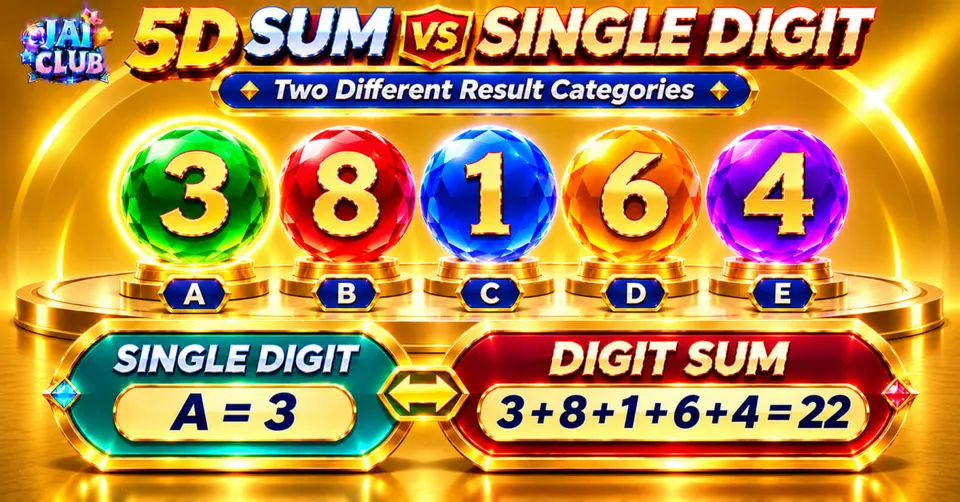
Its digit sum is:
1 + 1 + 1 + 1 + 1 = 5
Every position contains the value 1.
This makes the pattern visually simple, but it does not mean the result is more valuable or easier to forecast.
A particular game may or may not classify such a pattern separately.
Without verified rules, it should be described as a five-position sequence containing identical digits.
What Does 77777 Mean?
The result 77777 contains the digit 7 in all five positions.
Its digit sum is:
7 + 7 + 7 + 7 + 7 = 35
The repeated pattern is easy to recognise because every character is identical.
However, it is important to distinguish visual repetition from financial meaning.
The mathematical pattern alone does not establish a special jackpot, multiplier or additional payout.
Any such category would require confirmation from the game rules.
Mixed-Digit Repetition
Not every repeated-digit sequence contains the same value in all five positions.
Consider 11223.
This result contains two 1s, two 2s and one 3.
The digit sum is:
1 + 1 + 2 + 2 + 3 = 9
The sequence 12123 contains the same collection of digits and the same total.
However, the ordered positions differ.
This illustrates why readers should examine both repetition counts and exact digit positions.
Examples of Repeated-Digit Results
| Fictional result | Pattern | Digit sum |
|---|---|---|
| 11111 | Five identical digits | 5 |
| 77777 | Five identical digits | 35 |
| 11234 | One matching pair | 11 |
| 11223 | Two pairs and one other digit | 9 |
| 33345 | Three identical digits and two other values | 18 |
| 22233 | Three of one value and two of another | 12 |
| 44441 | Four identical digits and one other value | 17 |
| 90909 | Three 9s and two 0s | 27 |
These are mathematical examples, not actual Jai Club results.
The table shows several distinct repetition patterns.
A result may contain one pair, two pairs, a triple or more complicated repeated-value structures.
Same Digits vs Same Positions
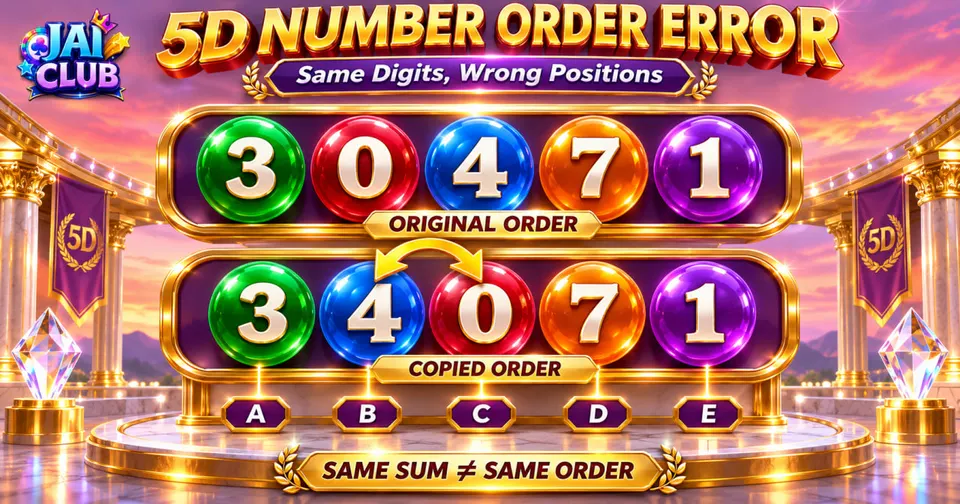
The result 11223 is different from 22113.
Both contain the same two 1s, two 2s and one 3.
Their digit sums are identical.
However, the values occupy different positions.
For example, in 11223, position A contains 1.
In 22113, position A contains 2.
This difference matters whenever a result format uses position-specific information.
A comparison based only on the frequency of digits loses the original ordering.
Repetition and ABCDE Positions
A five-position result can be represented using A, B, C, D and E.
For the fictional result 90909:
| Position | Value |
|---|---|
| A | 9 |
| B | 0 |
| C | 9 |
| D | 0 |
| E | 9 |
The digit 9 appears three times, while zero appears twice.
The sequence remains five characters long.
It should not be simplified or rearranged when being stored as a result.
For a broader explanation of the position system, read the 5D Lottery ABCDE Guide.
How Many All-Identical Results Exist?
Suppose each of the five positions can contain any digit from 0 through 9.
To produce an all-identical result, choose one digit and repeat it in all five positions.
The possible sequences are 00000, 11111, 22222, 33333, 44444, 55555, 66666, 77777, 88888 and 99999.
Therefore, there are exactly 10 all-identical sequences.
This count assumes a five-position decimal format that permits leading zeros.
It does not establish whether an operator provides any special selection for those patterns.
Probability of Five Identical Digits
Under a mathematical model where each position is generated independently and uniformly from 0 to 9, there are:
10 × 10 × 10 × 10 × 10 = 100,000
possible ordered five-digit sequences.
Exactly 10 of these contain five identical digits.
Therefore:
[ P(\text{all five identical})=\frac{10}{100000} ]
This equals 0.01%, or one in 10,000 under the stated model.
However, the actual probability in a particular digital game cannot be assumed from its interface alone.
The generating rules and outcome distribution must be verified separately.
Probability of One Specific Result Like 11111
Under the same independent uniform model, one exact five-digit result has a probability of:
[ \frac{1}{100000} ]
That is 0.001%, or one in 100,000.
The same probability applies to any other exact sequence under the model, including 12345 or 90909.
This is an important point.
A memorable pattern such as 11111 is not more likely than a particular ordinary-looking sequence if every five-position outcome has the same probability.
It is simply easier for people to recognise.
Why 11223 Has Fewer Unique Arrangements
Consider the collection containing two 1s, two 2s and one 3.
If all five values were distinct, there would be 120 arrangements.
However, the two 1s are identical, and the two 2s are identical.
Swapping identical digits does not create a new visible sequence.
Therefore, the number of distinct arrangements is:
[ \frac{5!}{2!\times2!}=30 ]
The collection 1, 1, 2, 2, 3 can produce 30 distinct ordered sequences.
This is a mathematical count, not a statement about operator-specific game payouts.
Repeated Digits and Digit Sums
Every five-digit result has a digit sum.
Repeated digits contribute each time they appear.
For example, 33345 has a sum of 18:
3 + 3 + 3 + 4 + 5 = 18
The repeated value 3 must be counted three times.
A common mistake is counting each distinct value only once.
That would incorrectly produce 12 rather than 18.
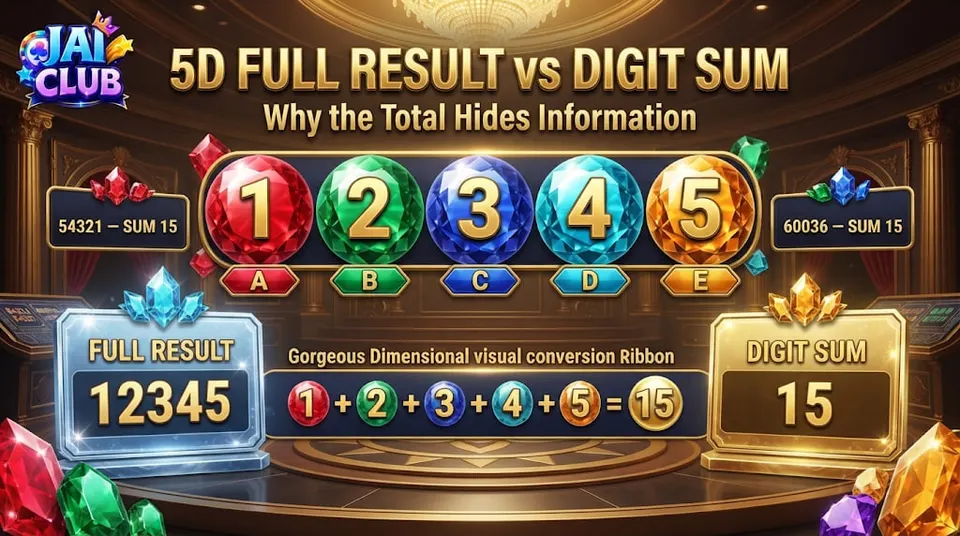
The digit sum describes one property of the sequence, while the repetition pattern describes another.
Can Different Repetition Patterns Have the Same Sum?
Yes.
For example, 22233 gives:
2 + 2 + 2 + 3 + 3 = 12
The sequence 11145 also gives:
1 + 1 + 1 + 4 + 5 = 12
Both have a sum of 12, but their repetition patterns differ.
One contains three 2s and two 3s.
The other contains three 1s and two distinct additional digits.
Therefore, a sum alone cannot identify the repetition structure.
Readers need the individual position values.
Repeated Results vs Repeated Digits
There is an important difference between digits repeating within one result and an entire result repeating across separate rounds.
For example, 11223 contains repeated digits within one sequence.
If the exact sequence 11223 appears again in a later round, that would be a repeated full result.
These are two different observations.
A historical chart may track both, but they should not be confused.
The number of repeated digits within a sequence does not automatically establish when that complete sequence will appear again.
Why Repeated-Digit Patterns Attract Attention
People naturally notice symmetry, repetition and unusual visual patterns.
A sequence such as 99999 is easier to remember than a mixed sequence like 40271.
As a result, memorable patterns may receive more attention on social media or in game discussions.
However, a result attracting attention does not make it mathematically special in terms of future prediction.
Under an independent random model, the next result is not forced to avoid or repeat a recently observed digit pattern.
Human recognition of patterns should not be confused with evidence of predictive power.
Are Repeated Numbers Good Prediction Signals?
Historical repetition can be measured, but measurement and prediction are different activities.
A chart may show how often double digits, triples or all-identical sequences appeared in a selected sample.
That information describes the sample.
It does not necessarily reveal the future outcome-generation process.
Claims that a repeated sequence makes a particular next result certain require evidence that goes beyond historical observation.
The correct approach is to treat repeated-digit charts as descriptive rather than guaranteed forecasting tools.
Leading Zeros and Repeated Digits
The result 00011 contains three zeros and two 1s.
If a spreadsheet converts it into the ordinary integer 11, the five-position structure is lost.
The original repeated-digit pattern becomes difficult to recognise.
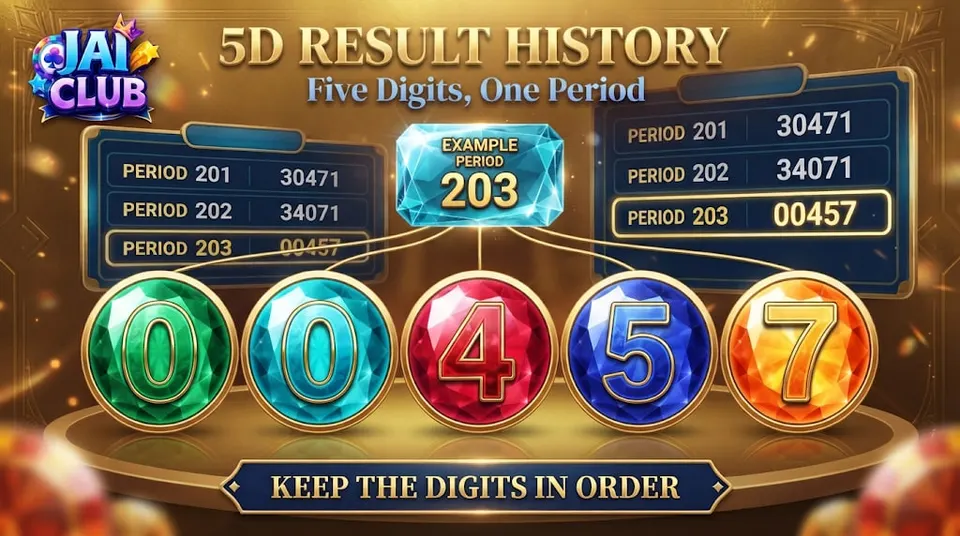
A fixed-width five-digit result should therefore be stored in a format that preserves all five characters.
This is particularly important for sequences beginning with several zeros.
The meaning of the position labels depends on the full original representation.
Common Mistakes With Repeated Numbers
One mistake is assuming that five identical digits must produce a special payout.
Another is treating rearranged sequences as identical results.
Some readers also ignore repeated zero digits because they do not contribute to the digit sum.
Others confuse the probability of a specific sequence with the probability of a broader repeated-digit category.
Finally, a memorable historical result should not be presented as evidence of a reliable future prediction.
Clear definitions help avoid these problems.
Frequently Asked Questions
What are repeated digits in 5D Lottery?
They are values that appear more than once within the same five-position sequence.
What does 11111 mean?
It is a result containing the digit 1 in all five positions.
Is 77777 automatically a jackpot?
No. Any special financial meaning depends on the particular game's verified rules.
What is the sum of 11223?
It is 9.
Is 11223 the same result as 22113?
No. They contain the same collection of digits but have different positions.
How many five-identical-digit sequences are possible?
There are 10 under the standard five-position 0–9 format.
What is the theoretical probability of any five-identical result?
It is 0.01% under an independent uniform decimal model.
What is the probability of exactly 11111?
It is 0.001% under the same model.
Can a five-digit sequence begin with repeated zeros?
Yes, if the format permits leading zeros.
Can repeated-digit history predict the next result?
Not reliably without evidence of a genuine predictive mechanism.
Conclusion
Repeated digits are a normal mathematical feature of five-position number sequences.
Patterns such as 11111, 11223 and 77777 differ in their repetition structure, position values and digit sums.
Understanding those differences helps readers classify completed results accurately.
A familiar or memorable pattern does not automatically create a special payout or future prediction advantage.
The safest interpretation preserves the original five-digit sequence and separates mathematical descriptions from game-specific rules.
For additional game-format explanations, visit the Jai Club Games Guide.
Editorial note: All sequences are mathematical examples. Probability calculations assume five independent uniform digits from 0 to 9 and do not certify a specific Jai Club game implementation.